The 20-second rule says a habit is decided by how hard it is to start, not by how much you want it. Psychologist Shawn Achor found that adding about twenty seconds of effort to a behaviour is usually enough to stop doing it — and removing about twenty seconds is usually enough to start. He called this gap activation energy, borrowing the term from chemistry. It is the single most practical idea in habit change, because it means you can change what you do without changing who you are. You just have to move things.

Where does the 20-second rule come from?
Achor described it in The Happiness Advantage after failing, repeatedly, to practise guitar. He had the guitar, he had the intention, he had a schedule taped to the wall. He practised for four days out of twenty-one.
Then he changed one thing. He bought a stand and put the guitar in the middle of the living room, where he could pick it up without crossing the room, opening a cupboard, and unzipping a case. Practice went from four days out of twenty-one to twenty-one out of twenty-one.
He ran the experiment in reverse on television, which he was watching too much of. He took the batteries out of the remote and put them in a drawer in another room — a delay of roughly twenty seconds. His TV time collapsed.
Nothing about his motivation changed in either case. What changed was the number of seconds between the impulse and the action.
Why do twenty seconds matter so much?
Because most of what we do is not decided. It is executed.
Your phone habit runs on a loop that takes under two seconds: hand moves, thumb finds the corner of the screen, app opens, feed loads. There is no moment in that sequence where a decision gets made. By the time you are aware of it, you are already forty seconds into a video you did not choose.
Twenty seconds of friction is not a physical barrier. It is a decision window. It is long enough for the automatic sequence to break and for the conscious part of your brain to catch up and ask what you are doing. Often the answer is “nothing, actually”, and you put the phone down. That question never gets asked when the app is one thumb-length away.
This is why “just have more discipline” fails and moving the phone works. Discipline operates at the decision layer. Your phone habit never reaches the decision layer.
How do you apply it to your phone?
The rule has two directions, and you need both. Add seconds to what you want less of, subtract them from what you want more of.
| Add 20 seconds to scrolling | Subtract 20 seconds from what you want |
|---|---|
| Delete the app; use the browser version | Leave the book on your pillow |
| Log out after every session | Put running shoes by the door |
| Move apps off the home screen into a folder on page three | Keep the guitar, sketchbook, or weights in the room you sit in |
| Turn on greyscale so the feed looks dull | Open tomorrow’s document before you shut the laptop |
| Charge the phone in another room overnight | Lay tomorrow’s clothes out tonight |
| Use a blocker that requires a wait, not a tap | Put the kettle on before you sit down |
Notice how cheap every one of these is. Nothing on that list requires motivation, a purchase, or a personality change. This is the whole appeal of the 20-second rule: it is the highest-leverage habit intervention per unit of effort that exists.
The single highest-return move, if you only do one: charge your phone outside the bedroom. It adds twenty seconds to the two worst moments of the day — the last thing you do at night, and the first thing you do in the morning — and those two moments set the tone for everything between them.
“I moved Instagram to the last page of my home screen and logged out. That is it. My daily use dropped by about an hour in the first week, and I never once used willpower. I just kept forgetting it existed.” — Elif, architecture student, 22
The catch: friction you control is friction you can undo
Here is the honest limit of the rule. Twenty seconds stops an automatic behaviour. It does nothing against a motivated one.
When you genuinely want the app — bored on a Tuesday night, avoiding a hard task, feeling low — twenty seconds is nothing. You will reinstall the app, log back in, dig it out of page three. Then reinstalling becomes the habit, and you have added a step to a ritual rather than removed one.
This is where the rule needs reinforcement:
Make the reversal slower than the impulse. The impulse to check has a short half-life. If undoing your barrier takes longer than the urge lasts, the barrier wins. A blocker with a mandatory wait before the app opens beats a blocker with a dismiss button, for exactly the same reason the batteries in another room beat the batteries on the table.
Let someone else hold the key. Every commitment device in history works by making the future version of you unable to overrule the present version. A shared passcode, an accountability partner, a schedule you did not set today — all of these outlast a bad evening. There is more on this in commitment devices and why they work.
Stack it with a replacement. Friction creates a gap. Something fills it. If you take the phone out of your hand and put nothing in its place, the phone comes back. Pair every subtraction with an addition — see things to do instead of scrolling.
How does it fit with the other habit rules?
The 20-second rule is one of a small family, and they are complementary rather than competing:
- The two-minute rule shrinks the habit you want until starting is trivial. It edits the task.
- The 20-second rule changes the distance to the habit. It edits the environment.
- Habit stacking attaches a new habit to an existing one. It edits the timing.
- Implementation intentions pre-decide the when and where. They edit the decision.
If you are choosing where to start, start with the 20-second rule. It is the only one of the four that keeps working while you are not paying attention, and it is the foundation of environment design — the idea that your surroundings do more of the work than your resolve ever will.
How does Unscrol help?
A short caveat first: most of this article costs nothing. Moving apps off your home screen, logging out, greyscale, and charging the phone in the hallway are all free, and if they work for you, they are the whole answer. Do those before you download anything.
Unscrol is for the second problem — the one where twenty seconds is not enough because you are motivated to undo it. It is an iPhone and Apple Watch app built on Apple’s Screen Time frameworks, so the blocks are system-enforced rather than a cosmetic overlay you can swipe away.
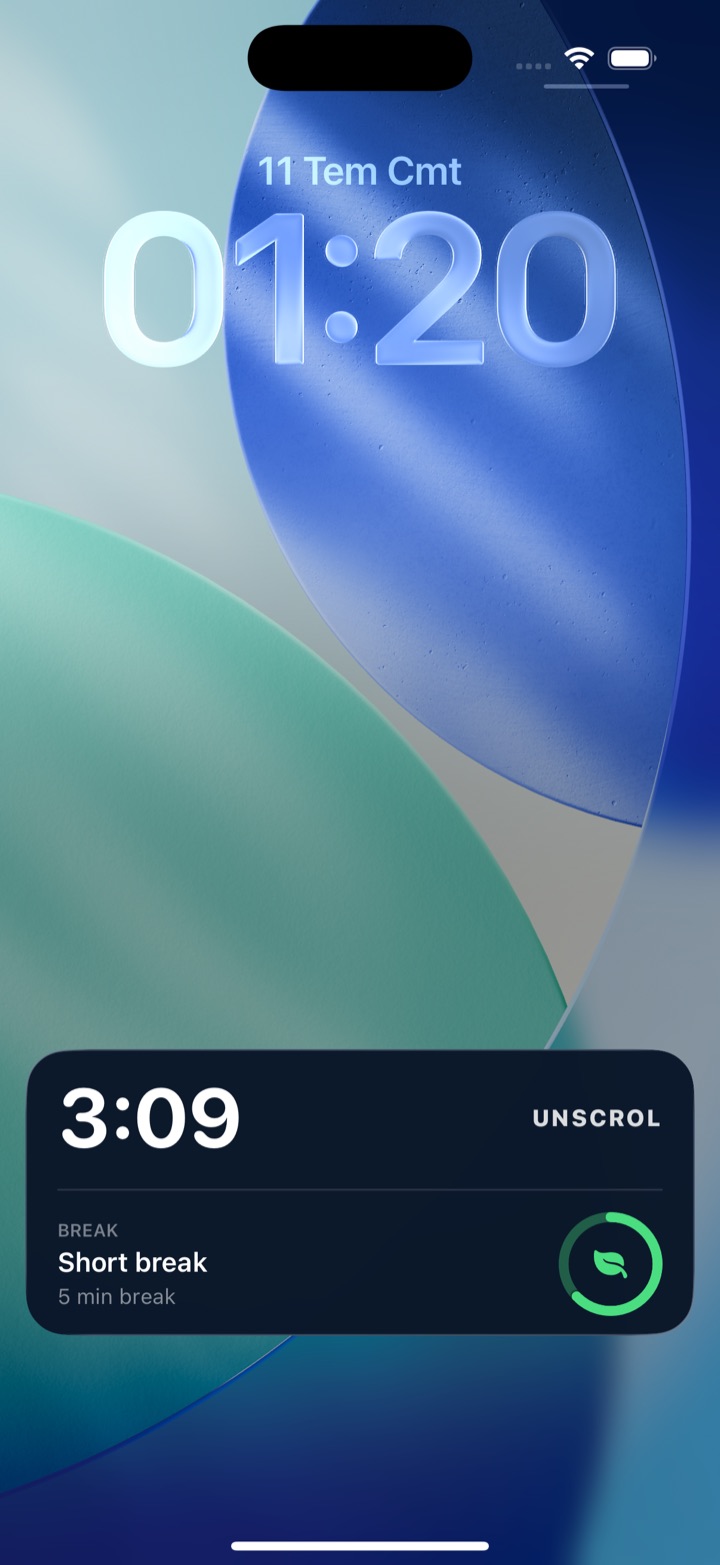
The design is the 20-second rule with teeth. Scheduled blocks put whole categories behind a shield during windows you set in advance — a sleep window, a work window — so the decision is made by yesterday’s calmer version of you. When you genuinely need an exception, a short deliberate take-a-break bypass exists, but it is a considered step rather than a reflexive tap. A unified daily streak grows on any day you complete a quick check-in or one of 45+ challenges, which supplies the addition side of the rule: something to fill the gap the friction opened. Block lists and usage data are processed on-device by iOS and never reach Unscrol’s servers. Free to download; the optional Pro tier adds a Streak Saver that rescues a single missed day, twice a week.
Frequently asked questions
What is the 20-second rule?
The 20-second rule comes from psychologist Shawn Achor's book The Happiness Advantage. It says that adding roughly twenty seconds of effort to starting a habit is usually enough to stop it, and removing roughly twenty seconds is usually enough to start one. Achor's own example was putting his guitar on a stand in the middle of the room to practise more, and taking the batteries out of the TV remote to watch less. The number is illustrative rather than precise. The principle is that habits are governed far more by the effort required to begin them than by how much you want the outcome.
How is the 20-second rule different from the two-minute rule?
They work on opposite ends of the same problem. The two-minute rule shrinks a habit you want until starting it is trivial — read one page, open the document, do two push-ups. The 20-second rule changes the environment so the habit you want gets closer and the habit you do not want gets further away. One edits the task, the other edits the room. They combine well: use the 20-second rule to put your phone in another room, then the two-minute rule to make the work you are avoiding small enough to start without negotiating with yourself.
Does adding friction actually reduce phone use?
Yes, and the effect is larger than most people expect. Research on choice architecture consistently shows that small changes in effort produce big changes in behaviour, because most phone pickups are automatic rather than deliberate. Removing an app from your home screen, logging out of it, turning on greyscale, or leaving the phone in a different room all break the automatic sequence and force a conscious decision. The catch is that friction you control can be undone in seconds when you are motivated to undo it, which is why the most durable versions are ones your future self cannot instantly reverse.