The two-minute rule comes in two flavors. David Allen’s version, from Getting Things Done, says that if a task takes less than two minutes, do it now rather than filing it for later. James Clear’s version, from Atomic Habits, says shrink any new habit to a two-minute starter — “read one page,” “open the document,” “put on running shoes” — so beginning is trivial. Both attack the same enemy: starting is almost always the hardest part. The rule is not about doing only two minutes. It is about making the start so small you cannot argue yourself out of it. Once you begin, momentum usually carries you far past the two-minute mark.
What is the two-minute rule?
Two different thinkers landed on the same number for two different jobs.
- David Allen (Getting Things Done): a productivity triage rule. If a task will take under two minutes — reply to that email, hang up the coat, rinse the mug — handling it immediately costs less than tracking it, remembering it, and returning to it. It stops small tasks from piling into a mountain.
- James Clear (Atomic Habits): a habit-formation rule. Any habit can be shrunk to a two-minute “gateway” version. “Do thirty minutes of yoga” becomes “take out the yoga mat.” “Study for the exam” becomes “open my notes.” You master the art of showing up before you worry about doing more.
They are not in conflict; they solve different problems. Allen’s clears the clutter of tiny to-dos. Clear’s defeats the procrastination that guards big ones.
Why is starting the whole battle?
Procrastination is rarely about the task being hard. It is about the start being hard. A task in your head looks like the whole mountain, and the mind flinches from mountains. But you never have to climb a mountain — you only have to take the first step, and the first step is small.
Two forces make the two-minute start so effective:
- Activation energy. Every task has a threshold you must cross before it begins. Lowering that threshold to two minutes means almost no motivation is required to cross it — which matters, because motivation is unreliable exactly when you need it.
- The Zeigarnik effect. Psychologist Bluma Zeigarnik found that unfinished tasks linger in the mind and create a mild tension that pulls toward completion. Once you have started — once the loop is open — your brain keeps nudging you to close it. Two minutes of writing turns “write the report” from an untouched dread into an open loop that nags you forward.
This is why “I’ll just open the document” so often becomes an hour of work. You were never going to do the hour on purpose. You did the two minutes, and the Zeigarnik effect did the rest.
Which version should you use when?
| Situation | Use the… | Because |
|---|---|---|
| A small task keeps reappearing on your list | GTD do-it-now version | Handling it now is cheaper than tracking it |
| You dread a big project and won’t start | Clear’s gateway version | A tiny start beats the activation-energy wall |
| Your inbox or desk is buried in micro-tasks | GTD do-it-now version | Clearing them frees attention for real work |
| You want to build a lasting daily habit | Clear’s gateway version | Showing up reliably matters more than volume |
A word of honesty on the GTD version: the “do it now” rule can become its own trap if a stream of two-minute tasks keeps yanking you out of deep work. Batch them into one window rather than letting every small thing interrupt a focus block.
How do you shrink a task to two minutes?
The skill is finding the smallest first action that still counts as starting. Scale it down until refusing feels absurd:
- “Study for the exam” → “open my notes and read one heading.”
- “Write the essay” → “write one bad sentence.”
- “Go for a run” → “put on my running shoes and step outside.”
- “Clean the kitchen” → “clear one countertop.”
- “Do my taxes” → “open the folder and find one document.”
Write it as a plan, not a hope. Pairing the two-minute start with an if-then trigger — “If it’s 7pm, then I open my notes and read one heading” — borrows the reliability of implementation intentions and doubles the odds you follow through. And because the start is so small, it stacks beautifully onto an existing cue, the way any tiny habit does in a habit stack.
Does the two-minute rule actually work?
Honestly: it is one of the most reliable starting techniques there is, and a poor finishing one — which is the point. It gets you over the only barrier you reliably fail at (beginning), and hands you to momentum. But keep two caveats in mind. First, on genuinely depleted days you may stop at two minutes, and that is fine; two minutes beats zero and keeps the habit alive. Second, if you find you can never get past two minutes on a specific task, that is a signal the task is unclear, wrongly scoped, or being sabotaged by your environment — usually a phone within reach. For the wider toolkit, see how to beat procrastination.
Do you need an app for the two-minute rule?
No. This is a pure mindset tool — you can run it right now with nothing but a decision to shrink the start. The only thing that reliably breaks it is a competing two-minute temptation: the moment you open your notes, a notification offers an even easier “start” on your phone. That is the one place a tool helps — not with the rule itself, but with removing the rival that hijacks it.
How Unscrol makes the first two minutes stick
The two-minute rule assumes your start is not competing with an easier one. In practice it usually is — you open the document, and the feed is one thumb away offering instant reward. Unscrol closes that gap. Its focus session is built to be your two-minute start: tap once, and a countdown begins with a Live Activity on the Lock Screen and Dynamic Island, while Apple Screen Time shields the distracting apps for the duration. You are not deciding to work for an hour — you are starting a short block, and the Zeigarnik effect handles the rest while the phone stays quiet.
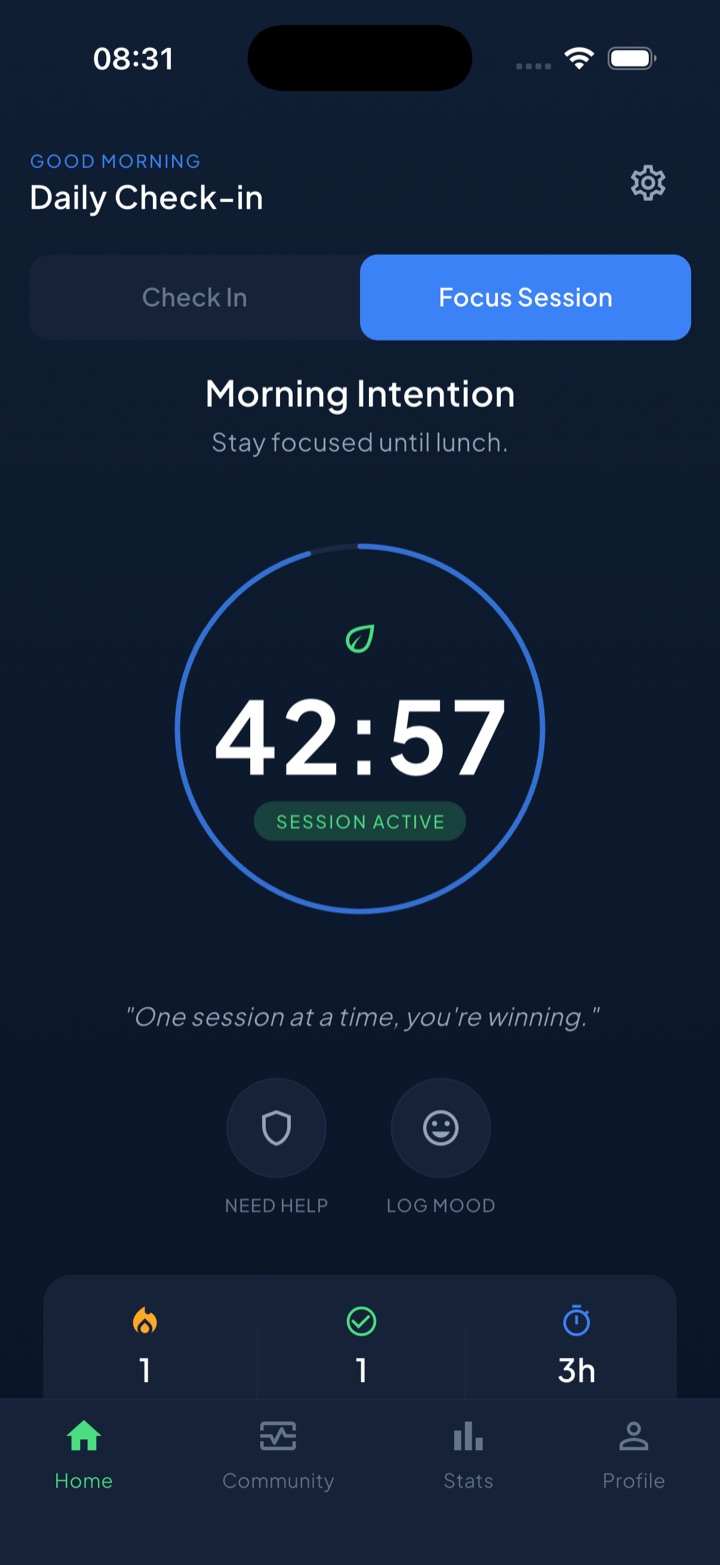
You can do the exact same thing with a kitchen timer and your phone in another room. The tool just makes the two-minute start the path of least resistance instead of the path you have to defend.
Stop trying to feel like starting. Shrink the start until you don’t have to.
Frequently asked questions
What is the two-minute rule?
There are two versions. David Allen's Getting Things Done version says if a task takes less than two minutes, do it now instead of writing it down for later. James Clear's Atomic Habits version says shrink any new habit to a two-minute starter, like read one page or open the document, so beginning is trivial. Both target the same obstacle: starting is the hardest part of almost any task.
Does the two-minute rule actually work?
For starting, yes, it is one of the most reliable techniques there is, because it removes the excuse of not having enough time or energy to begin. It is not a finishing technique. Once you start, the Zeigarnik effect (our tendency to be nagged by unfinished tasks) usually carries you well past two minutes. On low days you may stop at two minutes, and that still beats zero.
How do I start studying when I don't want to?
Shrink the task until starting feels almost silly to refuse. Do not commit to studying for two hours. Commit to opening your notes and reading one heading. Put the phone in another room first so the start is not competing with a feed. Once the page is open and your brain is engaged, momentum usually takes over and you keep going far longer than two minutes.
What is the Zeigarnik effect?
The Zeigarnik effect, named after psychologist Bluma Zeigarnik, is the finding that unfinished tasks stay active in your mind and create a low-level mental tension that pulls you to complete them. It is why a task you have started nags at you more than one you have not. The two-minute rule weaponizes it: once you begin, the open loop keeps working on you.