An implementation intention is a specific if-then plan that decides your response to a situation before the situation arrives: “If it’s 9pm, then my phone goes on the kitchen charger.” “If I reach for my phone mid-study, then I turn it face down and start my timer.” Psychologist Peter Gollwitzer introduced the concept and, with Paschal Sheeran, showed across a large body of studies that people who form these plans follow through far more reliably than people who only set a goal. The reason is mechanical: you make the hard decision once, in advance, so the moment itself pulls the behavior forward instead of leaving it to willpower.
What is an implementation intention?
Most of us set goal intentions — “I want to focus more,” “I’ll scroll less,” “I should study tonight.” Goals point you in a direction, but they’re silent about the exact moment of action. So when 9pm arrives and you’re tired, the goal offers no instructions, and the old habit wins by default.
An implementation intention fills that gap with a rigid structure:
If [specific situation], then [specific response].
That’s it. You specify the cue — a time, a place, an event, an internal state — and the precise action you’ll take when it appears. Gollwitzer’s insight is that this hands control of the behavior over to the situation. Once the plan is set, encountering the cue triggers the response with the same near-automatic quality as a well-worn habit, even though you’ve only decided it once. You’re essentially pre-installing a habit before it has time to form on its own.
Why does “if-then” beat a normal goal?
Three things happen when you convert a goal into an if-then plan:
- You pre-make the decision. In the tempting moment, motivation and self-control are usually at their lowest. An implementation intention moves the choice to a calm earlier moment when your future self is designing the day, not defending it.
- You make the cue impossible to miss. By naming a concrete trigger (“when I sit at my desk”), you prime your brain to notice it. Research suggests the cue becomes mentally “highlighted,” so it grabs your attention when it appears.
- You link cue to action so tightly it feels automatic. After planning, the situation and the response are fused. You don’t deliberate; you just do the thing you already decided, which is exactly how habits behave.
This is why if-then plans are such a good antidote to procrastination: procrastination thrives in the gap between intention and action, and an implementation intention closes that gap in advance.
How much do implementation intentions actually help?
The strongest evidence is a meta-analysis by Gollwitzer and Sheeran that pooled results from a very large number of studies — spanning exercise, healthy eating, studying, screening tests, and more. Across all of it, forming implementation intentions produced a medium-to-large positive effect on whether people actually reached their goals, over and above simply having the goal.
A few honest qualifiers:
- The effect is an average across many contexts; it’s larger for some behaviors and smaller for others.
- Plans work best for goals you genuinely want and for behaviors that are otherwise easy to forget or skip, not for tasks that are impossible for other reasons (no time, no resources).
- Vague plans don’t help. “If I have a chance, then I’ll study” is barely better than a goal. Specificity is the active ingredient.
Even with the caveats, few behavior-change techniques are this cheap to apply and this well supported. Writing one sentence measurably changes what you do.
How do you write your own if-then plans?
Use this three-part recipe, then test it against real life:
- Name the exact cue. Pick something that reliably happens: a clock time, finishing a specific task, walking into a room, or a feeling (“if I feel the urge to check my phone”). Anchoring to something you already do makes it fire; this is the same logic behind habit stacking.
- Name one specific response. Not “focus better” but “start a 25-minute timer and put my phone in a drawer.” Concrete and physical beats abstract.
- Say it or write it as one sentence. Rehearsing the full “If X, then Y” sentence a few times seals the link.
Ready-made scripts for focus and phone habits:
- “If it’s 9pm, then I plug my phone in outside the bedroom.” (protects sleep)
- “If I sit down at my desk, then I start one focus session before opening email.”
- “If I finish a task, then I stand up and stretch instead of grabbing my phone.”
- “If I want to check social media, then I write down what I’m feeling first.”
- “If my focus session ends, then I take exactly one 5-minute break, then start the next.”
What is a coping plan, and why do you need one?
Basic if-then plans handle the when of good behavior. Coping plans — a variant Gollwitzer and Sheeran also studied — handle the obstacles. You anticipate the specific thing that will derail you and script your counter-move in advance:
- “If I catch myself opening Instagram out of habit, then I close it and take three slow breaths.”
- “If a notification pulls me out of deep work, then I don’t reply; I write the task on a sticky note and return to my timer.”
- “If I feel too tired to study, then I commit to just two minutes at my desk.” (the two-minute rule as a coping plan)
Coping plans are powerful precisely because temptation is predictable. You already know how you’ll be tempted tomorrow. Deciding your response today means the ambush isn’t an ambush — it’s a situation you’ve rehearsed.
How Unscrol wires your if-then plans into the day
The weak point of any if-then plan is the “then.” You decide “if the urge hits, then I won’t open the app” — but in the moment, opening the app takes one tap and your resolve takes real effort. Unscrol closes that gap by making the “then” enforce itself. Your plan becomes: “If I start work, then I start a focus session” — and during that session, Apple’s Screen Time frameworks actually shield the distracting apps, so the tempting response is no longer one tap away.
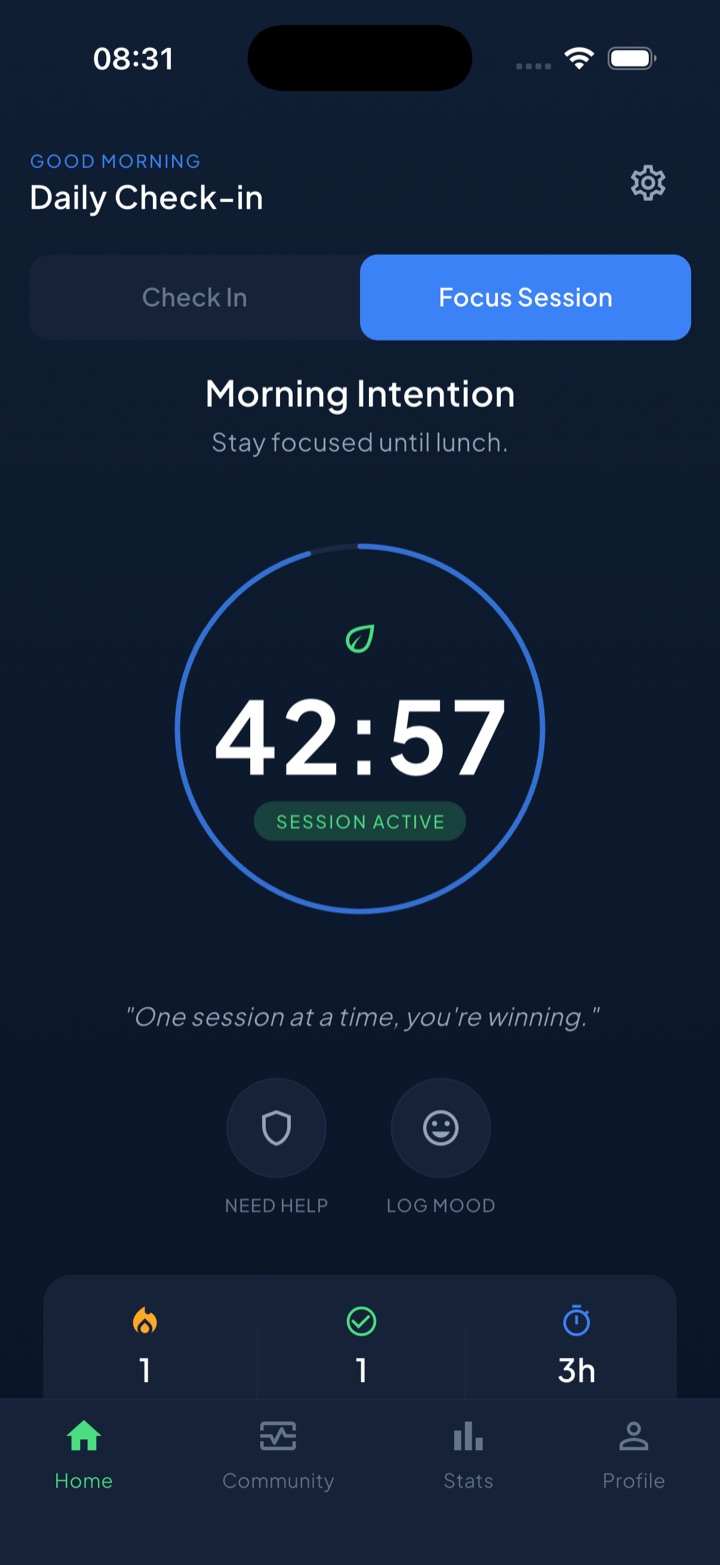
Each session also carries an intention you name up front — “stay focused until lunch” — which is an implementation intention made visible: the situation (session running) is fused to the response (deep work). Scheduled blocking routines do the same for recurring cues, auto-blocking chosen apps during, say, 9-to-5 or your study hours, so “if it’s work time, then distractions are off” happens without you lifting a finger.
You absolutely don’t need an app to benefit here — an index card with three if-then sentences taped to your monitor is a legitimate, research-backed tool. Unscrol just guarantees the hardest part of the plan, the response, so a good intention doesn’t quietly lose to a one-tap habit.
Write the sentence, name the trigger, and decide your move before the moment comes. That single line of planning is worth more than a week of willpower.
Frequently asked questions
What is an implementation intention?
An implementation intention is a specific if-then plan that links a situation to a response you decide in advance: 'If it is 9pm, then I put my phone on the charger in the kitchen.' Psychologist Peter Gollwitzer coined the term. Unlike a vague goal, it pre-loads exactly when, where, and how you will act, so the situation itself triggers the behavior without needing an in-the-moment decision.
Do implementation intentions actually work?
Yes, and the evidence is unusually strong. A large meta-analysis by Peter Gollwitzer and Paschal Sheeran, pooling many studies across health, work, and study behaviors, found a medium-to-large effect on goal attainment. People who formed if-then plans followed through substantially more often than people who only set a goal. It is one of the most reliable behavior-change tools in psychology.
What is the difference between a goal and an implementation intention?
A goal states what you want: 'I want to study more.' An implementation intention states exactly when and how you will act on it: 'If I sit down at my desk after dinner, then I start a 25-minute focus session.' Goals set direction but leave the critical decision for later, when motivation is low. Implementation intentions make the decision now, so the moment triggers the action automatically.
How do I use if-then plans to stop checking my phone?
Write a plan for the exact moment temptation hits, not a general wish. For example: 'If I reach for my phone while studying, then I turn it face down and take three breaths,' or 'If I feel bored at my desk, then I open my notebook instead of my feed.' Naming the trigger and the replacement response in advance is what makes the new behavior fire instead of the old one.