No online quiz can measure your attention span, because attention is a behaviour, not an opinion about yourself. What you can do is measure it directly, with a timer and an honest hand. The three tests below take about half an hour in total, they are uncomfortable in a useful way, and they give you a real number to improve rather than a vague sense that you have got worse. Most people who have not deliberately practised focus in a few years land somewhere between six and twenty minutes of genuinely unbroken attention. If that sounds low, it is worth knowing it is also very trainable.

Test 1: The unbroken block
The core measurement. It answers one question: how long can you stay on a single task before you leave it?
How to run it
- Pick a real task you have been avoiding — not something enjoyable. Enjoyable tasks measure interest, not attention.
- Put your phone in another room. Not face down. Another room.
- Close every tab not required for the task.
- Start a timer and begin.
- Stop the timer the instant you do any of these: open a new tab, check a message, stand up without a reason, pick up a device, or follow a thought away from the task for more than a few seconds.
- Write down the number.
Run it three times over three different days and take the middle result. One attempt tells you about your sleep last night, not about your attention.
| Result | What it means |
|---|---|
| Under 5 minutes | Heavily fragmented. Usually sleep, stress, or constant interruption rather than capacity |
| 5–12 minutes | Common for anyone doing knowledge work with notifications on |
| 12–25 minutes | Solid. This is roughly one useful work unit |
| 25–45 minutes | Well above average for an untrained adult |
| Over 45 minutes | Either trained, genuinely interested, or you were not honest about step 5 |
Be strict about step 5. The value of this test is entirely in how ruthlessly you stop the clock.
Test 2: The reading page
This one measures something different — whether information is landing, rather than whether you stayed in the chair.
Take a physical book, non-fiction, on a subject you do not already know well. Read for ten minutes. Then close it and write, from memory, three specific claims the author made.
- Three specific claims: comprehension is intact.
- Two vague ones: normal, mildly fragmented.
- A general sense of the topic and no specifics: you were decoding words without processing them. This is the experience people describe as reading the same paragraph four times, and it is the clearest everyday sign of the state discussed in brain fog.
The reason to use paper is that it removes every confound. No notifications, no tabs, no possibility of a quick check.
Test 3: The switch count
The first two measure capacity. This one measures environment, which is usually the actual culprit.
Work normally for one hour. Keep a piece of paper beside you and draw a tally mark every single time you switch context — a notification, a message, a tab, a colleague, a thought that sends you somewhere else. Do not change your behaviour, just count.
- 0–5 switches: an unusually protected hour.
- 6–15: typical for most office and remote work.
- 16–30: your hour is not an hour. It is thirty fragments.
- 30+: capacity is not your problem. Nothing could focus in this environment.
Most people are shocked by this number, and it is the most actionable of the three: every mark is a switch you could remove without becoming a different person. The cost is not just the seconds — each switch leaves residue that slows the next stretch of work, which is covered in the cost of context switching.
“My unbroken block was nine minutes and I was quite upset about it. Then I did the switch count and got 24 in an hour. It was never nine minutes of capacity — it was nine minutes between interruptions.” — Hannah, insurance analyst, 35
What about the goldfish claim?
You have seen the statistic: human attention span has fallen to eight seconds, shorter than a goldfish. It gets quoted everywhere, including by people selling focus products.
It does not hold up. The figure has no credible research behind it, the goldfish comparison appears to be invented, and attention is not a single quantity that can be expressed as one number anyway. Sustained attention, selective attention, and the willingness to stay on something boring are different capacities with different determinants.
What is genuinely supported is less catchy and more useful: attention is context-dependent and trainable. The same person can lose ninety minutes to a novel and be unable to hold four minutes on a spreadsheet. That gap is about motivation, interruption, and sleep far more than about some fixed personal capacity. More on the evidence in attention span statistics.
What if your score is low?
Three things, in order of size.
Sleep first. Fragmented sleep produces results indistinguishable from an attention problem, and no technique compensates for it. If the phone charges in your bedroom, that is the first experiment to run.
Cut the switches before you train the capacity. There is no point practising focus in an environment that interrupts you twenty times an hour. Notifications off, one tab, phone in another room. Test 3 gives you the exact list.
Then train it deliberately. Take your test 1 number, add five minutes, and work in that block once a day. Increase weekly. This is the whole idea behind the Pomodoro technique — not that 25 minutes is magic, but that a defined block with a defined end is easier to hold than an open-ended intention. Retest in three weeks; improvement is usually obvious and faster than people expect.
One caveat worth repeating: if the pattern is lifelong rather than recent, and inconsistent rather than uniformly short, that points somewhere else. ADHD and phone addiction is a better starting point, and an assessment is worth more than any self-test.
How does Unscrol help?
The tests above need a timer and a piece of paper. That is genuinely all, and if you want a number today, go run test 1 rather than downloading anything.
Where Unscrol fits is the retest — turning a one-off measurement into a block you can repeat daily. It is an iPhone and Apple Watch app built on Apple’s Screen Time frameworks, so blocking is enforced by iOS rather than by a cosmetic overlay.
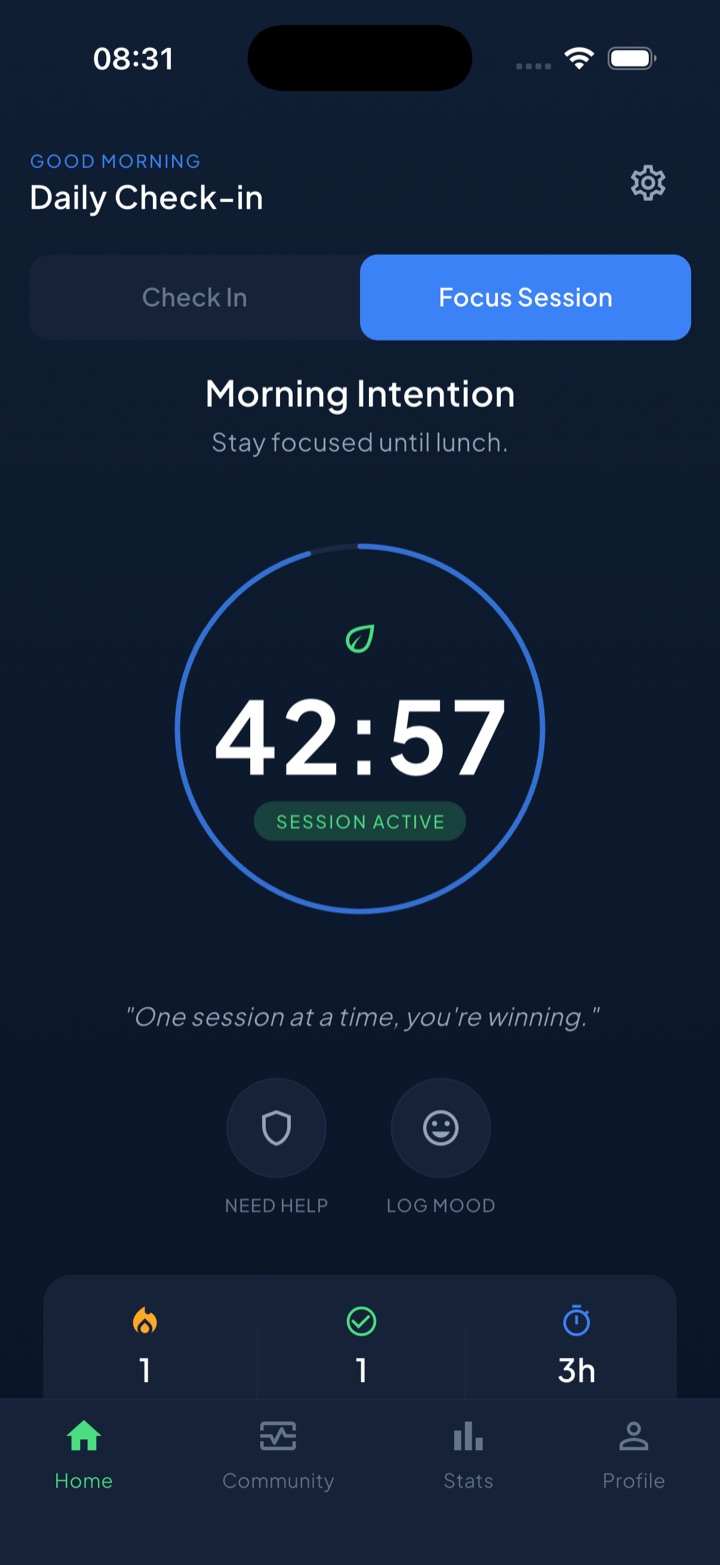
A focus session runs a visible countdown with a Live Activity on the lock screen and blocking active for the duration, which is test 1 with the interruptions removed instead of merely counted. Scheduled blocks shield chosen categories during the hours you want protected, so the switch count from test 3 drops without you having to police it. A unified daily streak grows on any day you complete a quick check-in or one of 45+ challenges, so the practice accumulates visibly rather than depending on memory. Block lists and usage data are processed on-device by iOS and never reach Unscrol’s servers. Free to download; the optional Pro tier adds a Streak Saver that rescues a single missed day, twice a week.
Frequently asked questions
How can I test my attention span?
The most honest test is behavioural rather than a quiz. Set a timer, work on one single task with your phone in another room, and stop the timer the moment you switch to anything else — a tab, a message, standing up, or a thought you follow. The elapsed time is your current unbroken attention span. Run it three times across different days and take the middle result, since a single attempt is heavily affected by sleep, caffeine, and how interesting the task is. Most people who have not practised recently land somewhere between six and twenty minutes.
What is a normal attention span for an adult?
There is no single official figure, and the widely quoted claim that human attention has fallen below that of a goldfish is not supported by evidence. What research does show is that sustained attention on a genuinely demanding task is limited for everyone and depends heavily on task difficulty, motivation, sleep, and interruption. In practice, an untrained adult often manages ten to twenty minutes of unbroken focus on unappealing work, while the same person can hold attention for hours on something they find engaging. Trainability matters more than any average.
Does a short attention span mean I have ADHD?
Not on its own. Almost everyone's sustained attention is worse than it was, largely because of constant interruption and fragmented sleep, and that is a different thing from ADHD. ADHD is a lifelong pattern present since childhood rather than a recent decline, and it is inconsistent rather than uniformly short — the same person may be unable to start a dull task and unable to stop an engaging one. If the description fits a lifelong pattern and it affects work, study, or relationships, a proper assessment is worth pursuing rather than a self-test.