Brain fog is a symptom, not a condition. It describes slow thinking, a memory that will not hold anything for more than a minute, and the sensation of reading the same paragraph four times without absorbing a word. It has many possible causes — sleep, stress, iron, thyroid, illness, mood, medication — and it deserves proper investigation if it has been going on for weeks. But there is one contributor almost nobody screens for, and most people are exposed to it for eight hours a day: an attention system that never gets a moment of rest.

What does brain fog actually feel like?
People describe the same handful of things:
- Thoughts arrive slowly, and finish half-formed
- You walk into a room and the reason is already gone
- Reading is possible; retaining what you read is not
- Conversations require visible effort to follow
- Words you know perfectly well go missing mid-sentence
- You are not sleepy, exactly — you are unavailable
The distinguishing feature is that it is not tiredness. Tired has an obvious fix. Fog persists through a full night’s sleep and a coffee, which is what makes it so unsettling.
What causes brain fog?
Before blaming your phone, work through the list that a doctor would. These are the common causes, roughly in order of how often they turn out to be the answer:
| Cause | Typical clue |
|---|---|
| Poor or fragmented sleep | Fog is worst on days after a broken night; better after a long sleep |
| Chronic stress or burnout | Fog arrived alongside a stressful period; weekends help slightly |
| Low iron, B12, or vitamin D | Fog plus fatigue, breathlessness, pale skin, cold hands |
| Thyroid dysfunction | Fog plus weight change, temperature sensitivity, hair changes |
| Depression or anxiety | Fog plus low mood, loss of interest, or constant background dread |
| Medication side effects | Fog started within weeks of a new prescription |
| Recovery from infection | Fog followed an illness and has not lifted |
| Perimenopause or hormonal change | Fog cycles with other hormonal symptoms |
| Dehydration and skipped meals | Fog clears after water and food |
If your fog has lasted more than a few weeks, see a doctor before you optimise anything. Anaemia and thyroid problems are common, cheap to test for, and completely untouched by better phone habits. Nothing in the rest of this article replaces that.
Where do screens come into it?
Screens rarely cause brain fog on their own. What they do is take a mild fog and hold it in place, through three specific mechanisms.
They eat sleep, twice. Once by delaying it — the “one more video” that turns 23:00 into 01:00 — and once by fragmenting it, because a phone within reach gets checked during the small wakings we all have and normally do not remember. Sleep debt is the most reliable producer of foggy thinking there is. If you only change one thing, change where the phone charges. There is more in screen time and sleep.
They keep attention permanently switching. Every notification, tab, and glance costs a switch, and switching has a measurable price — a residue of the previous task that lingers into the next one. Spend a day doing that and you have not concentrated for eight hours; you have started concentrating four hundred times. The exhaustion is real, and it feels exactly like fog. See the hidden cost of context switching.
They crowd out recovery. Attention refills during unremarkable things: a walk without headphones, staring out of a window, a queue you did not fill with your phone, a conversation with nowhere to be. Those gaps are precisely the ones a phone is designed to occupy. Fill every one of them and there is no point in the day when your attention is not being spent. That is why boredom is good for your brain is not a wellness cliché but a maintenance requirement.
“I assumed I had developed some kind of memory problem at 31. Two weeks of leaving my phone downstairs at night and walking at lunch without headphones and I got my head back. It was never a memory problem. I had just not been alone with a thought since 2019.” — Tomas, operations manager, 31
Is it brain fog or is it ADHD?
Worth separating, because the two get conflated constantly and the answers are different.
Brain fog is usually a change from your normal baseline. There was a before. It fluctuates with sleep, stress, and illness, and it affects everything — reading a novel, following a recipe, and doing your job all feel equally sludgy.
ADHD is a lifelong pattern rather than a recent change, present since childhood even if only recognised later. It is inconsistent rather than uniformly slow: impossible to start a boring task, and impossible to stop an interesting one. Someone with ADHD may lose four hours to hyperfocus on something engaging on the same day they cannot answer one email.
If the description fits the second pattern more than the first, ADHD and phone addiction and ADHD hyperfocus and scrolling are more relevant places to start — and a proper assessment is worth pursuing.
What actually clears the fog?
In rough order of impact per unit of effort:
- Protect sleep first, and physically. Not “try to sleep better” — charge the phone in another room and buy a cheap alarm clock. Everything else is downstream of this.
- Give attention one unbroken block a day. Sixty to ninety minutes on one thing, phone in a drawer, notifications off. The point is not productivity; it is proving to yourself that sustained attention still exists.
- Walk outside without headphones. Daylight, movement, and unfilled time do more for mental clarity than any supplement marketed for it.
- Eat and drink like it matters. Skipped meals and mild dehydration produce a fog that is indistinguishable from the mysterious kind, and clears in an hour.
- Cut the evening switching. The fog you feel at 22:00 is usually the accumulated bill for the day’s four hundred micro-switches. An after-work shutdown ritual is worth more than an early night you spend scrolling.
- Give it two weeks. Attention recovers slowly and unevenly. Judging it after three days is how people conclude nothing works.
What does not work: more caffeine, which converts fog into jittery fog; and “just concentrating harder”, which is asking a depleted system to spend money it does not have.
How does Unscrol help?
Being clear about what this is and is not: Unscrol is not a treatment for brain fog. If your fog has been going on for weeks, the useful next step is a blood test, not an app. Every recommendation above about sleep, daylight, and unbroken attention is free.
Where Unscrol helps is the specific piece people find hardest to do by resolve alone: keeping the phone out of the two windows that matter most — the hour before sleep, and one protected block during the day. It is an iPhone and Apple Watch app built on Apple’s Screen Time frameworks, so blocks are system-enforced rather than a cosmetic overlay.
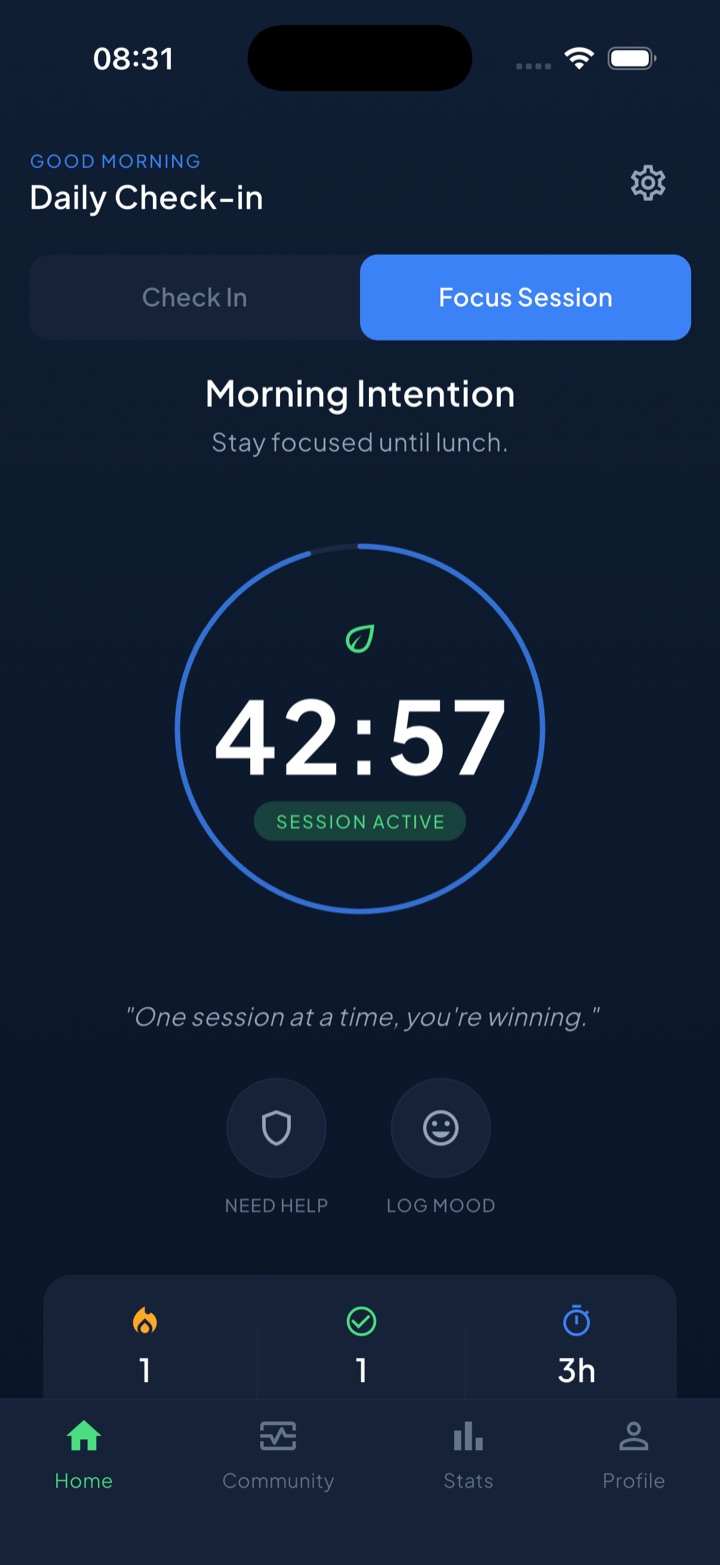
Scheduled blocks shield whole app categories during windows you set in advance, so the 23:00 decision is made by the version of you who set it at 10:00. A focus session gives you one deliberate unbroken block with a visible timer and a Live Activity on the lock screen, which is the practical version of point two above. And a unified daily streak grows on any day you do a quick mood or urge check-in or finish one of 45+ challenges — a small amount of structure while attention recovers on its own schedule. Block lists and usage data are processed on-device by iOS and never reach Unscrol’s servers. Free to download; the optional Pro tier adds a Streak Saver that rescues a single missed day, twice a week.
Frequently asked questions
What is brain fog?
Brain fog is not a medical diagnosis. It is an everyday term for a cluster of symptoms — slowed thinking, poor short-term memory, difficulty holding a thought, mental fatigue, and a feeling of moving through treacle. Because it is a symptom rather than a condition, it has many possible causes: poor or fragmented sleep, chronic stress, dehydration, low iron or vitamin B12, thyroid problems, medication side effects, recovering from infection, hormonal changes, depression, and anxiety. Heavy fragmented screen use makes almost all of these feel worse, but it is rarely the sole cause on its own.
Can too much screen time cause brain fog?
Screens do not cause brain fog directly, but they reliably amplify it through three routes. They displace and delay sleep, which is the single biggest driver of foggy thinking. They keep attention in a constantly switching state, which produces genuine mental fatigue and the sense that nothing sticks. And they replace the recovery activities — walking, boredom, daylight, conversation — that let attention refill. If your fog is worst in the evening after a day of constant switching and better after a night of proper sleep or a long walk, screen habits are likely a major contributor.
When should I see a doctor about brain fog?
See a doctor if the fog has lasted more than a few weeks without improving, if it is getting worse, or if it comes with other symptoms such as unexplained fatigue, weight change, low mood, numbness, headaches, or changes to your vision or speech. Persistent brain fog can be a sign of anaemia, thyroid dysfunction, sleep apnoea, long-term effects of infection, depression, or a medication interaction — all of which are treatable and none of which respond to better phone habits. Rule those out first. Habit changes are worth making regardless, but they are not a substitute for a diagnosis.