If you have ADHD, the same brain that can lock onto a project for six straight hours can also lose an entire evening to a feed — and genuinely not feel the time pass. That’s hyperfocus: an intense, absorbed state of attention that many ADHD brains drop into, and it is indifferent to its target. Pointed at work you love, it’s a superpower. Pointed at an infinite feed, it’s a trap — and short-form video is engineered to capture exactly this state. The way out isn’t willpower in the moment; mid-trance, there’s nobody home to appeal to. It’s exit ramps you build in advance: physical interrupts, transition rituals, and environmental cues that break the trance from the outside. One honest note before we start: this is practical strategy, not medical advice — it belongs alongside professional support, not in place of it.

What is hyperfocus, and why is it a double-edged sword?
Hyperfocus is the state where attention locks on so completely that time, hunger, and the room around you fade out. It’s one of the most commonly reported ADHD experiences, even though it isn’t part of the formal diagnostic criteria and researchers are still debating how to define and measure it. That paradox is the clue: “attention deficit” is a misleading name. ADHD is better described as a difficulty regulating attention — aiming it on demand is hard, but when something hits the right mix of interest, novelty, or urgency, the ADHD brain often locks in harder than a neurotypical one.
That’s the double edge. The state that produced your best code, your best essay, your best painting is the same state that just ate your Tuesday night. Hyperfocus doesn’t grade its targets. Whatever captures an interest-driven attention system gets the full lock-in — whether it deserves it or not.
Why do ADHD brains lose hours to scrolling specifically?
Four mechanics stack on top of each other:
- An interest-driven nervous system. ADHD motivation runs on interest, novelty, challenge, and urgency far more than on importance. A feed is a novelty machine — every swipe is something new — so it speaks the brain’s native language fluently.
- Time blindness. Many people with ADHD have a weakened felt sense of time passing (Russell Barkley’s term for it, “time blindness,” stuck for a reason). Hyperfocus suppresses time perception even further. Stack the two and 23:10 becomes 01:40 with no sensation of transit.
- Exiting is a task switch. Stopping a scroll session is a switch of task and state — precisely the move ADHD brains find most expensive. Continuing costs nothing; stopping costs activation energy you don’t have at midnight.
- Zero cost of entry. Opening a feed requires no setup, no decisions, no blank page. It is always the lowest-friction option in the room, which is a big part of why phones hit ADHD brains harder in general.
None of this is a character flaw. It’s a predictable interaction between a known attention style and software optimized against it.
Why is short-form video a purpose-built hyperfocus trap?
Long-form content can absorb you too, but short-form feeds are close to a lab-designed hyperfocus trigger:
- Variable rewards on every swipe. Most clips are mediocre, some are great, and you can’t predict which — the same unpredictability that makes slot machines compulsive keeps the seeking system firing.
- No unit boundaries. Books have chapters, shows have credits, matches have final whistles. Those endings are natural surfacing points — moments where a trance can break. Feeds deliberately remove all of them and fill every gap with autoplay.
- The feed holds up both ends. Hyperfocus on work requires the work to stay interesting; you’re an active partner. A feed asks nothing of you. It’s hyperfocus with the effort removed — which means there’s no fatigue signal to end it.
- It learns your triggers. The algorithm tunes itself to whatever your brain finds novel. Within weeks it knows your interest profile better than you’d comfortably admit. (What this does to attention spans generally is its own story — see TikTok brain and short-form video.)
| Hyperfocus on chosen work | Hyperfocus in a feed | |
|---|---|---|
| How it starts | You choose the task, often with a ritual | One “quick check” |
| Who steers | You and the task | The recommendation algorithm |
| Stopping cues | Built in — the task ends, a milestone lands | Deliberately removed; autoplay fills every gap |
| Sense of time | Reduced | Nearly erased |
| Afterward | Tired but satisfied | Drained, foggy, “where did the night go?” |
Same neurological state, different owner. The question isn’t how to stop hyperfocusing — it’s who gets to steer.
How do you break the trance? Exit ramps that actually work
General anti-scrolling advice helps (our guide to how to stop doomscrolling covers it), but the ADHD version has one non-negotiable rule: the interrupt must come from outside the trance, and every decision must be made in advance.
- Make interrupts physical. A loud alarm across the room forces sound and movement. A silent notification or a mental “just five more minutes” gets filtered out — the trance eats quiet cues for breakfast.
- Change your body’s state. Stand up, splash cold water on your face, step onto the balcony. The trance lives in stillness; moving your body is the fastest way to evict it.
- Pre-decide the next thing. ADHD brains hate exiting into a vacuum, so build a transition ritual: “When the 22:30 alarm fires, the phone goes on the hallway charger and the kettle goes on.” You’re not stopping scrolling — you’re starting tea. That reframe does real work.
- Rebuild stopping cues in the environment. Charger outside the bedroom. Feeds off the home screen. Grayscale after dinner. Each one is a small speed bump exactly where the trance is weakest — at its edges.
- Use hard edges, not fuzzy limits. “I’ll stop soon” doesn’t exist mid-trance. A block that ends the session at a time your calm self chose does. This is the same cold-state logic as any commitment device: decide while sober about attention, comply while drunk on novelty.
“I’d surface at 1:40 a.m. with a dead arm and start doing sleep math. What finally worked wasn’t discipline — it was an alarm across the room at 11 and a rule that the phone sleeps in the kitchen. The trance can’t argue with a charger in another room.” — Marcus, software developer, 34
Can you point hyperfocus at things you actually want?
Sometimes — and it’s worth trying, because the goal was never to kill hyperfocus. You can’t summon it on command, but you can set the table: start with the most interesting entry point of a task rather than the “proper” first step, use an entry ritual (same desk, same playlist, same drink), add mild urgency or a body-double, and — crucially — protect the state once it arrives by blocking the apps that would otherwise steal it. A “quick check” mid-flow doesn’t pause work hyperfocus; it transfers the lock-in to the feed, and the feed doesn’t give it back. Be honest with yourself about the odds: it’s not a switch you flip. But an environment where the interesting thing is reachable and the infinite thing is not tilts the game in your favor.
How does Unscrol help ADHD brains exit the scroll trance?
Start with the free, DIY route — it’s genuinely good. Apple’s Screen Time gives you Downtime for a nightly shutdown hour and App Limits for your stickiest feeds; add a charger in the kitchen and a real alarm clock, and you’ve built most of the exit ramps above without spending anything. The honest caveat: ADHD brains are world-class at bypassing their own rules, and “Ignore Limit” is one tap away, forever.
Unscrol is the iPhone app for when your own taps can’t be trusted at 1 a.m. It uses the same Apple Screen Time frameworks to enforce real, system-level shields, and everything — block lists, usage — is processed on-device, never sent to our servers.
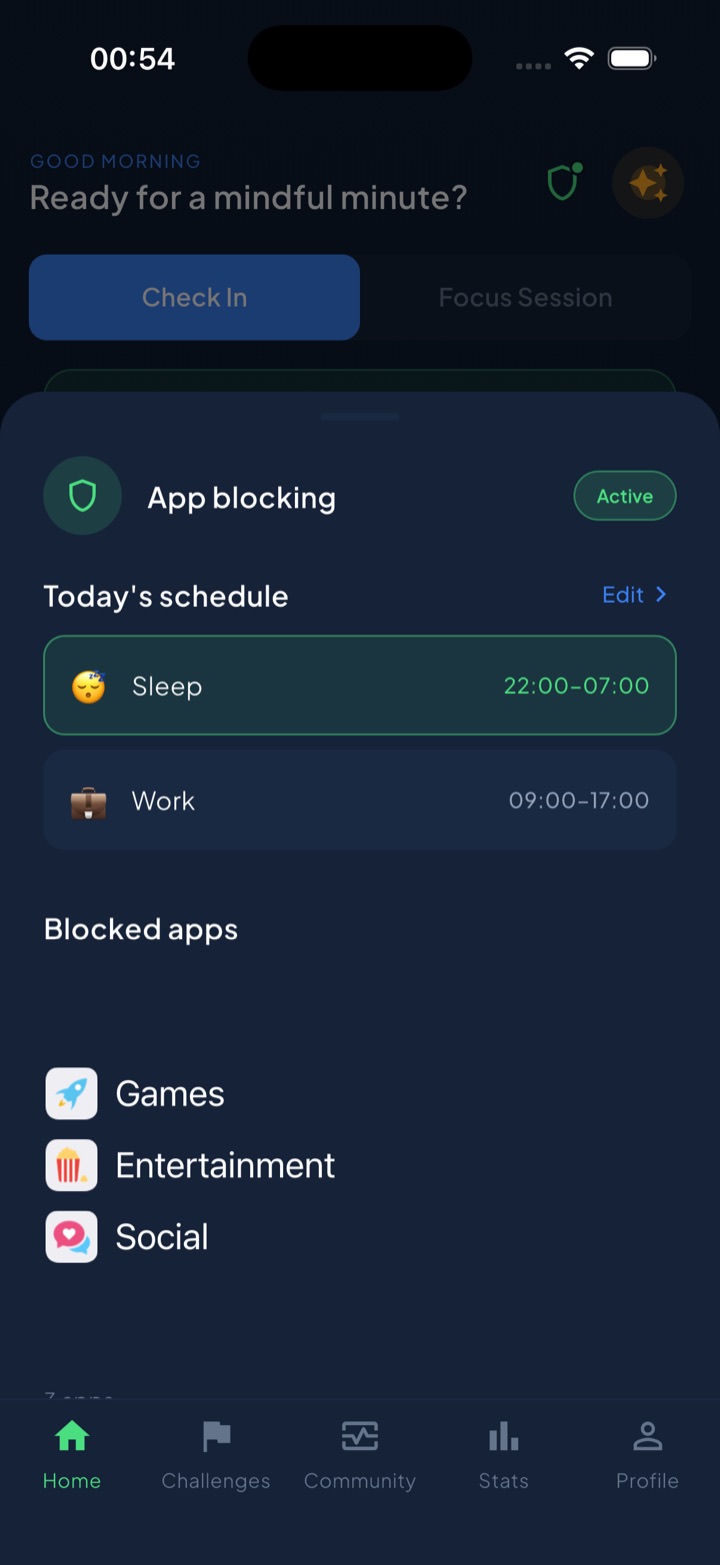
- Hard edges on a schedule. Scheduled routines like Sleep or Work end the scroll session at the time your calm self chose — the trance doesn’t get a vote.
- A ramp, not a wall. The short “take a break” bypass gives you an intentional exception without tearing the whole system down — which matters, because for ADHD brains a rigid wall usually ends in deleting the blocker entirely.
- An external clock against time blindness. Focus sessions run a Live Activity on your Lock Screen — a visible, draining timer where your internal clock fails — and home-screen widgets keep your streak in sight.
- Small wins that fit your brain. Daily morning/afternoon/evening check-ins and 45+ challenges give the novelty-seeking system quick, real rewards; the daily streak (with a Streak Saver for the inevitable missed day) keeps it forgiving rather than all-or-nothing.
The honest close: paper rules and Screen Time can absolutely do this, and none of it treats ADHD — that’s between you and your clinician. What Unscrol does is narrower and very practical: it makes the edges real, so the same hyperfocus that eats feeds tonight can be spent on something you’ll actually be glad about tomorrow.
Frequently asked questions
Can ADHD hyperfocus happen while scrolling?
Yes. Hyperfocus is a state of intense, absorbed attention that many people with ADHD report, and it isn't picky about its target. The same lock-in that fuels hours of deep work can attach to an infinite feed, because feeds supply exactly what an interest-driven brain seeks: constant novelty with zero effort. The difference is that work eventually ends and gives something back, while a feed is designed never to end — so the state persists until something external interrupts it.
Why do people with ADHD lose track of time on their phone?
Two forces stack. ADHD often involves time blindness — a weakened internal sense of time passing, a concept popularized by ADHD researcher Russell Barkley. Hyperfocus then suppresses time perception even further. Feeds also strip out every external time marker: no episode endings, no page breaks, no natural pause where you would surface and check a clock. With the internal clock quiet and the external cues removed, three hours can honestly feel like twenty minutes.
How do you break out of a scrolling trance with ADHD?
Use physical interrupts, not intentions. An alarm across the room, a charger in another room, or a system-enforced app block will break the trance; a silent resolution made mid-scroll will not. Pair the interrupt with a pre-decided next step — stand up, put the phone on its charger, start the kettle — so you exit onto something instead of into a vacuum. Deciding all of this in advance is the whole trick, because the trance itself is terrible at deciding.
Is hyperfocus scrolling the same as doomscrolling?
They overlap but aren't identical. Doomscrolling usually means compulsively consuming negative news, and anyone can do it. Hyperfocus scrolling is the ADHD-specific version of the mechanism: an interest-driven brain locks into an absorbed state, time perception drops out, and the session only ends when something external breaks it. The content doesn't have to be negative at all — it can be genuinely fun — which is exactly what makes the lost hours so confusing afterward.