If you have ADHD, phones hit harder for reasons rooted in how the brain works, not in a lack of discipline. ADHD tends to involve stronger stimulation-seeking, weaker impulse control, and time blindness — the sense that time is slippery and “five more minutes” vanishes into an hour. Phones and feeds are built to exploit exactly those traits, offering fast, variable rewards with zero friction. Research links ADHD symptoms with higher rates of problematic phone use, though it’s correlational and the relationship likely runs both directions. This article is not diagnostic — only a clinician can assess ADHD — but the practical takeaway is clear: the strategies that help are about external structure, not willpower.
Why do phones hit ADHD brains harder?
Three features of ADHD, described in the clinical work of researchers like Russell Barkley, line up almost perfectly with how feeds are engineered:
- Stimulation-seeking. ADHD brains are often under-stimulated by ordinary tasks and reach for something more engaging. A feed is an endless supply of novelty — precisely the input the brain is hunting for.
- Impulse control challenges. ADHD makes it harder to pause between an urge and an action. The gap where “should I check my phone?” would normally sit is narrower, so the tap happens before the thought.
- Time blindness. Without a strong internal clock, time on a phone doesn’t register. This is why people with ADHD so often describe “losing” hours — not exaggeration, but a genuine difference in how elapsed time is perceived.
Layer a variable-reward feed on top of that — the same loop covered in dopamine and social media — and you have a near-perfect trap. The feed provides the stimulation, defeats the weakened impulse brake, and hides the passage of time. It’s not that people with ADHD lack willpower; it’s that phones are designed to bypass the exact systems ADHD already taxes.
What does the research actually say?
Here’s where honesty matters, because this topic attracts a lot of overclaiming in both directions.
What’s reasonably supported:
- ADHD symptoms and problematic phone use are correlated. Multiple survey studies find people with more ADHD traits report more compulsive phone and social media use.
- The link probably runs both ways. ADHD makes feeds stickier; heavy feed use can also worsen attention and sleep, which amplifies symptoms.
What’s not established:
- That screens cause ADHD. ADHD is a neurodevelopmental condition with strong genetic roots. A widely cited 2018 JAMA study of Los Angeles teenagers found a modest association between heavy digital media use and later ADHD-like symptoms — but the effect was small, and association isn’t causation.
The responsible summary: phones don’t create ADHD, but they hit ADHD brains disproportionately hard, and managing use produces real relief. If your attention problems are lifelong, pervasive across settings, and genuinely disruptive, that’s a conversation for a clinician — not something an app or an article can diagnose.
How do you support executive function instead of fighting it?
The winning strategy for ADHD and phones is to stop relying on in-the-moment self-control (the weakest system) and instead build external structure that does the work for you. Every tactic below is an executive-function support, a prosthetic for the brain functions that ADHD taxes.
- Make time visible. Time blindness fights a hidden clock. Use a countdown you can see — a visible timer during work blocks turns invisible time into something concrete. This alone addresses one of ADHD’s core difficulties.
- Put friction between impulse and app. Block distracting apps during work and study so the impulsive tap hits a wall instead of a feed. When the brake is weak, the environment has to be the brake.
- Reduce choices. A cluttered home screen is a decision minefield. Fewer apps, no badges, grayscale if it helps — every removed choice is one less place for the impulse to go.
- Use body doubling. Working alongside someone — in person or via a virtual body doubling session — provides the external accountability and gentle social pressure that ADHD brains respond to well.
- Externalize memory. Don’t rely on remembering; write it down, set alarms, use lists. Offloading frees the working memory ADHD already stretches thin.
These pair naturally with broader focus tactics in how to improve concentration — but for ADHD specifically, the emphasis is always on structure you don’t have to sustain by force.
What helps in the moment the urge hits?
Because the impulse gap is narrow, having a pre-loaded response matters more than for most people:
- Name it out loud. “That’s the urge to check.” Naming inserts a half-second gap where the impulse brake can engage.
- Move your body. Stand, walk to another room, get water. Physical movement discharges the restlessness that often drives the reach.
- Log it instead of act on it. Note the urge — what you were doing, how you felt — rather than following it. Over time this builds the self-awareness ADHD often lacks about its own patterns.
The honest caveat: none of this replaces treatment. For many people, ADHD is best managed with a combination that a clinician oversees, which may include therapy, coaching, and sometimes medication. Environmental strategies work better alongside that care, not instead of it. And you can build most of this structure for free — a cheap kitchen timer, a decluttered home screen, and a friend on a video call are a completely legitimate starting kit.
How Unscrol provides external structure for ADHD brains
The through-line of everything above is the same: ADHD does better with structure that lives outside your head. Unscrol is the iPhone and Apple Watch app we build to put that structure in place so you don’t have to hold it by willpower. Focus sessions give you a visible countdown on the Lock Screen and Dynamic Island — a direct counter to time blindness — while blocking your chosen distracting apps with Apple’s official Screen Time frameworks, so an impulsive tap meets a wall instead of a feed. Scheduled routines can block social and entertainment apps automatically during work or study windows, meaning the structure runs itself.
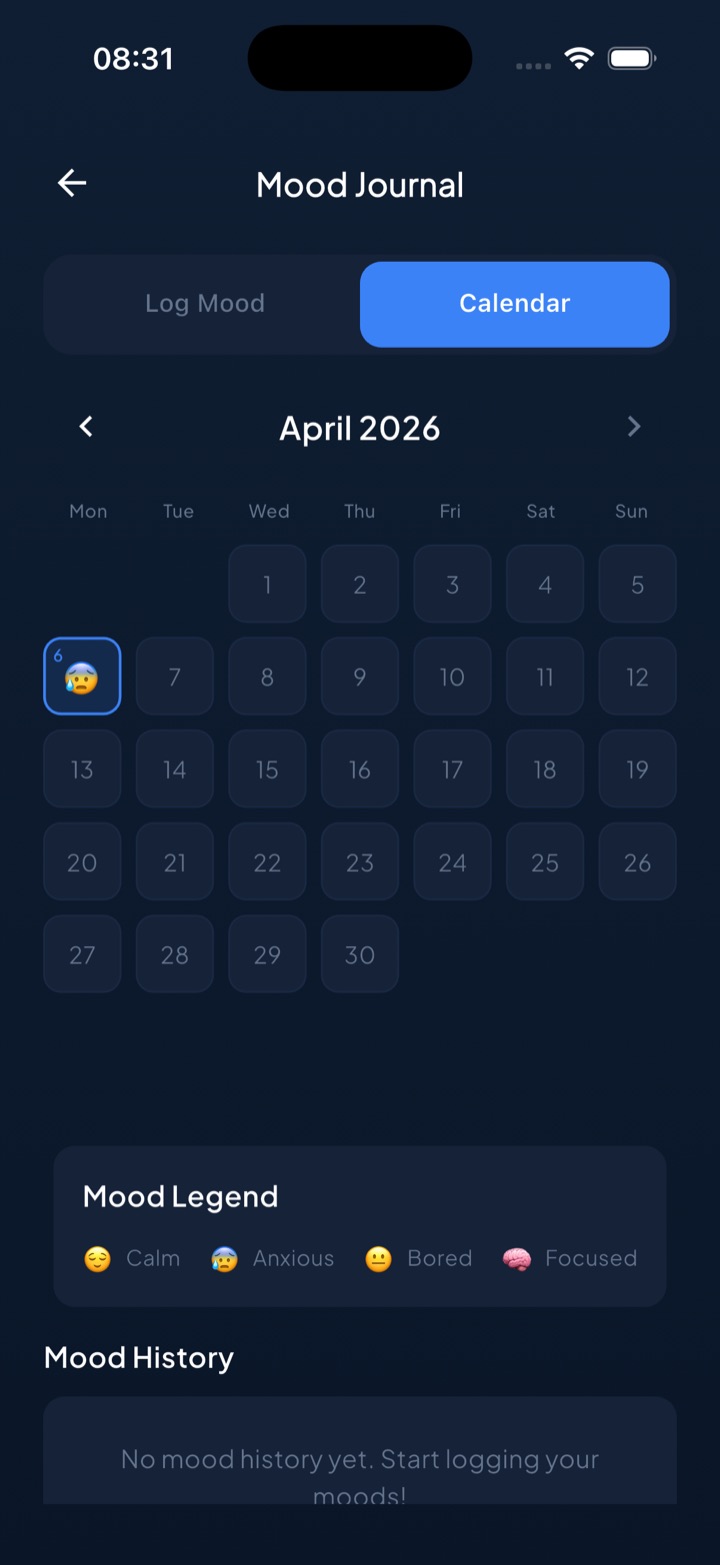
The mood and urge journal is especially useful for ADHD, because it makes invisible patterns visible — logging when you reached, and whether you were bored, anxious, or avoiding a task, turns a foggy habit into data you can act on. None of this is treatment, and it’s not a diagnosis; if attention problems are disrupting your life, please talk to a clinician. But as an executive-function support that runs in the background, external structure like this is one of the most practical things you can add.
Work with your brain’s wiring, not against it: build the structure once, and let it carry the load your willpower can’t.
Frequently asked questions
Why is phone addiction worse with ADHD?
ADHD brains tend to seek stimulation more strongly and struggle more with impulse control and time awareness, and phones deliver fast, variable rewards on tap. Feeds provide exactly the novelty an under-stimulated brain craves, while time blindness makes 'five minutes' quietly become an hour. Research links ADHD symptoms with higher rates of problematic phone use, though it's correlational — the relationship likely runs both ways rather than one causing the other.
Does screen time cause ADHD?
There's no good evidence that screens cause ADHD, which is a neurodevelopmental condition with strong genetic roots. A 2018 study in JAMA of Los Angeles teens found a modest association between heavy digital media use and later ADHD-like symptoms, but association isn't causation, and the effect was small. The more supported view is that ADHD makes phones stickier, not that phones create ADHD. Either way, managing phone use helps.
What phone strategies actually help people with ADHD focus?
External structure that doesn't rely on willpower: visible timers for time blindness, app blocking during work so the impulsive tap hits a wall, body doubling for accountability, and reducing on-screen choices. The principle is to move effort out of the vulnerable moment and into the environment. These are executive-function supports, not cures, and they work best alongside whatever treatment a clinician recommends.
Is it ADHD or just too much phone use?
Only a qualified clinician can answer that, and it's worth asking if attention problems disrupt your work, relationships, or daily life across many settings and have done so for years. Heavy phone use can produce ADHD-like symptoms in anyone — restlessness, distractibility, trouble finishing tasks — that ease when use drops. If reducing screen time doesn't help and the difficulties are lifelong and pervasive, an assessment is reasonable.