Body doubling is working on your own task while another person is present and also working. The other person doesn’t help you — their presence is the help. Popularized in the ADHD community, it makes hard or boring tasks easier to start and sustain, and it works in person, over video, or with a “study with me” recording. It works because someone else in the room creates mild accountability, models focused behavior you unconsciously match, and gives a shapeless intention a real start and end time. Part of the effect is what psychologist Robert Zajonc called social facilitation: we often do our well-practiced work better when others are around.
What exactly is body doubling?
The setup is almost embarrassingly simple. You and at least one other person occupy the same space — physical or virtual — and each work on your own thing. No collaboration, no talking through the middle, no one checking your output. A roommate reads while you do your taxes. Two friends on a video call write separate essays. A thousand strangers work along to a silent “study with me” livestream.
The name comes from the idea that the other person acts as a “double” whose steady presence anchors your attention. It spread first through ADHD communities, where people described a familiar experience: a task that felt impossible alone became doable the moment someone was simply there, even doing something unrelated. From there it moved into wider study and productivity culture, especially once remote work and study-with-me videos made virtual versions easy.
Crucially, body doubling is not about pressure or judgment. The double isn’t a supervisor. That’s what separates it from being micromanaged — the accountability is ambient and gentle, which is exactly why it doesn’t trigger the resistance that surveillance does.
Why does another person’s presence make you focus?
Four mechanisms do the work, and knowing them helps you set a session up well.
Social facilitation. Back in the 1960s, Robert Zajonc synthesized decades of findings into a clean rule: the presence of others tends to improve performance on simple, well-learned tasks and can impair it on complex, unfamiliar ones. Most body-doubled work — writing you know how to do, admin, studying material you’ve already learned — sits in the “simple/practiced” category, where an audience helps. (This is also a hint about the limits, which we’ll get to.)
Accountability made visible. When someone can see you, abandoning the task or pulling out your phone becomes a small public act. You don’t want to be the person who announced “I’m going to write for 50 minutes” and then started scrolling. The social cost of quitting rises just enough to keep you going.
Norm-matching. Humans automatically calibrate to the people around them. Sit next to someone typing steadily and your brain treats focused work as the ambient norm and quietly falls in line.
A container for the session. Body doubling almost always comes with a defined block — “let’s do 50 minutes.” That start and end time converts a vague someday into a concrete now, which is often the entire battle. This is the same reason a timed deep work block beats “I’ll get to it.”
Does body doubling really help with ADHD?
The technique’s popularity in ADHD communities isn’t an accident. Many of the hardest parts of ADHD are executive-function challenges: initiating a task, sustaining attention on something under-stimulating, and resisting more interesting distractions. Body doubling supplies external structure for exactly those gaps — the presence helps you start, the accountability helps you stay, and the session boundary helps you stop drifting.
It’s worth being careful and non-diagnostic here. Body doubling is a support strategy, not a treatment, and it isn’t a substitute for clinical care. Responses vary a lot from person to person. If phone use and focus feel unmanageable, that’s a reason to talk with a clinician rather than to self-diagnose from an article — a theme covered more fully in the piece on ADHD and phone use. What’s fair to say is that as a cheap, no-side-effect tool, a lot of people find it genuinely useful, ADHD or not.
In-person vs virtual body doubling: which should you use?
Both work; they trade off differently.
| In-person | Virtual (video / focus room) | Study-with-me video | |
|---|---|---|---|
| Accountability | Strongest | Strong | Mild |
| Availability | Needs a person nearby | Anytime, anyone online | Instant, always on |
| Distraction risk | Chatting | Chat, tab-switching | You control it |
| Best for | Deep solo work with a friend | Remote workers, students | Solo starts, low stakes |
| Setup cost | Coordinate schedules | A call or a focus platform | Press play |
A reasonable default: use a live partner or focus room when you can, and keep a study-with-me stream as your always-available fallback for the days you just need to start.
How do you run a good body-doubling session?
A structure that consistently works, in person or online:
- Set the container. Pick a length — 25 or 50 minutes is ideal — and agree on it out loud. The number matters less than the fact that it’s fixed.
- State your one task. Each person names the single thing they’ll work on. Saying it aloud is the accountability hook. Vague (“do some work”) is weak; specific (“draft section 3”) is strong.
- Kill your own distractions. The double handles the human side, but your phone is a separate threat. Put it in another room or block your distracting apps for the block. Presence alone won’t stop a notification.
- Work in silence. Cameras on for virtual sessions, but no talking through the middle. The silence is the feature.
- Check in at the end. Two lines: what you got done, what’s next. This closes the loop and makes the next session easier to start.
For studying specifically, this pairs well with the tactics in how to focus while studying, and the same session structure carries straight over to office work.
And the honest caveat from Zajonc’s own finding: on genuinely novel, complex problems — the kind where you’re stuck and thinking hard — an audience can actually hurt, because the pressure of presence interferes with fragile new reasoning. Use body doubling for execution and grind, and protect your hardest creative problem-solving for true solitude.
How Unscrol backs up a body-doubling session
A body double handles the human side of focus — the accountability and the norm. What it can’t do is stop your own phone from lighting up mid-session, and one notification is enough to break the spell. Unscrol, the screen-time app we build, covers that gap. Start a focus session for the length of your block and it shields your most distracting apps with Apple’s official Screen Time frameworks — real system-level blocks — so picking up the phone no longer opens a door to the scroll. A Lock Screen and Dynamic Island countdown mirrors the session’s start-and-end structure, giving you a private version of the accountability your body double provides.
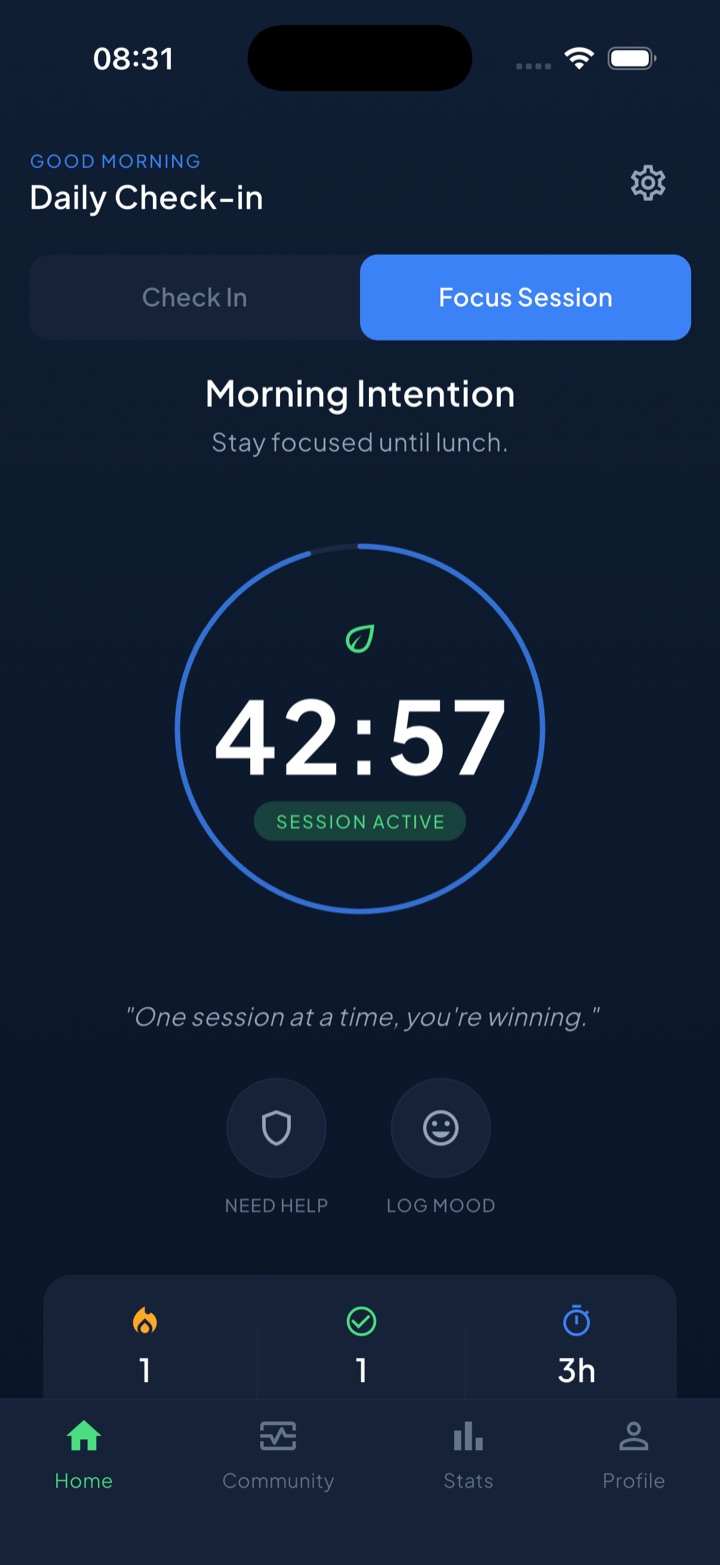
Each completed session also feeds a daily streak, so the block you did with a friend leaves a visible trace that makes tomorrow’s easier to start. You don’t need any of this to body-double — two friends and a shared timer are the whole method. Unscrol just guards the one thing a human double can’t: the phone in your own hand.
The takeaway: focus is easier when you’re not doing it alone. Borrow someone’s presence to start and to stay, then close the one loophole they can’t — your own phone.
Frequently asked questions
What is body doubling?
Body doubling is working on your own task while another person is present and working alongside you. The other person doesn't help with the task; their presence is the point. It became popular in the ADHD community as a way to start and sustain hard or boring tasks, and it works in person, over video, or even with a 'study with me' recording. The shared focus makes it easier to begin and harder to drift off.
Why does working next to someone help you focus?
A few forces combine. The other person's presence creates mild accountability, so quitting or picking up your phone feels more visible. Their focused behavior sets a norm you unconsciously match. And having a set start and end time turns a vague intention into a concrete session. Psychologists call part of this social facilitation — people often perform simple, well-practiced tasks better when others are around.
Does body doubling work for ADHD?
Many people with ADHD find it genuinely helpful, which is why the term spread through ADHD communities. It provides external structure and accountability that can compensate for the executive-function challenges — starting tasks, sustaining attention, resisting distraction — that make solo work hard. It isn't a treatment and results vary, but as a low-cost support it's widely used. If you're exploring ADHD strategies, pair it with clinical guidance rather than self-diagnosis.
How do I do virtual body doubling?
Get on a video call or into an online focus room with one or more people, state your one task and how long you'll work, then keep your camera on and work in silence. A 25 or 50 minute block with a short check-in at the start and end works well. If you can't find a live partner, a 'study with me' video gives a lighter version of the same presence and structure.