Context switching is the hidden tax on every “quick check.” Each time you jump between tasks, your brain doesn’t move cleanly — part of it stays stuck on what you just left, and attention researcher Gloria Mark has found it takes on average around 23 minutes to fully return to the original task after an interruption. The real cost isn’t the ten seconds you spent glancing at a notification; it’s the degraded focus for the half hour afterward. Multiply that across the dozens of daily switches most of us make — many triggered by a phone in reach — and it becomes the single largest leak in a working day. The fix isn’t switching faster. It’s switching less.
What actually happens when you switch tasks?
Your brain treats a demanding task like a loaded program: it holds the goal, the relevant rules, and the working context in mind. Switching tasks forces two costly operations that cognitive psychologists have measured for decades:
- Goal shifting — deciding to stop doing one thing and start another.
- Rule activation — turning off the mental rules for the old task and loading the rules for the new one.
Foundational lab studies by Robert Rubinstein, David Meyer, and Jeffrey Evans, later summarized by the American Psychological Association, showed that these switches cost measurable time — often just tenths of a second in a controlled task, but scaling up sharply as the tasks get more complex and less similar. In real knowledge work, where each switch means reloading a different mental model, the cost balloons.
The uncomfortable part: this happens even when the switch feels effortless. You don’t feel the reload happening, which is exactly why the cost stays invisible and why people believe they’re good at multitasking when the data says almost no one is.
What is attention residue, and why does it linger?
In 2009, University of Washington researcher Sophie Leroy published a study with a title that names the whole problem: “Why is it so hard to do my work?” Her answer was attention residue — when you switch tasks, especially before finishing or under time pressure, a residue of the previous task keeps occupying your mind. Part of your attention is still writing the last email while you’re supposed to be planning the next project.
Residue explains why the cost outlasts the interruption. A ten-second glance at Instagram doesn’t just cost ten seconds; it leaves a film of “what did I just see?” over the next stretch of work. It’s also why finishing a task, or at least reaching a clean stopping point, matters so much — an unfinished task leaves the stickiest residue.
Leroy’s practical implication is powerful: how you leave a task shapes how well you start the next one. Closing an open loop (jotting the next step, marking where you’ll resume) reduces the residue you carry forward.
How big is the total cost, really?
No single number captures it, because it depends on the work and the person. But the research points in one direction — the cost is large and mostly hidden:
| Switch type | What it feels like | Typical hidden cost |
|---|---|---|
| Glancing at a phone notification | ”One second” | Attention residue for minutes; possible full derail |
| Answering a message mid-task | ”Just replying quick” | Reload of the original task; residue from the reply |
| Jumping between two projects | ”Being efficient” | Full goal-shift both directions, compounded |
| A deep interruption (call, someone at your desk) | “A short chat” | Around 23 minutes on average to fully refocus |
Gloria Mark’s field research, conducted by observing real office workers, is the anchor here: that ~23-minute refocus figure comes from watching what people actually do after being pulled away, not from a lab estimate. Her work also documented how short our on-screen attention spans have become — averaging well under a minute in recent measurements, down from around two and a half minutes two decades ago. We are switching more, and paying for each switch more often.
Why is your phone the biggest switch generator?
Most productivity advice treats interruptions as things that happen to you. But the largest source of switching for most people is self-initiated, and it sits on the desk. A phone is a switch generator: it manufactures reasons to leave the current task, on its own schedule, dozens of times an hour.
- Every notification is a switch invitation, and even the ones you dismiss cost residue.
- Every idle moment — a slow-loading page, a hard sentence — becomes a cue to check, because checking is easier than thinking.
- Because the reward is variable (sometimes there’s something good, usually there isn’t), the pull is unusually strong, the same mechanism explored in dopamine and social media.
This is why the phone-in-the-room brain drain effect matters: the device doesn’t have to buzz to cost you. But when it comes to context switching specifically, the actionable insight is simpler — cut the number of times the phone can pull you out, and you cut the tax directly.
How do you build a “switch budget”?
Treat switches like money: you have a limited number of good ones per day, so spend them deliberately.
- Batch by type. Group similar tasks — all email at set times, all calls in one window, all writing in another. Similar tasks share mental rules, so switching within a batch is cheap; switching between batches is where the cost lives.
- Check on a schedule, not on arrival. Messages and email get two or three defined windows, not a continuous open channel. This alone removes most of the day’s switches.
- Give each block one goal. A block with a single objective has nothing to toggle between. This is the core of the time-blocking technique and of any real deep work practice.
- Close loops before you leave. When a block ends, spend 30 seconds writing the next concrete step. You’ll carry less residue into the next task.
- Remove the switch generator. Put the phone in another room or a drawer during focus blocks, and silence non-VIP notifications. You can’t spend a switch you can’t reach.
You don’t need any software to do this. A paper list, a kitchen timer, and Do Not Disturb will get you most of the way — the honest truth is that the biggest wins here are about arrangement, not apps.
How Unscrol turns fewer switches into a default
The hard part of a switch budget is that the decision keeps arriving mid-task, exactly when your focus is weakest. Unscrol is the iPhone and Apple Watch app we build to make the low-switch choice automatic instead of a repeated act of willpower. A focus session blocks your chosen distracting apps for the length of the block using Apple’s official Screen Time frameworks, so the switch generator is disarmed while you work, and a Live Activity countdown on the Lock Screen and Dynamic Island keeps your remaining time visible without you opening anything.
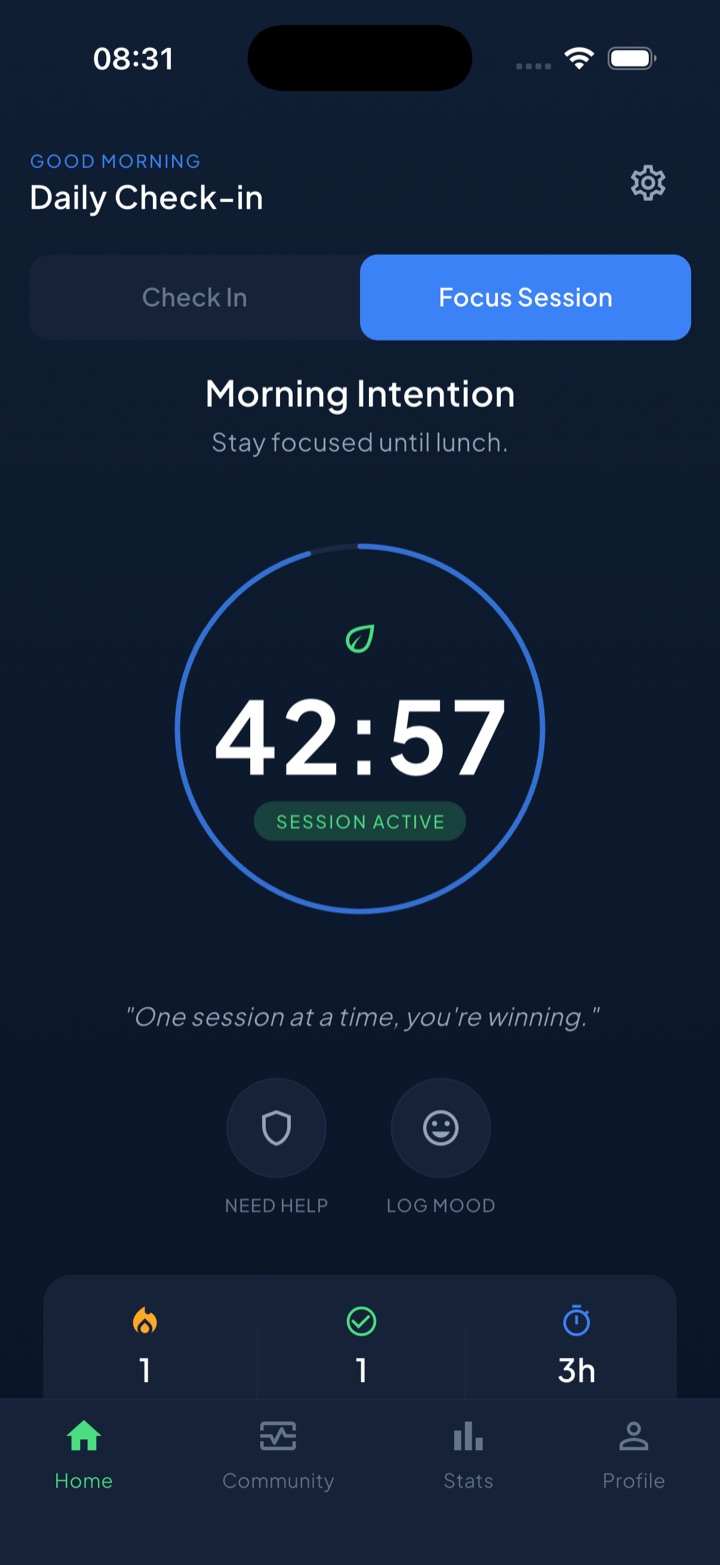
Scheduled blocking routines can go further, auto-blocking social and entertainment apps during your defined work windows so the batching happens on its own. None of this replaces a good plan — a timer and a phone in another room does the same job for free. What the app adds is consistency: the decision to not switch is made once, in advance, instead of thirty times a day under pressure.
Count your switches for one afternoon. The number is almost always higher than you’d guess — and lowering it is the fastest focus upgrade most people can make.
Frequently asked questions
How much time does context switching actually cost?
The visible cost is a few seconds per switch, but the hidden cost is much larger. Attention researcher Gloria Mark found it takes on average around 23 minutes to fully return to a task after an interruption. Laboratory work summarized by the American Psychological Association suggests heavy task-switching can consume up to 40 percent of someone's productive time. The seconds you spend glancing aren't the problem; the degraded focus for the next half hour is.
What is attention residue?
Attention residue is the part of your mind that stays stuck on a previous task after you've moved to a new one. Researcher Sophie Leroy described it in 2009: when you switch before finishing something, or under time pressure, a 'residue' of the old task keeps running in the background and lowers your performance on the new one. It's why answering one email mid-project makes the project feel foggy afterward.
Is multitasking real or a myth?
For anything requiring conscious attention, multitasking is a myth. Your brain doesn't run two demanding tasks in parallel; it rapidly switches between them and pays a small cost each time. You can genuinely combine one automatic task (walking, folding laundry) with one thinking task, but two thinking tasks always degrade both. What feels like multitasking is really fast, expensive switching.
How do I stop context switching at work?
Reduce the number of switches rather than trying to switch faster. Batch similar work into blocks, check messages on a schedule instead of on arrival, and remove the biggest switch generator from view — your phone. Turn off non-essential notifications, work in single-task blocks of 25 to 90 minutes, and give each block one clear goal so there's nothing to toggle between.