Boredom feels like a problem to solve, but it’s closer to a nutrient your brain needs. When you’re understimulated, your mind shifts into a resting state where it does some of its most useful work — making unexpected connections, planning the future, reflecting, consolidating experience. Research links mild boredom to a measurable bump in creativity on the task that follows it. Boredom is also where self-control is trained: learning to sit in an uncomfortable, empty moment without escaping is the exact muscle that resists compulsive checking. The trouble is that phones let us kill boredom the instant it appears, so we never get the benefit — or build the tolerance. This is about reclaiming that space, not romanticizing being bored.
What does boredom actually do for your brain?
The idea that boredom is wasted time gets the science backwards. When you stop focusing on an external task, your brain doesn’t switch off — it switches to a different, richly active mode.
- Creative incubation. Psychologist Sandi Mann ran studies where people did a deliberately dull task (like copying numbers from a phone book) before a creativity test, and the bored group generated more creative ideas afterward. Boredom appears to prod the mind to seek stimulation internally, which is where original ideas come from.
- Planning and reflection. Idle mind-wandering is when people tend to think about their future, review the past, and make sense of experience — the mental housekeeping that a constantly occupied mind never gets to.
- Consolidation. Downtime helps the brain process and integrate what it has taken in, which is part of why insights so often arrive in the shower or on a walk, not at the desk.
Much of this is associated with the default mode network — a set of brain regions that comes online when you’re not engaged with the outside world. It’s linked to autobiographical memory, imagining the future, and creative connection-making. Fill every gap with a feed and this network rarely gets to run. We don’t yet know the full cost of that, so hold the claim loosely — but the pattern is suggestive enough to take seriously.
Why do we now find boredom unbearable?
Because we’ve lost the tolerance for it, and we lost it recently. The most vivid evidence comes from a 2014 study led by University of Virginia psychologist Timothy Wilson. Participants were left alone in a plain room for 6 to 15 minutes with nothing to do but think. They’d been given the option to self-administer a mild electric shock — one they had earlier said they would pay money to avoid. Many chose to shock themselves rather than sit quietly with their thoughts: roughly two-thirds of men and a quarter of women did it at least once.
Let that land: a meaningful share of people preferred physical pain to a few minutes of unstructured boredom. And that was before short-form video made escape effortless.
Here’s the compounding problem. Every time boredom appears and you immediately reach for your phone, you teach your brain two things: that boredom is an emergency, and that relief is one tap away. Do that thousands of times and your tolerance for understimulation collapses. Ordinary quiet starts to feel intolerable, which drives more checking, which lowers tolerance further — the loop behind why you keep checking your phone. The feed didn’t just fill your boredom; it trained you to panic at the first hint of it.
How is boredom connected to self-control and focus?
This is the part that turns boredom from a nice-to-have into a training tool. The skill of sitting with an urge without acting on it — what therapists call urge surfing — is the same skill whether the urge is to check your phone, break a diet, or quit a hard task early. Boredom is the cleanest, most available place to practice it.
When you let a boring moment exist without reaching for stimulation, you’re doing a rep of exactly the capacity you need for deep focus. Sustained attention requires tolerating the dull middle stretch of hard work — the part after the novelty wears off and before the reward arrives, which is where most focus attempts collapse into a “quick check.” A brain that can’t tolerate two minutes in an elevator line will not tolerate the boring middle of a difficult task. Rebuild the first and you strengthen the second, which is why boredom tolerance underpins real gains in increasing your attention span.
What’s a practical “boredom reps” protocol?
You rebuild boredom tolerance the way you’d rebuild any capacity — small, deliberate doses that get gradually longer. Treat each one as a rep.
- Reclaim the micro-gaps. Elevators, lines, waiting rooms, the walk to the kitchen — leave the phone in your pocket and just be there. These 30-second-to-2-minute gaps are your beginner sets.
- Take a phoneless walk. Once a day, walk with no phone, no podcast, no music. Let your mind wander. This is where the creative and reflective benefits show up most reliably.
- Build one daily “empty” block. Five to ten minutes of doing nothing on purpose — sitting with coffee and no screen, staring out a window. Expect an itch to reach for stimulation; not acting on it is the entire exercise.
- Make the phone harder to reach. Boredom reps are much easier when the escape isn’t in your hand. Distance does most of the work here.
- Log the urge, don’t obey it. When you notice the pull to check during a boring moment, note it — what you were doing, how it felt — instead of following it. Naming the urge is how it stops being a command.
Start with two or three minutes and extend from there. Over a few weeks, unstructured moments stop feeling like emergencies and start feeling like space.
The honest note: none of this needs an app, and arguably the whole point is fewer apps, not more. The core practice is simply “leave the phone in your pocket and let the boredom happen.” A paper note where you jot the urges you resisted is plenty.
How Unscrol helps you make room for boredom
The obstacle to boredom reps is that the escape lives in your hand and answers in half a second. Unscrol is the iPhone and Apple Watch app we build to widen the gap between the boredom and the escape. Scheduled blocking routines and focus sessions shut off your distracting apps with Apple’s official Screen Time frameworks, so when a dull moment arrives and your thumb goes to open a feed, it meets a wall — which is exactly enough friction for the boredom to become a rep instead of another scroll.
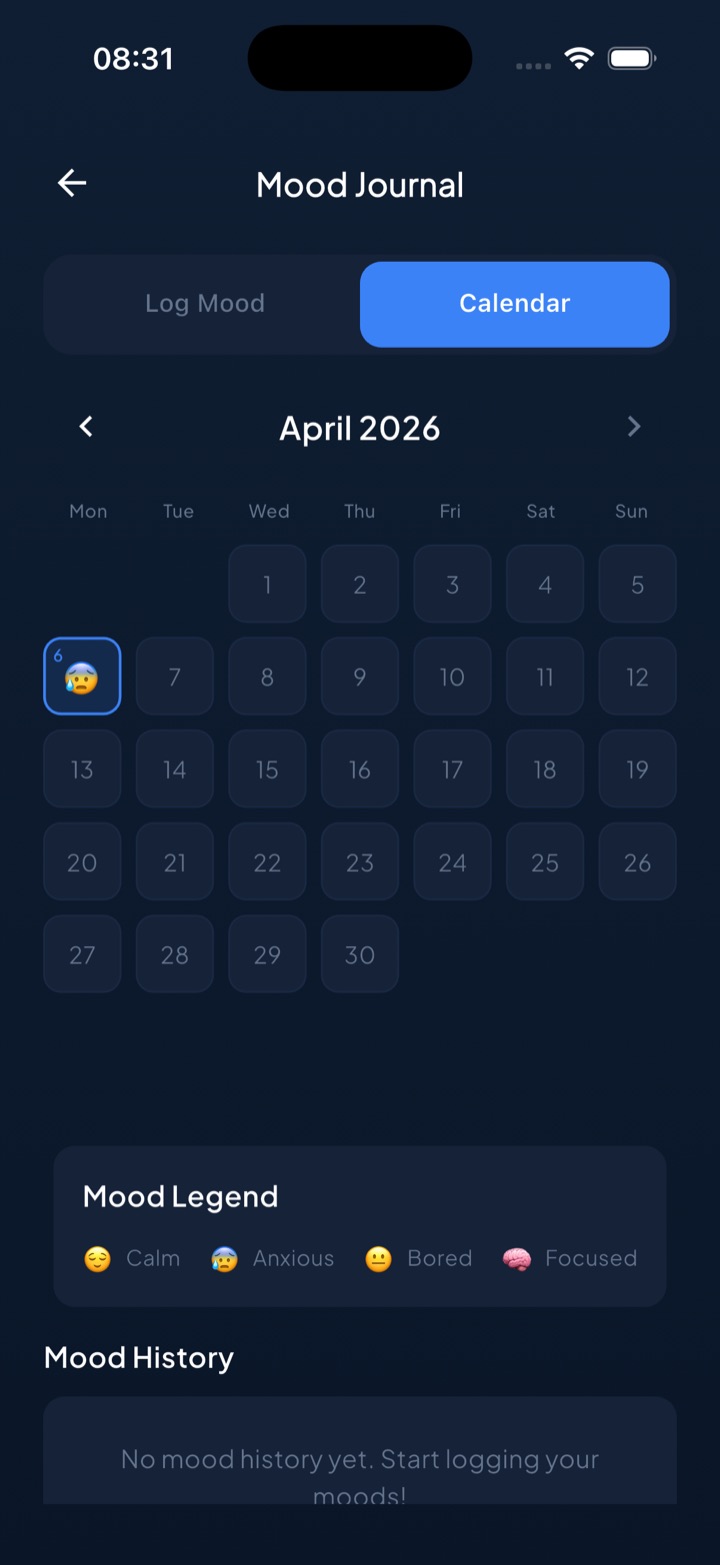
The mood and urge journal is where the boredom work becomes visible — you can log a day as Bored and note that you sat with it instead of escaping, turning a fleeting, invisible practice into something you can see accumulating. Awareness Nudges can prompt you at your peak distraction times, the moments you’re most likely to reach. As always, you don’t need any of this to be bored well — a phone in a drawer and a bit of resolve is the free version. Unscrol just holds the door shut long enough for the practice to take.
Stop treating boredom as a bug to be patched. It’s where your best thinking, and your self-control, quietly get built.
Frequently asked questions
Why is boredom good for your brain?
Boredom pushes your brain into a resting mode where it does some of its most valuable work: making unexpected connections, planning, reflecting, and consolidating experience. Research links mild boredom to increased creativity on tasks that follow it. Boredom is also the raw material of self-control — learning to sit with an uncomfortable, understimulated moment without immediately escaping it is exactly the skill that resists compulsive phone checking. It's discomfort that builds capacity.
What is the default mode network?
The default mode network is a set of brain regions that becomes active when you're not focused on an external task — daydreaming, resting, letting your mind wander. It's associated with autobiographical memory, imagining the future, moral reasoning, and creative incubation. When you fill every idle moment with a feed, you rarely give this network room to run, which may cost you the reflection and idea-generation that happens during unstructured mental downtime.
Would people really rather be shocked than sit alone with their thoughts?
In a striking 2014 study led by Timothy Wilson, many would. Participants left alone in a bare room for 6 to 15 minutes, with the option to self-administer a mild electric shock they'd earlier said they'd pay to avoid, often chose the shock rather than just think. Roughly two-thirds of men and a quarter of women shocked themselves at least once. It shows how uncomfortable unstructured boredom has become — and how little tolerance we've built for it.
How do I get comfortable being bored again?
Rebuild the tolerance in small doses, like reps at a gym. Leave your phone in your pocket during short waits — a line, an elevator, a walk — and simply let the boredom exist. Start with two or three minutes and extend gradually. Expect an itch to reach for stimulation; not acting on it is the whole exercise. Over a few weeks, unstructured moments stop feeling like emergencies and start feeling like space.