You check your phone dozens of times an hour because checking has become a conditioned reflex, not a decision. Screen-tracking studies (notably from RescueTime) put the average at roughly 58 to 96 pickups a day, many lasting only seconds. Each check is a tiny habit loop: a cue (boredom, a buzz, a pause between tasks), the routine (unlock, glance), and a variable reward (sometimes something interesting, usually nothing). Because the reward is unpredictable, the loop resists extinction the way a slot machine does. The good news: since checking is a learned reflex and not a character flaw, it can be un-learned, but not with willpower at the moment of temptation. You break it by removing the cue and the payoff.
How many times do people actually check their phones?
The often-quoted numbers vary because studies measure different things (unlocks, glances, app opens), but they cluster in the same alarming range. RescueTime’s analysis of its users found people interacting with their phones around 58 times a day on average, and other studies of younger adults have logged closer to 80 to 96 pickups. The “100 times” in the headline is a fair round number for a heavy user on a busy day.
Two findings matter more than the exact count:
- Most checks are short and empty. A large share last under a minute and end with nothing accomplished. You didn’t open the phone to do something; you opened it to check whether there was something.
- People underestimate wildly. When researchers compare guessed usage to logged usage, self-reports run roughly half of reality. If you’d have guessed 40 checks, you’re probably closer to 80. This gap is exactly why honest measurement, like comparing your guess to your actual average screen time statistics, is the first step to change.
Why does checking feel automatic?
Because it is automatic in the technical sense: a stimulus reliably triggers a response with almost no conscious mediation. Behavioral psychologists describe habits as a cue-routine-reward loop, and phone checking is a textbook example that runs faster than deliberation.
The engine is the reward’s unpredictability. When a reward arrives on a variable schedule (sometimes yes, sometimes no), the behavior that produces it becomes far more persistent than if the reward were guaranteed. Your feed, your inbox, and your notifications are all variable-ratio machines: most checks return nothing, but the occasional hit, a like, a message, a piece of news, is enough to keep the whole loop firing. The dopamine system, as covered in dopamine and social media, responds most to anticipation of an uncertain reward, not the reward itself. That’s why the itch to check peaks in the seconds before you look.
The cue is often internal and nearly invisible. Gloria Mark’s research on attention shows how thin our tolerance for a single screen has become (attention on any one screen now averages under a minute), and the smallest gap, a loading page, a red light, a lull in conversation, becomes a trigger to reach.
What is micro-boredom and pre-emptive checking?
Watch yourself for a day and you’ll notice most checks aren’t reactions to a notification. They’re reactions to micro-boredom: the two-second void between tasks that used to be filled with nothing and is now filled with a reflexive reach.
This produces pre-emptive checking, glancing at the phone before the boredom even arrives, like checking your messages the instant you sit down on a train, before you’ve had a chance to feel understimulated. The brain has learned that empty moments are uncomfortable and that the phone reliably ends the discomfort, so it acts ahead of the feeling.
The tell is the moment nearly everyone recognizes: the “what was I even opening this for?” blank. You unlock the phone, stare at the home screen, and realize you have no goal. The reach happened; the reason never existed. That blankness is proof the behavior has decoupled from intention entirely, which is both unsettling and useful, because a behavior with no real goal is one you can remove without losing anything.
How do you break a checking habit?
You can’t out-willpower a variable-reward loop in the moment, but you can dismantle its parts. Behavior change here follows one principle: make the cue disappear and the reward harder to reach. This is an extinction protocol, weakening a conditioned response by repeatedly denying it the payoff.
| Loop part | What it is for phone checking | How to break it |
|---|---|---|
| Cue | A buzz, or the internal itch of boredom / a task-pause | Silence non-human notifications; give empty moments a non-phone default |
| Routine | The automatic reach, unlock, and glance | Add physical distance so friction interrupts the reflex |
| Reward | The occasional hit (a like, a message, news) | Move rewarding apps off the home screen or block them during focus |
Then apply it deliberately:
- Kill the notification cues. Turn off every non-human notification (news, games, social likes, promotions). Keep only calls and messages from actual people. Fewer buzzes means fewer triggers, and each silenced app removes a whole branch of the loop.
- Add distance. Put the phone in another room, a bag, or across the desk when you work. Even a few seconds of friction is often enough to let the reflex pass, because the urge to check is short-lived; it fades in about a minute if you don’t feed it.
- Strip the home screen. Move the most rewarding apps (feeds, video, email) off page one and into a folder, or delete them and use the browser. When the payoff isn’t one tap away, many pre-emptive checks die on the home screen.
- Practice urge-surfing. When you feel the reach, name it (“checking urge”) and wait 60 seconds without acting. You’re teaching your brain that the empty moment is survivable, the same muscle explored in how to improve concentration.
- Replace, don’t just remove. Give micro-boredom a different default: a paperback in your bag, a breath, looking out the window. An unfilled void tends to get refilled by the old habit.
You do not need an app for any of this. A drawer, airplane mode, and a deleted Instagram will get most people most of the way. The honest limit of willpower-only methods is the moment of weakness itself, which is where a system that removes the choice, rather than asking you to make it, does the heavy lifting.
“I turned off every notification except texts and moved Instagram off my home screen. The first two days my thumb kept opening an empty pocket of the screen where the icon used to be. By week two I stopped reaching. I didn’t realize how much of it was pure muscle memory.” — Nadia, graphic designer, 29
Turning the reflex off with Unscrol
The hardest part of breaking a checking loop is that the decision happens faster than you do. That’s the gap Unscrol is built to close. Instead of relying on you to resist at the exact wrong moment, it uses Apple’s official Screen Time frameworks (Family Controls and Managed Settings) to put a real system-level shield on the apps you compulsively open, so the reflex reaches an actual wall, not just a soft reminder you can swipe away.
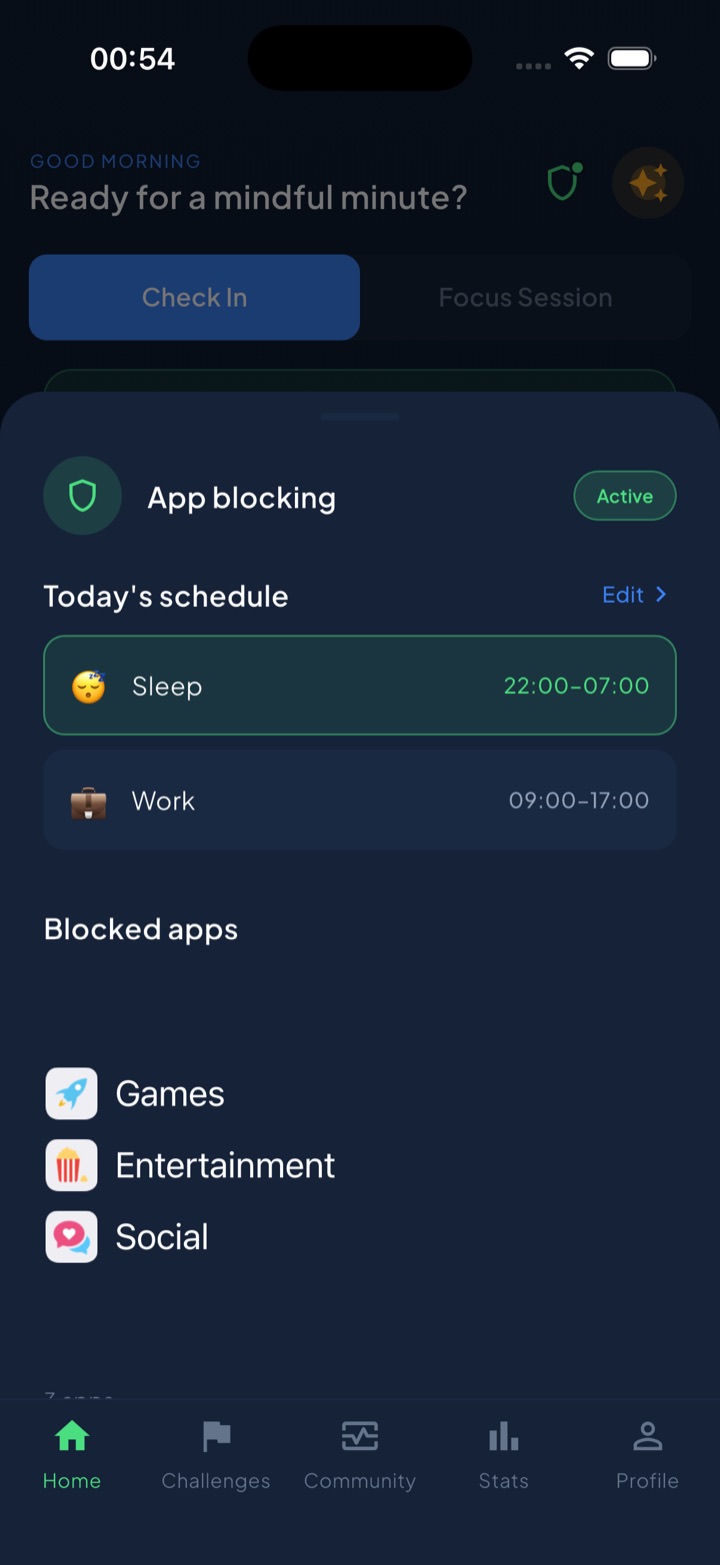
You choose the apps and categories to block, and Unscrol enforces it during focus sessions or on a recurring schedule. The check-in feature also closes the awareness gap by asking you to guess your screen time and compare it to the real number, which is often the first honest look at how many pickups you’re really racking up. None of this requires giving up your data: which apps you block and your usage stats are processed on-device by iOS and never reach Unscrol’s servers.
You can build the same defenses by hand with Apple’s built-in tools and a drawer. Unscrol just makes the wall consistent, so you stop spending willpower on a decision you’d rather not have to make a hundred times a day.
Frequently asked questions
How many times a day does the average person check their phone?
Screen-tracking studies put it at roughly 58 to 96 pickups a day, with younger adults at the high end. Many of these last only seconds and happen without any notification prompting them. The exact number varies by study and measurement method, but nearly all research agrees most people check far more often than they estimate, and underreport it by half when asked to guess.
Why do I check my phone without even deciding to?
Because checking has become a conditioned reflex rather than a choice. A cue (boredom, a pause between tasks, a faint buzz) triggers an automatic routine (unlock, glance) that occasionally delivers a reward (something new). Since the reward is unpredictable, the loop is highly resistant to breaking, the same reinforcement schedule that makes slot machines compelling. Your hand moves before conscious thought catches up.
How do I stop compulsively checking my phone?
Attack the cue and the reward, not your willpower. Turn off non-essential notifications so there is nothing to prompt the check, move the phone out of arm's reach so friction interrupts the reflex, and remove the payoff by deleting the most rewarding apps from your home screen or blocking them during focus windows. Expect a few days of phantom urges before the loop weakens.