You increase your attention span the same way you increase any physical capacity: progressive overload. Start with focus blocks short enough that you can finish them cleanly — often 10 to 15 minutes — then add a few minutes each week until you can hold 45 minutes or more of unbroken single-tasking. Three principles do the work: remove interruptions so a block actually completes, single-task (one thing, phone out of the room), and do boredom reps by sitting with dull moments instead of filling them. Track your longest clean block each day. Most people roughly double their sustained-focus duration within about a month.
Is attention span actually trainable?
Mostly yes, with an honest caveat. Attention is not purely fixed, and it is not infinitely elastic either. It responds to training like a muscle: practice holding focus and your ceiling rises; never practice and it drops. Researcher Gloria Mark’s data shows how far the average has fallen — attention on a screen now lasts roughly 47 seconds — but that number reflects a heavily-trained distraction habit, not a hard biological limit. You spent years training the short span. You can spend weeks training it back.
The caveat: even elite performers have limits. Psychologist Anders Ericsson’s research on deliberate practice suggests that even world-class experts can sustain only around four hours of truly focused work a day, in blocks with real rest between them. The goal is not to focus endlessly. It is to reliably hold a solid, useful block — 45 to 90 minutes — instead of collapsing at two.
The training principles
Five rules make the plan work:
- Progressive overload. Add difficulty gradually. Jumping to a two-hour block on day one is like trying to deadlift triple your bodyweight; you fail and quit.
- Clean completion over length. A finished 12-minute block beats an abandoned 40-minute one. You are training the feeling of sustained focus, so protect the clean rep.
- Single-tasking. One task, one tab. Every switch leaves attention residue, so multitasking is not a smaller rep — it resets the set.
- Boredom reps. Between formal blocks, stop filling micro-gaps with the phone. These build the tolerance that deep focus runs on.
- Rest between reps. Focus is depleting; recovery is part of the training. The well-known DeskTime pattern (~52 minutes on, ~17 off) and shorter Pomodoro cycles both build in real breaks for a reason.
The 4-week plan
Do one to three blocks a day. The lengths are guidelines — start wherever you can complete a block without a single phone check.
| Week | Block length | Blocks/day | Goal |
|---|---|---|---|
| Week 1 | 15 minutes | 2 | Finish every block phone-free; get the clean-rep feeling |
| Week 2 | 25 minutes | 2–3 | Hold a standard Pomodoro without switching tasks |
| Week 3 | 35 minutes | 2 | Push past the first urge to check; ride it out |
| Week 4 | 45–50 minutes | 1–2 | Sustain a real deep-work block start to finish |
Rules that apply every week: phone in another room, one task per block, and a genuine break between blocks — walk, look out a window, do not scroll. If a block falls apart, do not judge it; just note where it broke and repeat that length rather than advancing. When you can comfortably hold 45 minutes, you have the raw capacity for real deep work; extend only if your work needs it.
How do you measure progress?
Keep a one-line log: your longest clean block each day. Clean means one task, zero phone checks, no switching. That single number is the honest measure — not hours “at your desk,” which multitasking inflates. Watching it climb from 12 to 35 minutes over three weeks is concrete proof the training works, and the proof is its own fuel, the same way a visible count keeps any habit alive. If you also run timed Pomodoros, the Pomodoro technique gives you a ready-made structure to log against.
Common mistakes that stall progress
- Starting too long. The most common error. If you can’t finish it phone-free, it’s too long. Shrink it.
- The “quick check.” Glancing at your phone mid-block doesn’t pause the rep — it ends it. One check restarts the clock on residue-free focus.
- Counting multitasking as focus. Two tabs is not a longer block; it’s a broken one.
- No rest. Skipping breaks leads to a mushy, unfocused hour that trains nothing. Rest is not cheating; it is the second half of each rep.
- Judging bad days. Sleep, stress, and hunger all shrink your span on a given day. A short day is data, not failure. If focus never improves at all, revisit the underlying causes in why can’t I focus anymore.
What you can do for free
Everything above needs exactly two things you already have: a timer and a way to get your phone out of reach. Set a kitchen timer, put the phone in another room, and keep the log on a sticky note. That is a complete, no-cost attention-training program. A tool only earns its place if the phone keeps sabotaging the block — if “in another room” quietly becomes “in my pocket” by Wednesday, and the block collapses because the feed is one tap away.
How Unscrol supports the training
Two parts of the plan are hard to protect with willpower alone: keeping the block interruption-free, and taking a real break instead of a scroll break. Unscrol handles both. During a focus session it uses Apple’s official Screen Time frameworks to shut your distracting apps for the block’s duration, so a clean rep stays clean. When the block ends, its break timer runs a short Live Activity countdown on your Lock Screen — a rest that ends on its own instead of turning into a lost half-hour.
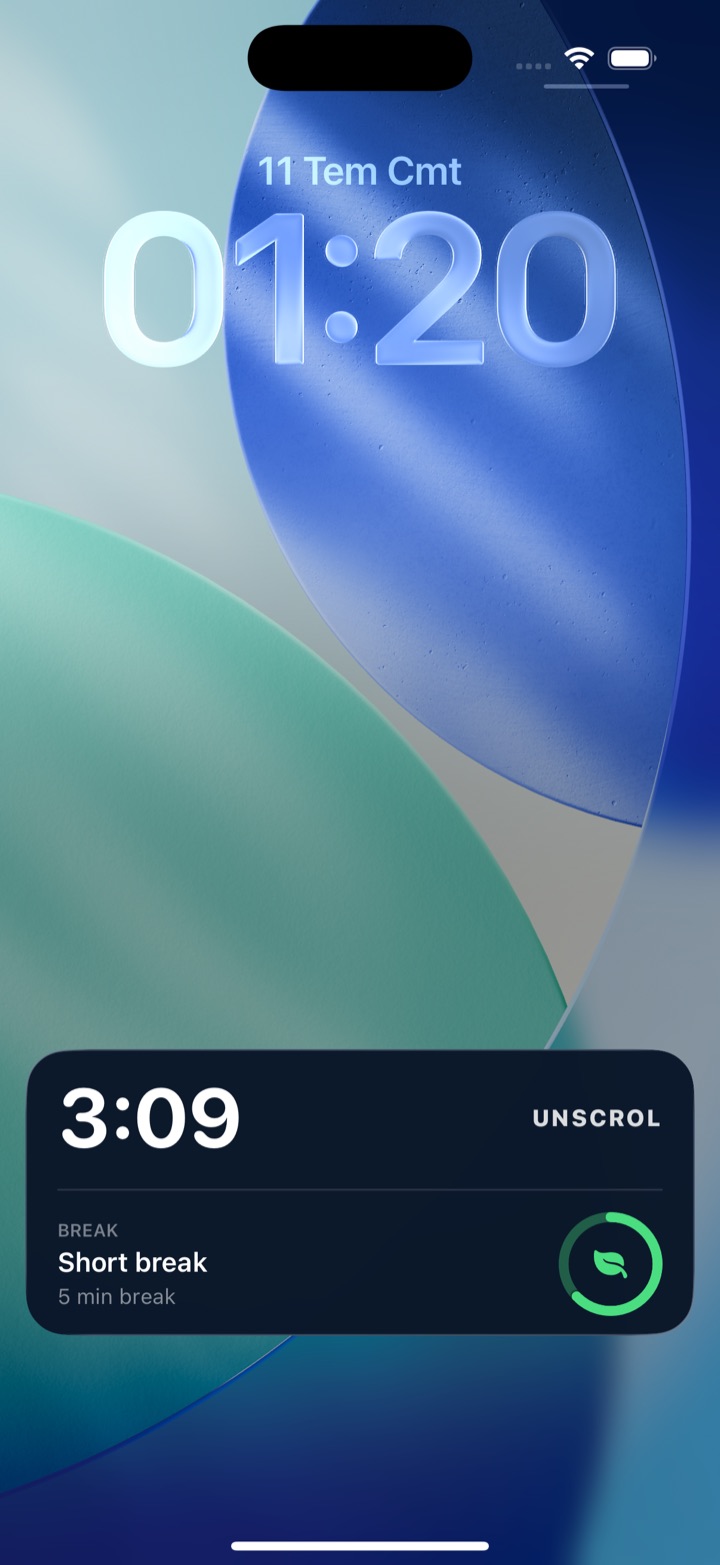
You can replicate this with a timer and some discipline. The app just guarantees the block and the break, which is exactly the pair that willpower drops first when you are tired.
Train the span like a muscle: short clean reps, a few more minutes each week, and real rest in between. In a month you will not recognize your old two-minute ceiling.
Frequently asked questions
Can you actually train your attention span?
Yes, within limits. Attention behaves more like a trainable capacity than a fixed trait: the more you practice holding focus without interruption, the longer you can hold it. The key is progressive overload, the same principle as strength training. You start with focus blocks short enough to finish cleanly, then add a few minutes each week. Most people meaningfully extend their sustained focus in about a month.
How long should a beginner focus block be?
Shorter than you think. Start with a block you can complete without checking your phone even once, which for many people is 10 to 15 minutes. Finishing a short block cleanly trains the skill; abandoning a long one halfway trains failure. Once you can hold the short block reliably for a few days, add five minutes. The clean completion matters far more than the length.
What are boredom reps?
Boredom reps are deliberately sitting through small dull moments, like a queue or an elevator ride, without reaching for your phone. Tolerating boredom is the same skill as tolerating the discomfort of a hard task, so each rep strengthens attention. Filling every empty second with stimulation does the opposite: it trains your brain to demand a new hit the moment focus gets slightly uncomfortable.
How do I measure my attention span improving?
Track your longest clean focus block each day, meaning the longest stretch you held one task with no phone checks and no task-switching. Write down the number. Watching it climb from, say, 12 minutes to 35 over a few weeks is concrete evidence and its own motivation. A single interruption ends a block, so this also trains you to protect the block, not just endure it.