Habit stacking means attaching a new habit to one you already do, using a single formula: After I [current habit], I will [new habit]. It works because your existing habit is already an automatic cue that fires reliably every day, so the new behavior borrows that reliability instead of depending on a fresh trigger you have to remember. James Clear popularized the phrase in Atomic Habits, building on BJ Fogg’s idea of anchoring a tiny behavior to an existing routine. The single biggest predictor of whether a stack sticks is the anchor: it must be specific, daily, and tied to one clear moment.
What is habit stacking, exactly?
Every day you already run dozens of rock-solid habits without thinking — you brush your teeth, pour coffee, sit at your desk, get into bed. Each of those is a reliable cue that already exists. Habit stacking hijacks that reliability. Instead of hoping you will remember to meditate “sometime,” you bolt it onto a cue that never forgets to fire:
After I pour my morning coffee, I will take three slow breaths.
The coffee is the anchor. The breaths are the new habit. You are not building a new trigger from scratch — the hard part of any habit — you are renting one that already works. This is why stacking is the lowest-effort way to install a behavior, and why it pairs naturally with the mechanics in how to build better habits.
Why do habit stacks beat scheduling?
Scheduling (“I’ll journal at 8pm”) sounds organized but leans on two fragile things: being in the right place at that time, and remembering. Life ambushes both. An anchor sidesteps them because the cue is a behavior, not a clock. When the anchor happens, the prompt happens — automatically, wherever you are.
This connects directly to BJ Fogg’s behavior model, where a prompt is one of the three things any behavior needs. A stack solves the prompt problem for free. If you want the full mechanics of why prompts drive behavior more than motivation does, see the Fogg behavior model.
15 habit stacks you can steal
Keep the new behavior small enough that it is hard to refuse. You can always do more once the stack fires.
Focus and work
- After I sit down at my desk, I will start one focus session before opening email.
- After I close my laptop, I will write the first line of tomorrow’s top task.
- After I finish lunch, I will do one 25-minute deep-work block before anything else.
Digital wellbeing
- After I get into bed, I will plug my phone in across the room.
- After I unlock my phone out of boredom, I will ask “what was I opening this for?”
- After I sit on the couch, I will put my phone face-down on the far cushion.
- After I wake up, I will keep the phone off until I have washed my face.
- After I open a social app for no reason, I will close it and take one breath.
Body and mind
- After I pour my morning coffee, I will write my top task for the day.
- After I brush my teeth at night, I will lay out tomorrow’s clothes.
- After I take off my work shoes, I will do ten push-ups.
- After I get in the car, I will start the audiobook, not the feed.
Wind-down
- After I finish dinner, I will set my phone to grayscale for the night.
- After I set my morning alarm, I will read one page of a paper book.
- After I turn off my desk lamp, I will write one line about how the day went.
Notice the pattern: every anchor is a single, specific moment, and every new habit is tiny. That is the entire skill.
How do you build your own stack?
Four steps.
- Pick a specific anchor. It must happen every day, at one clear moment, in the right place. “After I finish my morning coffee” beats “in the morning.”
- Match location and energy. Do not stack a workout onto an anchor that happens when you are exhausted, or a quiet-focus habit onto a chaotic one. The anchor’s context should fit the new behavior.
- Keep the new habit tiny. Start with the two-minute version. A stack that is too ambitious dies fast; see the two-minute rule for how small it should be.
- Write it as one sentence. “After I [anchor], I will [behavior].” If you can’t fill both blanks with something specific, the stack isn’t ready.
Why do habit stacks fail?
Almost always, it is the anchor. Here is the fix in one table:
| Weak anchor (fails) | Specific anchor (works) |
|---|---|
| After I get home | After I hang up my keys |
| In the morning | After my coffee finishes brewing |
| When I have time | After I close my laptop |
| Before bed | After I plug in my phone across the room |
| At the gym | After I put my water bottle on the rack |
The other failure modes: stacking a habit that is too big (shrink it), choosing an anchor in the wrong place or mood (move it), and piling three new habits onto one anchor at once (add them one at a time — let each become automatic first). Habit-formation research from University College London found it takes on average around 66 days for a behavior to feel automatic, with a wide range, so give each stack weeks, not days, before judging it.
Do you need an app for habit stacking?
No — this is one of the most genuinely free techniques in behavior change. A sticky note with three “After I… I will…” sentences on your bathroom mirror is a complete habit-stacking system. Where a tool helps is with the digital-wellbeing stacks that require friction to hold: it is easy to write “after I open a social app for no reason, I will close it,” and much harder to actually close it in the moment. That is the one place an app adds something a sticky note cannot.
How Unscrol keeps your stacks visible
A stack only works if the cue is reachable and the payoff is visible. Unscrol supports the digital-wellbeing side of your stacks in two ways. First, the daily check-in and unified streak give your “after I…” habits a satisfying reward to land on, so the behavior gets reinforced each time it fires. Second, its Apple Screen Time blocking and scheduled routines hold up the friction-based stacks — the ones like “after I sit at my desk, I will start focus” work far better when the distracting apps are actually shut during that window, instead of one tap away.
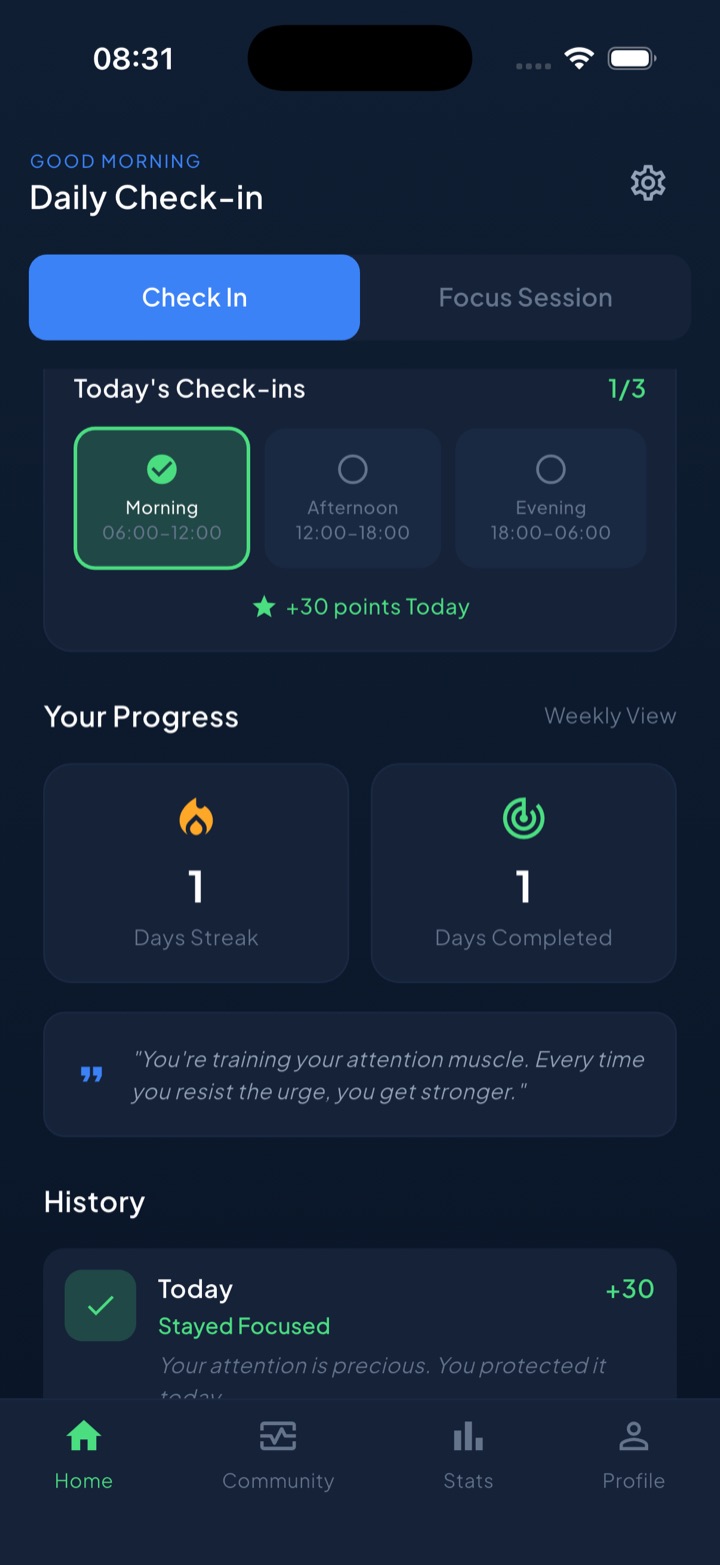
You can absolutely run all of this on paper. The app just keeps the reward and the friction in place so the stacks you built do not quietly erode.
Pick one specific anchor, bolt one tiny habit to it, and let a cue you already have do the remembering for you.
Frequently asked questions
What is habit stacking?
Habit stacking is attaching a new habit to one you already do, using the formula After I [current habit], I will [new habit]. Your existing habit is already an automatic cue that fires every day, so you borrow its reliability instead of inventing a brand-new trigger and hoping you remember it. James Clear popularized the term, building on BJ Fogg's idea of anchoring a tiny behavior to an existing routine.
What is a good habit stacking example?
A strong stack pairs a specific daily anchor with a tiny new behavior. Examples: After I pour my morning coffee, I will write my top task for the day. After I sit down at my desk, I will start one focus session. After I get into bed, I will plug my phone in across the room. Each anchor happens at one clear moment, which is what makes the new habit reliable.
Why does habit stacking work better than scheduling?
A schedule depends on you being in the right place and remembering at the right time, which willpower and memory often fail to deliver. An anchor habit already fires automatically every day, so the new habit inherits that reliability. You are not adding a new alarm to your life; you are riding one that already goes off, which is why stacks survive busy and low-motivation days.
Why does my habit stacking keep failing?
The usual culprit is a vague anchor. After I get home is fuzzy because home involves twenty different moments; After I hang up my keys is a single, specific one. Other common failures are choosing an anchor in the wrong location or energy state, making the new habit too big, or stacking several new habits onto one anchor at once. Fix the anchor first.