BJ Fogg’s model says a behavior happens only when three things line up at the same instant: Motivation, Ability, and a Prompt — B=MAP. You pick up your phone without deciding to because all three are almost always maxed. A prompt fires constantly (a buzz, a badge, or just seeing the screen), your ability is near-total (one thumb unlocks a feed), and motivation spikes the moment you feel bored or anxious. When all three cross the threshold together, the pickup runs on autopilot. To change the habit you do not need more willpower — you redesign one of the three variables: cut the prompt, add friction to drop ability, or lower the pull of the craving.
What is the Fogg Behavior Model (B=MAP)?
Stanford behavior scientist BJ Fogg spent two decades studying what actually makes people do things. His conclusion collapses into one equation: B = MAP. A behavior (B) occurs when Motivation, Ability, and a Prompt converge at the same moment. Miss any one and nothing happens.
- Motivation — how much you want to do it right now. It rises and falls constantly.
- Ability — how easy it is to do. The easier something is, the less motivation you need.
- Prompt — the trigger that says “do it now.” Without a prompt, even a motivated, capable person does nothing.
The practical genius is that motivation is the worst of the three to depend on, because it swings hour to hour. Fogg’s advice is to stop trying to pump up motivation and instead make the behavior easier (raise ability) and better prompted. That single reframe is the whole model.
Why does your phone win every time?
Look at your phone through B=MAP and the addiction stops feeling mysterious. All three variables are permanently turned up:
| Variable | Why the phone maxes it | How to break the scroll |
|---|---|---|
| Prompt | Notifications, badges, buzzes, and the mere sight of the screen all fire constantly | Turn off notifications; keep the phone out of sight |
| Ability | Unlock and scroll takes one thumb and zero thought | Log out, delete apps, add distance and friction |
| Motivation | Boredom, stress, and loneliness spike the urge many times a day | Address the feeling directly; have a better default ready |
This is why “just have more discipline” fails. Discipline is an attempt to fight a maxed prompt and maxed ability using the one weak lever, motivation. The phone was designed by teams who understand B=MAP better than you do. The fix is to redesign your side of the equation.
How do you redesign each variable?
You do not need to attack all three. Weakening even one drops the behavior below the line.
Cut the prompt. This is the fastest, highest-return move. Turn off every non-human notification. Take social, news, and video apps off the home screen so the visual prompt disappears. During focused work, put the phone in another room — you cannot be prompted by a screen you cannot see. Most people who do only this report a noticeable drop in mindless pickups within days. For the fuller version, see how to stop phone addiction.
Lower the ability (add friction). Make the scroll harder than the alternative. Log out of the stickiest apps so re-entry costs a password. Delete the two worst offenders and use them only in a browser. Use an app blocker during the hours you want protected. Each step raises the ability cost just enough that the behavior needs motivation you often will not have in that moment.
Address the motivation honestly. The urge usually rides on a feeling — boredom, anxiety, avoidance. You cannot design that away, but you can name it and have a better default queued. When the boredom prompt fires, a book on the desk or a two-minute walk is the behavior you want to be easiest.
What are Tiny Habits recipes?
For the good habits you want, Fogg flips the same model into a recipe you can install in a week. The format is: After I [existing routine], I will [tiny new behavior] — then celebrate.
- The existing routine is your prompt (it already fires reliably every day).
- The tiny size keeps ability high, so you barely need motivation.
- The celebration — a quiet “nice” or a fist pump — wires in the good feeling that makes it stick.
Phone-friendly recipes:
- After I close my laptop, I will put my phone on the shelf across the room.
- After I sit down at my desk, I will start one short focus session.
- After I get into bed, I will plug my phone in outside the bedroom.
- After I pour my morning coffee, I will leave my phone face-down for ten minutes.
Notice how small each one is. Fogg’s rule is to make the starter behavior so tiny it feels almost silly to skip. Anchoring a new behavior to an existing one is the same mechanic behind habit stacking — you borrow a prompt you already own instead of inventing one and hoping you remember it.
Why designing beats waiting to feel motivated
Fogg describes a motivation wave: motivation surges and crashes throughout the day. If your good habit requires high ability and high motivation at the same time, it only happens on your best days. Design for the trough instead. Make the behavior tiny enough that it works even when you feel like doing nothing, and let motivation be a bonus when it shows up rather than a prerequisite. This is why “read one page” beats “read for an hour,” and why a two-minute focus start beats a planned three-hour block.
Do you need an app for any of this?
No. The two most powerful moves — cutting prompts and writing Tiny Habits recipes — cost nothing. Turn off notifications tonight, move apps into the App Library, set Apple’s built-in Downtime, and write three “After I… I will…” recipes on a sticky note. That alone rewires most of the B=MAP equation. An app matters mainly for the ability lever, because Apple’s own Screen Time limits are easy to tap past in a weak moment. If your problem is that friction keeps collapsing the second you feel the urge, that is where a firmer blocker earns its place.
How Unscrol redesigns the equation for you
Unscrol is, in effect, a B=MAP machine pointed the right way. It uses Apple’s official Screen Time frameworks to block chosen apps, which lowers ability on distraction to near-zero — the shield is system-level, not a reminder you can dismiss. Awareness Nudges act as intentional prompts at your peak distraction times, and the daily check-in is itself a tiny anchored behavior with a built-in celebration when the streak ticks up. Scheduled routines like Work 09:00–17:00 handle the prompt-and-ability side automatically during the hours you choose.
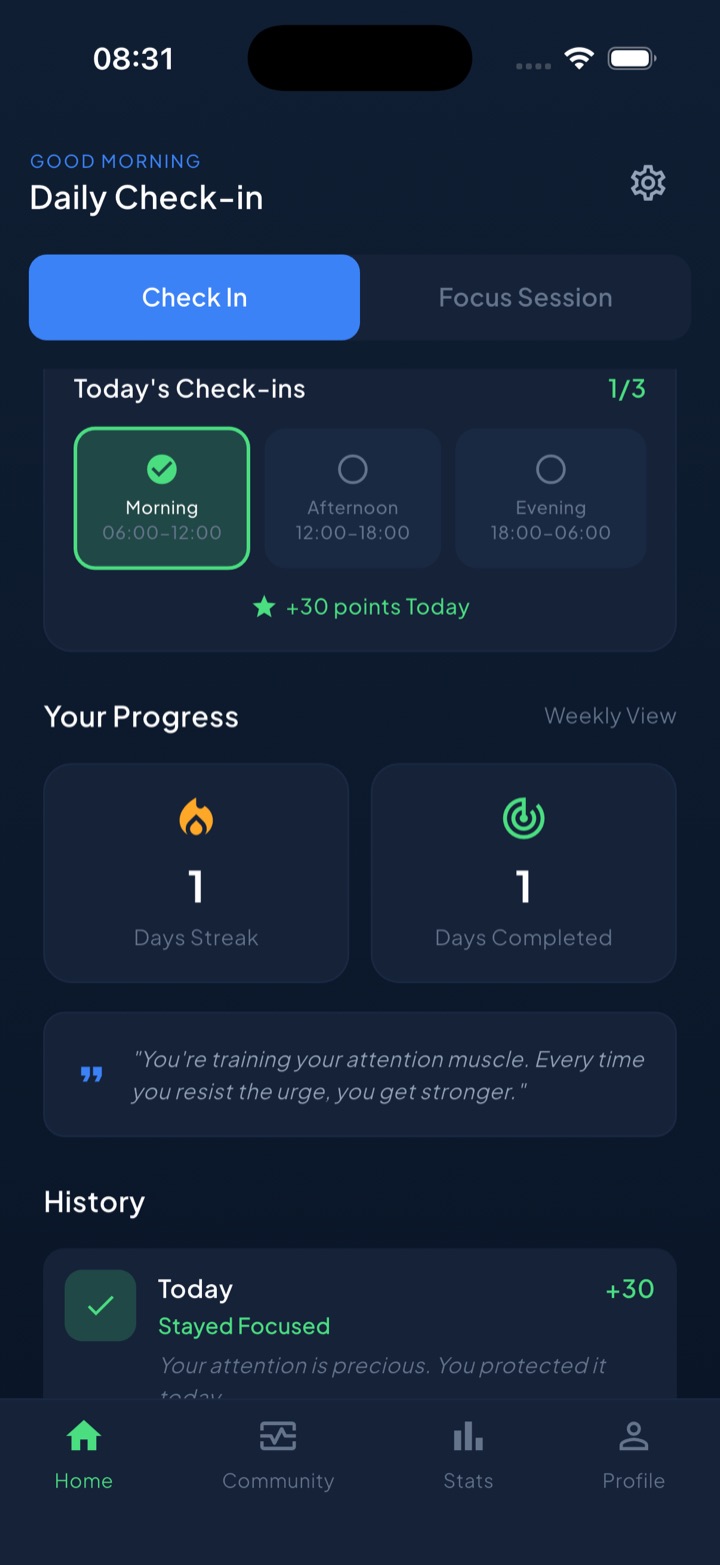
In Unscrol the whole loop stays visible, but you can build the same thing by hand: notifications off, phone across the room, and three Tiny Habits recipes taped to your monitor.
Stop trying to want it more. Change the prompt, change the ability, and let the behavior follow.
Frequently asked questions
What is the Fogg Behavior Model?
The Fogg Behavior Model, created by Stanford researcher BJ Fogg, states that a behavior happens only when three things converge at the same moment: Motivation, Ability, and a Prompt. Fogg writes it as B=MAP. If any one of the three is missing, the behavior does not occur. It is a design tool: to change any behavior, you change one of those three variables rather than relying on willpower.
Why do I pick up my phone without deciding to?
Because all three ingredients of the Fogg Behavior Model are maxed out. A prompt fires constantly (a notification, a buzz, or just a glance at the screen), your ability is near-total (unlocking and scrolling takes one thumb), and motivation spikes whenever you feel bored or anxious. When motivation, ability, and prompt all cross the line together, the pickup happens automatically, no conscious decision required.
What is a Tiny Habits recipe?
A Tiny Habits recipe is BJ Fogg's format for installing a new habit: After I [existing routine], I will [tiny new behavior], and then I celebrate. The existing routine is the prompt, the tiny size keeps ability high so you barely need motivation, and the celebration wires in a good feeling. Example: After I close my laptop, I will put my phone on the shelf across the room.
How is the Fogg model different from just using willpower?
Willpower relies on motivation, which Fogg shows is the least reliable of the three variables because it rises and falls hour to hour. The model's key move is to design for low-motivation moments by making the good behavior tiny (high ability) and anchoring it to a prompt you already have. You engineer the situation instead of trying to want it more.