Environment design is the practice of shaping your surroundings so the good choice becomes the easy one and the bad choice takes effort. Instead of relying on willpower to resist your phone a hundred times a day, you put it in another room; instead of fighting the urge to scroll, you delete the app from your home screen so opening it takes real steps. The behavioral scientist Wendy Wood has shown that a large fraction of daily behavior runs on autopilot, cued by context rather than chosen in the moment. Redesign the context, and the behavior changes without a fight.
What is environment design?
Every behavior is prompted by a cue in your environment: the couch cues relaxing, the visible phone cues checking, the open tab cues scrolling. Willpower operates after the cue fires — it’s the effortful, unreliable attempt to override a pull that’s already started. Environment design operates before the cue: it removes the trigger or adds friction so the pull is weaker or never starts.
The reframe is important. Most people treat self-control as a character trait — you either have discipline or you don’t. But studies of highly self-controlled people find something counterintuitive: they don’t report resisting more temptation than everyone else. They report encountering less of it. They’ve arranged their lives — homes, desks, phones, routines — so the tempting option simply isn’t in front of them. Their secret isn’t a stronger will; it’s a better-designed environment. This is the practical core of how to build better habits.
How much of what you do is really you deciding?
Wendy Wood’s research is the anchor here. Across studies tracking people’s daily behavior, she and colleagues estimated that roughly 40 percent or more of everyday actions are performed habitually — in the same context, cued automatically, without a fresh decision. You don’t decide to check your phone at a red light or reach for it when a conversation lulls. The context decides, and you follow.
That number reframes the whole problem. If most behavior is context-triggered, then trying to change behavior through conscious choice is fighting a small, tired part of your brain against a large, automatic one. Change the context instead and you’re working with the automatic system. This is why “just decide to scroll less” reliably fails, while moving the app two folders deep quietly works — one relies on the 40% you don’t control, the other edits it.
Is willpower even real? The honest version
You’ll hear willpower described as a muscle that gets tired — the theory of ego depletion, associated with Roy Baumeister, which held that self-control draws on a limited resource you can exhaust (the famous radish-and-cookies experiments). It’s a compelling idea, and it may capture something real about mental fatigue.
But honesty requires a caveat: ego depletion has struggled to replicate. Large multi-lab attempts to reproduce the classic effect have produced weak or null results, and the field is genuinely divided on how strong, or even real, the effect is. So don’t build your life around “conserve your willpower for the afternoon” as if it were settled science.
Here’s the thing, though: the practical conclusion is the same either way. Whether willpower is a depletable fuel tank or just an unreliable, effortful process, the smart move is to depend on it as little as possible. Design an environment that doesn’t demand constant self-control, and the debate stops mattering for your daily life.
The 20-second rule: friction is the lever
The most actionable principle in environment design is that behavior is exquisitely sensitive to small amounts of friction. Researcher Shawn Achor popularized this as the “20-second rule”: adding or removing roughly 20 seconds of effort can decide whether a habit happens.
It cuts both ways:
- Add friction to bad habits. Log out of social apps so you must re-enter your password. Delete them from the phone and use only the browser. Leave the phone in another room. Each added step is a chance for the urge to pass.
- Remove friction from good habits. Lay out your gym clothes the night before. Leave your book on the pillow. Keep the document open and the timer ready so a focus session starts in one tap.
Twenty seconds sounds trivial, which is exactly why it’s underused. But an impulse is a short-lived thing; make the tempting action take a little longer to begin, and it often expires before you complete it. Friction is the quietest and most reliable lever you have — and it’s the same mechanic behind commitment devices, just applied in smaller doses.
A room-by-room and screen-by-screen redesign checklist
Walk through your actual spaces and edit the cues:
Bedroom
- Charge the phone outside the room; use a separate alarm clock.
- Put a book on the nightstand where the phone used to live. This is the backbone of a phone-free morning routine.
Desk / workspace
- Phone out of sight and out of reach — a drawer or another room, not face-down beside you.
- One tab, one task. Close everything not needed for the current job.
- Keep what the good habit needs (notebook, water, timer) already set out.
Kitchen / living room
- Designate a “phone parking spot” by the door so it’s not in your hand by default.
- Leave a puzzle, instrument, or book in the spot where you’d normally reach for a screen.
The phone itself
- Home screen holds only tools (maps, camera, notes). No feeds, no games.
- Delete the most magnetic apps entirely; access them via browser if at all, which is deliberately clunkier.
- Grayscale, notifications off for everything non-human, tempting apps buried in a back-page folder.
The pattern is always the same: put one more step between you and the thing you want less; take one step away from the thing you want more.
How Unscrol redesigns your phone’s environment for you
The hardest environment to control is the phone, because the tempting apps live on the same device you need for everything else — you can’t just leave the useful part in another room. Unscrol solves this by editing the phone’s environment on a schedule, using Apple’s Screen Time frameworks to actually shield chosen apps and categories during the windows you set.
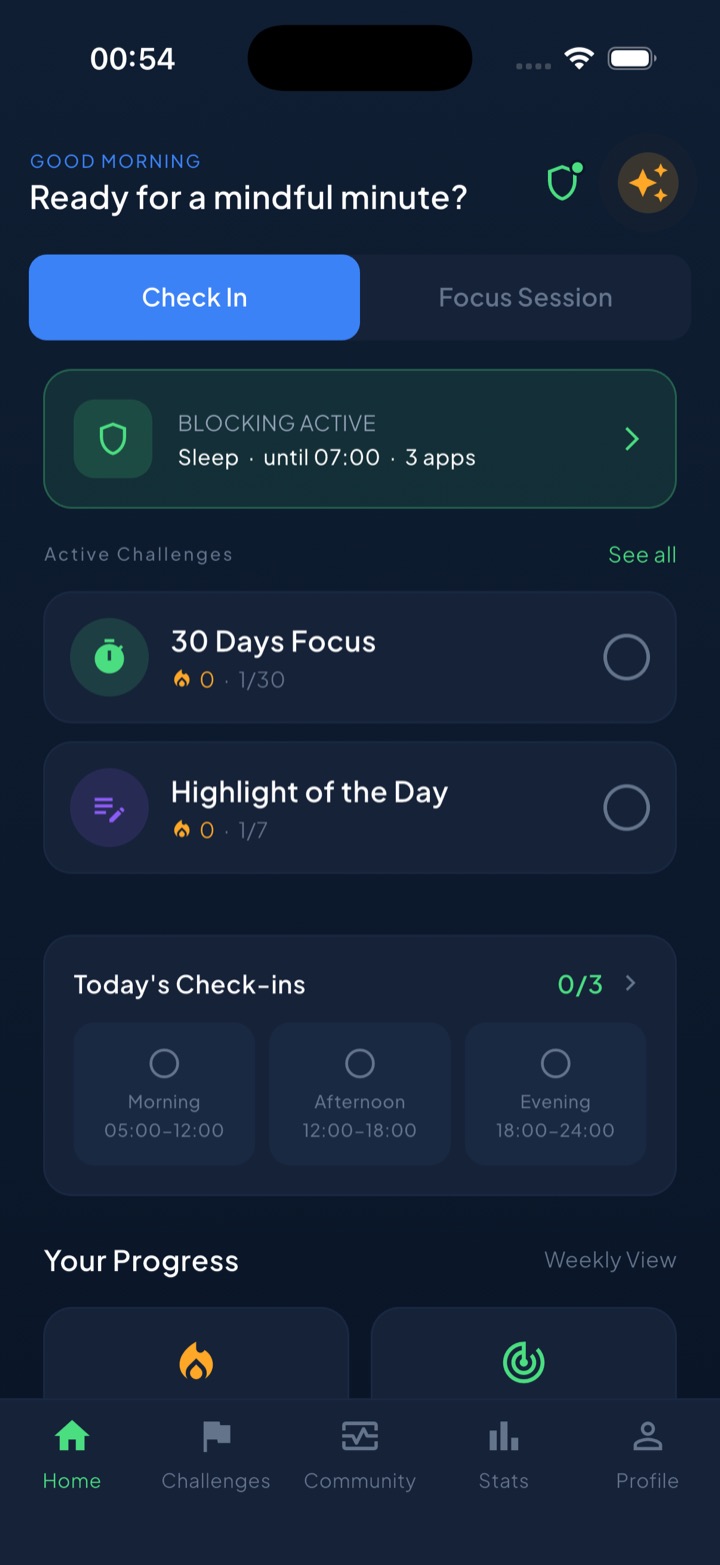
Scheduled blocking routines are environment design made automatic: define Work 09:00–17:00 or Sleep 22:00–07:00 once, and the tempting apps simply aren’t available during those hours — the maximum version of the 20-second rule, where the friction is a wall. You’re not resisting anything at 11pm; the option isn’t there. It’s the same logic as putting your phone in another room, except the useful half of the phone stays with you.
You genuinely don’t need an app to start. Moving your charger to the kitchen tonight, deleting one feed, and setting a book on your pillow are free, and they work. Unscrol just handles the one part of your environment — the apps on the device in your hand — that’s otherwise almost impossible to redesign by hand.
Stop trying to win the fight in the moment. Rearrange the room so the fight never starts.
Frequently asked questions
What is environment design in habit building?
Environment design means shaping your physical and digital surroundings so good behaviors are easy and bad ones are hard, instead of relying on willpower in the moment. It includes keeping tempting apps off your home screen, leaving your phone in another room, and setting out what you need for a good habit in advance. The idea is to change the context that cues behavior rather than trying to resist cues one by one.
Is environment or willpower more important for building habits?
For most everyday behavior, environment wins. Research by Wendy Wood suggests a large share of daily actions are habits triggered automatically by context, not conscious choices. Willpower is a limited, unreliable resource, while a well-designed environment works even when you're tired or distracted. The most self-controlled people tend to structure their lives to face fewer temptations, not to out-muscle them.
What is the 20-second rule?
The 20-second rule, popularized by researcher Shawn Achor, is the idea that adding or removing about 20 seconds of friction can make or break a habit. Make a good habit start 20 seconds faster and you're far more likely to do it; make a bad habit take 20 seconds longer to begin and you'll often skip it. Small changes in effort have outsized effects on behavior.
How do I reduce screen time without relying on willpower?
Change the environment so scrolling takes effort and focus doesn't. Delete tempting apps from your home screen or log out so they take extra steps to reach, keep your phone in another room while you work, and put a book or notebook where your phone used to sit. Blocking distracting apps during set hours removes the choice entirely, which beats deciding fresh every time.