A commitment device is any arrangement you set up in advance that makes it harder for your future self to give in to temptation. You lock savings in an account with withdrawal penalties, hand a friend your game controller until the weekend, or block distracting apps during work hours. The logic is old and clever: your present self is motivated and clear-headed, while your future self will be tired, tempted, and looking for excuses. Rather than trusting that future self to resist, you bind them now — you make the bad choice expensive or impossible before the moment of weakness arrives.
What is a commitment device, really?
The core problem commitment devices solve is preference reversal. Sitting here now, you sincerely prefer to study tonight over scrolling. But at 9pm, with the work in front of you and your feed one tap away, your preference flips — the scroll wins, and your morning self would be appalled. Both selves are “you”; they just want different things at different moments.
Economist Thomas Schelling, who studied strategy and self-control, described this as bargaining between multiple selves. A commitment device is how the far-sighted self gains the upper hand: it removes options from the future menu so the tempted self can’t choose them. You’re not becoming more disciplined. You’re arranging things so discipline is needed less.
This is a completely different move from setting a goal or trying harder. A goal asks your future self to behave. A commitment device doesn’t ask — it constrains.
The oldest example: Ulysses and the mast
The classic illustration comes from Homer. Ulysses wanted to hear the Sirens’ song, which lured sailors to steer onto the rocks and die. He knew that in the moment he’d be overwhelmed, so he made a plan while his judgment was clear: he had his crew plug their ears with wax, tie him to the mast, and refuse to release him no matter how much he begged. He got to hear the song and survive — because he’d removed his own ability to act on the temptation.
A Ulysses pact (or Ulysses contract) is this exact structure applied to modern life. You decide, while calm and motivated, to bind yourself against a lapse you know is coming. Every good commitment device is a mast of some kind: the app you can’t open, the money you can’t withdraw, the deadline you can’t push. The wisdom isn’t in resisting the Sirens — it’s in admitting you won’t resist them and planning accordingly.
Soft vs. hard commitment devices
Not all masts hold. The single biggest predictor of whether a commitment device works is how easy it is to escape.
| Soft commitment | Hard commitment | |
|---|---|---|
| What it relies on | Reminders, promises, guilt | Real friction, cost, or lockout |
| Escape in the moment | Easy — ignore or tap past it | Hard — you’d have to pay or wait |
| Example | A screen-time warning you can dismiss | An app that is actually blocked |
| Example | A note that says “study tonight” | Money you forfeit to a friend if you don’t |
| Failure mode | You override it and feel a little bad | Overusing loopholes; picking too-harsh a penalty |
| Works because | Occasionally jogs your memory | Doesn’t depend on willpower at temptation |
The lesson from behavior research is blunt: soft commitments leak. A reminder you can ignore is a reminder you will ignore on the day it matters most. This is exactly why built-in screen-time reminders so often fail — anything with a one-tap escape hatch is only as strong as your weakest moment, which is precisely the moment it needs to hold. (More on that in why screen time limits don’t work.)
What does the research say?
Three lines of evidence stand out:
- Costly deadlines beat free ones. Behavioral economists Dan Ariely and Klaus Wertenbroch let one group of students set their own deadlines for papers, with penalties for lateness they imposed on themselves. Students who set earlier, self-binding deadlines performed better than those given a single deadline at the end of term. People will voluntarily pay to constrain their own future procrastination — and it helps.
- Locked savings raise savings. In a field experiment in the Philippines, researchers including Nava Ashraf and Dean Karlan offered a savings account that restricted withdrawals until a goal was met. People who took it saved substantially more. Removing the option to dip in was the whole benefit.
- Stakes with a referee. Commitment platforms like stickK (co-founded by Karlan) let people put money on the line, forfeited to a cause they hate if they fail, with a friend verifying. Public stakes and real financial loss consistently improve follow-through — loss aversion, harnessed on purpose.
The through-line: commitment works best when breaking the promise carries a real, immediate cost you set up in advance.
App blocking as a modern mast
For phone habits, the app blocker is the cleanest Ulysses pact available. You decide during a calm moment which apps sabotage your focus, and you block them for a window — so at 9pm, opening them isn’t a matter of willpower, it’s a locked door. The temptation still calls; you just can’t steer onto the rocks.
To make it a hard commitment rather than a soft one:
- Choose the apps while you’re motivated, not in the moment you crave them.
- Set a fixed window (a focus session, or a recurring schedule like work hours), so the block isn’t yours to lift on a whim.
- Add friction to the escape. The harder it is to disable the block, the more it functions like a real mast. If turning it off takes ten calm minutes, most cravings pass before you get there.
- Escalate gradually. Start with one block window a day; widen it as it proves it holds. See how to block apps on iPhone for the mechanics.
How Unscrol acts as your commitment device
Unscrol is essentially a mast you tie yourself to on purpose. Using Apple’s official Screen Time frameworks (Family Controls and Managed Settings), it puts real system-level shields on the apps and categories you pick — not overlay reminders you can swipe away, but actual blocks. That’s the difference between a soft and a hard commitment, and it’s the whole game.
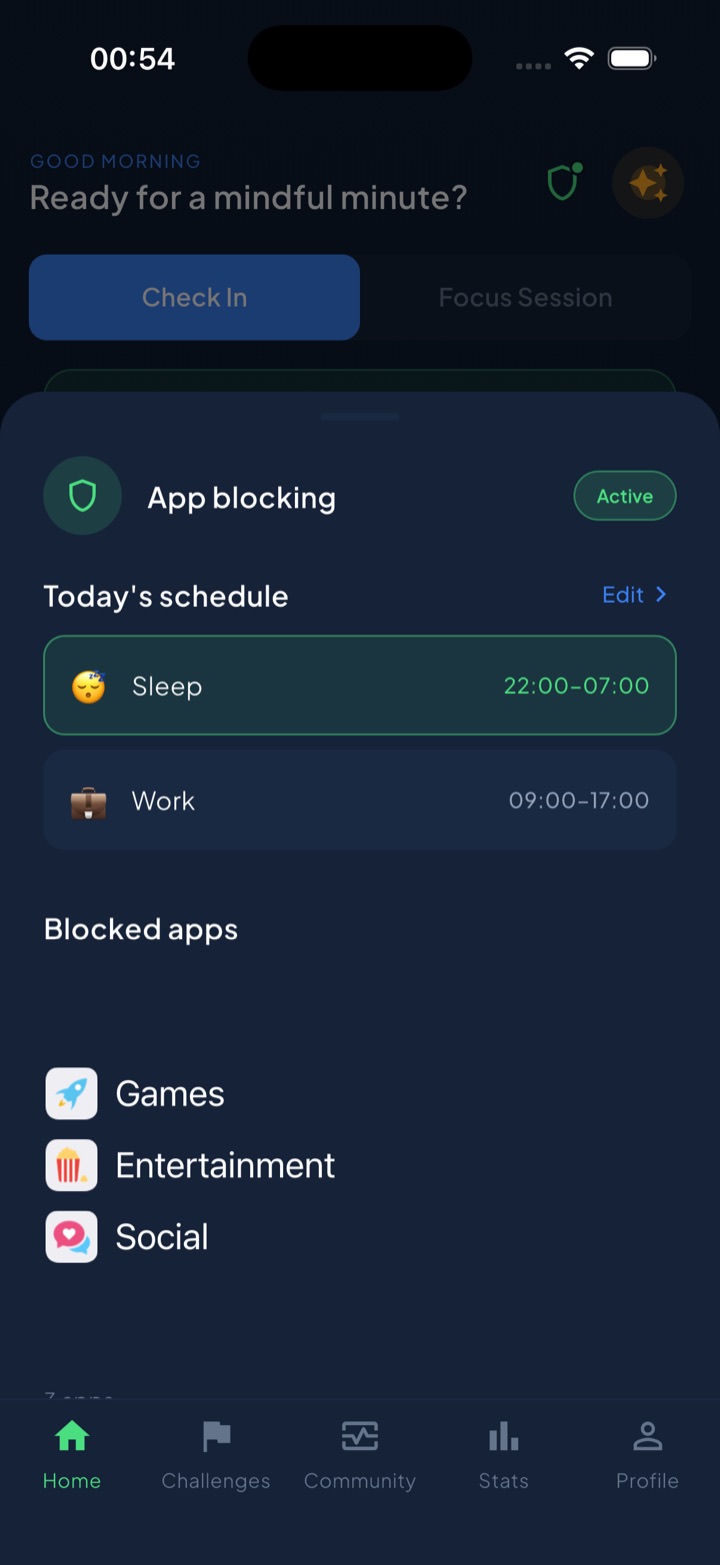
The scheduled blocking routines are the strongest version of a Ulysses pact: you set up a recurring window like Work 09:00–17:00 or Sleep 22:00–07:00 once, while clear-headed, and it binds every future weekday automatically. Your tired 11pm self doesn’t get a vote. Focus sessions do the same for shorter deep-work blocks.
You don’t strictly need software for this. You can hand your phone to a partner, leave it in another room, or log out and delete an app’s password — all legitimate commitment devices, and free. Unscrol’s advantage is that the mast is convenient enough to actually use every day, and hard enough to escape that it holds when it counts.
Stop relying on the version of you who shows up at the moment of temptation. Bind the choice while you’re strong, and let the plan do the resisting.
Frequently asked questions
What is a commitment device?
A commitment device is an arrangement you set up in advance that makes it harder for your future self to give in to temptation. Examples include locking money in an account you can't touch, giving a friend your car keys, or blocking distracting apps during work hours. The idea is to bind your present, motivated self so your later, weaker-willed self can't easily break the plan.
What is a Ulysses pact or Ulysses contract?
A Ulysses pact is a commitment device named after Homer's Ulysses, who had his sailors tie him to the mast so he could hear the Sirens' song without steering the ship onto the rocks. It means binding yourself in advance, while your judgment is clear, to prevent a predictable future lapse. Modern versions include app blockers, savings locks, and pre-set deadlines you cannot easily override.
Do commitment devices actually work?
Yes, when designed well. In a well-known study, students who set their own strict deadlines performed better than those with a single end-of-term deadline, showing people will pay to constrain themselves. Savings-commitment research in the Philippines found locked accounts raised savings significantly. The catch is that soft commitments with an easy escape hatch often fail, because you can just override them in the tempting moment.
What is the difference between a soft and hard commitment device?
A soft commitment device relies on a reminder, a promise, or a small penalty you can ignore, like a to-do note or a screen-time warning you can tap past. A hard commitment device makes the tempting action genuinely difficult or costly, like money you forfeit or an app that is actually blocked. Hard devices work better precisely because they don't depend on your willpower at the moment temptation strikes.