Instagram is harder to quit than TikTok, and it is not because you are weaker. TikTok is one thing: entertainment. Delete it and you lose entertainment. Instagram is three things stacked on top of each other — an entertainment feed, your social graph, and for a lot of people a portfolio or a shopfront. Quitting means cutting all three at once, so most people do not quit, they oscillate. Delete, reinstall, delete, reinstall. The way out is to stop trying to cut all three and start separating them.

Why is Instagram so hard to put down?
Four mechanics, each doing something different.
Reels is a slot machine bolted onto a photo app. The feed you signed up for was finite — you reached the end and left. Reels has no end and no natural stopping cue, so the session length is decided by exhaustion rather than by content. The same short-form loop is covered in TikTok brain and short-form video.
Stories run on a 24-hour countdown. This is the most underrated design decision on the platform. Expiring content manufactures genuine urgency: miss a day and it is gone forever. That is a deadline attached to something with no importance whatsoever, and deadlines are extremely good at getting people to open apps.
It is a comparison engine, not just a feed. The people whose lives you are watching are people you actually know — colleagues, classmates, exes, the friend who seems to be doing better than you. Anonymous entertainment does not produce that aftertaste. This is why people report feeling worse after Instagram than after equal time on YouTube, and why social media and anxiety shows up so consistently in the research.
DMs make every session legitimate. You opened it to reply to a message. That is true, and it is also the reason the app survives every purge — you have a defensible reason to open it forty times a day, and the feed collects the rest.
“I deleted Instagram four times in a year. Every time, someone messaged me about work and I reinstalled it within a week. The fifth time I kept the account and just used it in Safari on my laptop. That finally stuck, because nothing broke.” — Naomi, ceramicist, 33
The staged plan
Do these in order. Each stage is survivable on its own, and most people find they can stop after stage two.
Stage 1: Kill the pull (do today, takes ten minutes)
- Turn off every Instagram notification. Not most. All of them, including likes, follows, and “suggested for you”. Settings > Notifications > Instagram > off.
- Mute aggressively. Anyone who makes you feel behind, anyone posting for reach rather than to you. Muting is invisible to them and it changes the feed within days.
- Move the icon. Off the home screen entirely — into a folder on the last page. See the 20-second rule for why this small change does disproportionate work.
If you only do stage 1, expect roughly a 30 to 40 percent drop. The remaining use is the deliberate kind, which is fine.
Stage 2: Cut the infinite surface
Reels is the part with no end, so treat it separately from the rest of the app.
- Never enter through Reels. Opening the Reels tab first is how a two-minute check becomes forty. Enter through DMs, do the thing, leave.
- Long-press and mark Reels “not interested” for a week and the algorithm genuinely calms down.
- Set a hard window. Instagram between 12:00 and 12:30 and never after 21:00 beats “less Instagram”, because it is a rule you can actually be in or out of compliance with.
Stage 3: Separate the account from the app
This is the move that works when the others have not: delete the app, keep the account.
Use Instagram in a mobile browser or on a laptop. What you keep: your account, your DMs, your followers, your work enquiries, your ability to post. What you lose: push notifications, background refresh, a smooth Reels experience, and the ability to open it without typing something.
That is close to the perfect trade, and it is why it survives when full deletion does not. Nothing breaks, so there is no emergency that justifies reinstalling.
| Approach | You keep | You lose | Typically lasts |
|---|---|---|---|
| Willpower (“I’ll use it less”) | Everything | Nothing | Days |
| App Limit with a dismiss button | Everything | Nothing, once you learn to tap ignore | Two weeks |
| Delete app, keep account | Account, DMs, contacts | Notifications, easy Reels | Months to permanent |
| Deactivate account | Time | Contacts, messages, work leads | Weeks, then reversed |
What to do about the hole it leaves
Every honest account of quitting a feed mentions the same thing: the first week is not hard because you miss Instagram. It is hard because you have twenty small gaps a day that used to be filled and now are not — the queue, the lift, the ad break, the five minutes before a meeting.
If you leave those gaps empty, something will fill them, and it will probably be another app. Decide in advance what goes there. A book in your bag, a language app, a text to an actual friend, or nothing at all, deliberately — see why boredom is good for your brain and things to do instead of scrolling.
Expect the pull to fade in roughly two to three weeks, not two to three days. The timeline in how long it takes to break phone addiction is a realistic guide to what those weeks feel like.
Do you have to quit completely?
No, and framing it as all-or-nothing is usually what causes the yo-yo. Almost nobody needs zero Instagram. What people need is for Instagram to stop being the default answer to every unoccupied second.
A workable end state for most people looks like: app not on the phone, account alive, checked deliberately a few times a week from a browser, DMs answered in batches. That is not abstinence. It is Instagram going back to being a tool you use rather than a place you live.
How does Unscrol help?
Be clear on what is free: notifications off, muting, moving the icon, and deleting the app while keeping the account cost nothing and are the highest-impact steps in this article. Do those first.
Unscrol is for the specific failure mode this article opened with — the reinstall. It is an iPhone and Apple Watch app built on Apple’s Screen Time frameworks, so blocks are system-enforced rather than a cosmetic overlay, and it covers the browser route too, which is where most Instagram plans quietly leak.
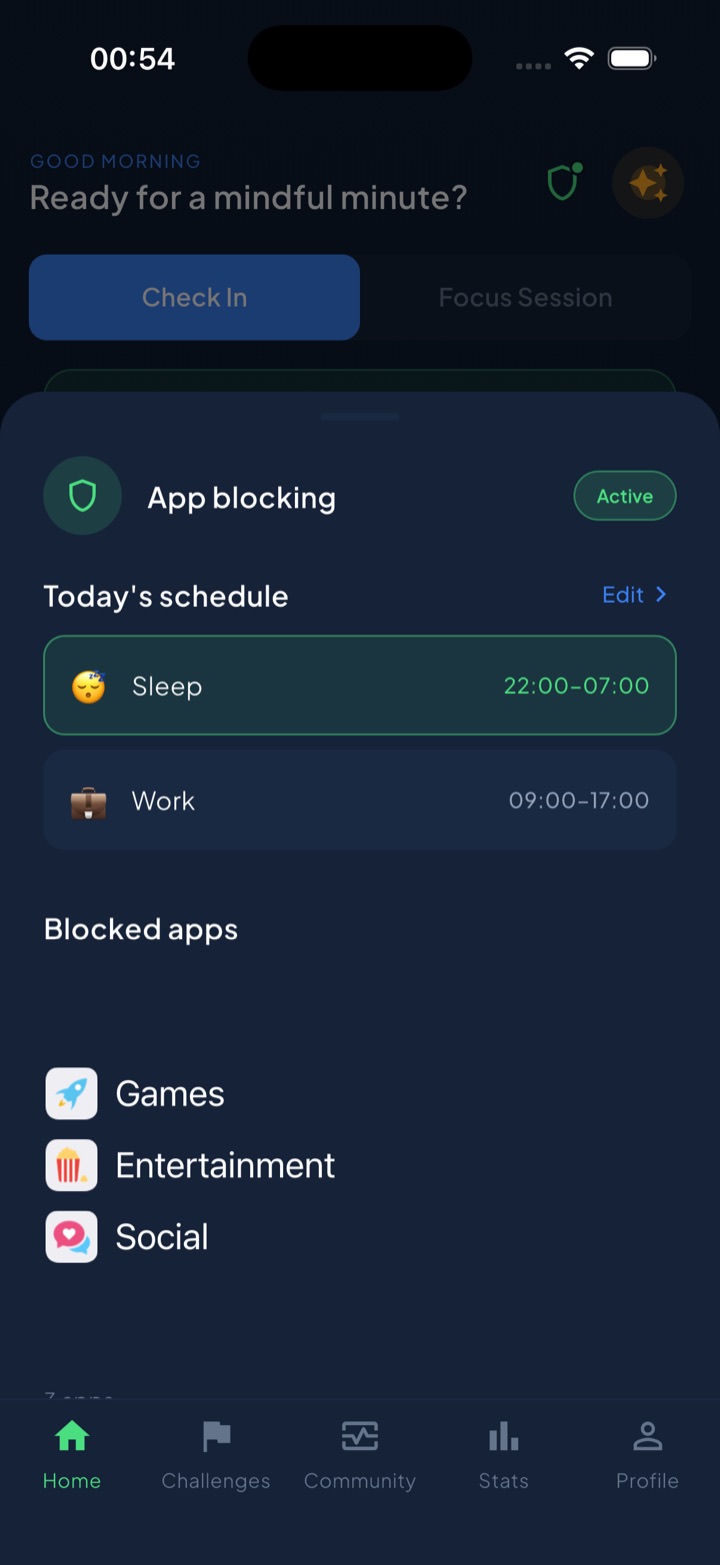
Scheduled blocks put Instagram behind a shield during windows you choose in advance — evenings, work hours, the hour before bed — so the decision belongs to yesterday’s version of you rather than to the version standing in a queue. When you genuinely need it, a short deliberate take-a-break bypass exists rather than a one-tap dismiss. The guess-versus-real check asks you to estimate your Instagram time before showing the actual figure, and for this app in particular the gap is usually startling. A unified daily streak grows on any day you do a quick check-in or finish one of 45+ challenges, which gives the first fortnight something to build instead of just something to resist. Block lists and usage data are processed on-device by iOS and never reach Unscrol’s servers. Free to download; the optional Pro tier adds a Streak Saver that rescues a single missed day, twice a week.
Frequently asked questions
How do I stop being addicted to Instagram?
Work in stages rather than deleting everything at once. First remove the pull: turn off all Instagram notifications, unfollow or mute every account that makes you feel worse, and switch the app icon off your home screen. Second, remove the infinite part: use Reels deliberately or not at all, since that is the endless surface. Third, add friction — log out after every session, or block the app during set windows so opening it requires a decision rather than a reflex. Most people find they can keep the account and still cut their usage by more than half, because the account was never the problem. The feed was.
Why is Instagram harder to quit than TikTok?
Because it does three jobs at once. TikTok is entertainment, so deleting it costs you entertainment. Instagram is entertainment, your social graph, and often your work or portfolio, so deleting it costs you contact with people and sometimes income. That mixture makes clean quitting feel impossible and gives every relapse a legitimate excuse — you were replying to a message. Instagram also adds a comparison layer that pure entertainment feeds do not have, because the people on it are people you actually know, which makes the emotional aftertaste heavier and the pull to check stronger.
Should I delete Instagram or just limit it?
Delete the app, keep the account. Deactivating the account creates real costs — lost messages, lost contacts, lost work enquiries — which is why most account deletions get reversed within a month. Removing the app from your phone while keeping the account reachable through a browser preserves everything that mattered and removes everything that did not. The browser version has no push notifications, a worse Reels experience, and requires logging in, which is enough friction to break the reflex without cutting you off from people.