There is no fixed number — and anyone who gives you one is selling something. Here is the honest answer: most people feel the urge to reach for their phone start to fade noticeably within one to four weeks of changing their environment, but rewiring the habit so it stops being automatic takes longer. The most-cited study on habit formation (Lally et al., University College London, 2010) found new behaviours took anywhere from 18 to 254 days to become automatic, with a median around 66 days. So a realistic expectation is: uncomfortable for a week or two, easier by week three or four, and genuinely effortless somewhere in month two or three. The popular “21 days to break a habit” rule is a myth — and believing it is one of the main reasons people quit early.
Is “21 days to break a habit” actually true?
No — and it’s worth knowing why. The 21-day figure traces back to a 1960 self-help book, Psycho-Cybernetics, by plastic surgeon Maxwell Maltz, who noted that patients needed “a minimum of about 21 days” to get used to a new face or a missing limb. Later writers deleted the word minimum and sold an offhand clinical observation as a hard rule.
Real data is messier and more useful. In the UCL study, everyday habits reached automaticity at very different speeds depending on the person and how hard the habit was, and twenty-one days sits well below the average. Expect to be “cured” after three weeks and you’ll hit day 22 still feeling the pull, decide it didn’t work, and quit right before it gets easier.

What does the phone-addiction timeline actually look like?
Everyone’s different, but the shape of the curve is remarkably consistent. Here’s a realistic map of what to expect once you seriously cut phone use — assuming the trigger is actually blocked, not just resisted with willpower.
| Phase | What’s happening in your brain | What it feels like |
|---|---|---|
| Days 1–3 | The reliable dopamine loop is suddenly interrupted | Phantom reaches, restlessness, boredom that feels urgent — this is the peak |
| Week 1–2 | Cue reactivity starts to weaken | Urges still come but get shorter; you catch yourself faster |
| Week 3–4 | The automatic checking reflex fades if the cue stays blocked | Long stretches without thinking about your phone; the itch is quieter |
| Month 2–3 | New default behaviours consolidate | Not reaching for the phone starts to feel normal, not like effort |
The week-three row hides the biggest variable — if the cue stays blocked. If your phone is still a thumb-swipe away during your weak hours, your brain never gets the uninterrupted stretch it needs, and the timeline keeps resetting.
Why do the first three days feel the hardest?
Because your brain has spent years learning that a dull moment can be instantly erased by a swipe. Take that away and you get cue reactivity — the restlessness a smoker feels near an ashtray: phantom vibrations (a buzz that never happened), an almost physical itch to check something, and a strange, urgent boredom.
This isn’t a sign you’re uniquely addicted — it’s proof the loop was real and is now being starved. The discomfort is loudest at the start and drops off fast, which is why the first 72 hours deserve the most protection. Not sure how deep the loop runs for you? A quick phone addiction test gives you an honest baseline.
What actually speeds it up?
Willpower is the slowest, least reliable lever. These four move the timeline far more:
- Remove the cue, don’t fight it. Across behaviour research, changing your environment beats out-disciplining your own impulses. Block distracting apps during your trigger hours and the urge arrives, finds a locked door, and fades — instead of you winning a hundred tiny battles a day.
- Have a replacement ready. A habit isn’t just deleted; the brain wants to fill the gap. Decide in advance what your hands do instead — a book by the bed, a walk, a chore — so the empty moment has somewhere to go. A 30-day social media detox works best when the freed-up time is pre-assigned.
- Set one clear rule, not a vague intention. “Less phone” is impossible to keep. “No social apps before 9am and after 10pm” is a rule your brain can actually enforce. Specific beats aspirational every time.
- Use streaks and loss aversion. We work harder to keep something than to gain it, so a visible run of successful days becomes something you don’t want to break — which is why streaks build habits better than motivation alone. Pair that with a simple habit tracker and an abstract goal turns into a chain you can see.
“I kept restarting every Monday and quitting by Wednesday because I expected it to be easy after three weeks. Once I stopped counting to 21 and just protected my first hour and my last hour of the day, week four was the first time I forgot my phone existed for a whole evening.” — Marcus, 29, product designer
What resets the clock — and what doesn’t?
Here’s the good news: a single slip does not reset your progress. Missing one evening, doom-scrolling one bad Sunday — that’s noise, not failure. In the habit research, one occasional lapse had a negligible effect on the underlying rewiring.
What does reset the clock is an unrestricted relapse week — going fully back to old patterns for days on end, which lets the cue-reward loop re-strengthen. The rule that protects you is simple: never miss twice. One missed day is human; two in a row is the old habit reinstalling itself. If you slip, the only job is to make the next day a clean one. The fastest recoverers aren’t the ones who never fail — they’re the ones who never let a bad day become a bad week.
One honest caveat: for most people this is a behavioural compulsion, not a clinical disorder, and this timeline applies. But if it comes with genuine anxiety, low mood, or an inability to function that doesn’t ease over weeks, that’s a signal to see a professional rather than muscle through alone.
How does Unscrol help you break phone addiction?
Start with the free route, because it’s real: on any iPhone, open Settings → Screen Time, turn on Downtime for your trigger hours, and add app limits — no third-party app required. If a plain daily schedule protects your first and last hour, use it and keep your money.
Unscrol exists for the part Apple’s built-in tools don’t cover: staying consistent long enough for that timeline to actually finish. It uses the same official Apple Screen Time frameworks to shield apps and whole categories on real schedules — Sleep 22:00–07:00, Work 09:00–17:00 — plus focus sessions with a Live Activity countdown, so the block is system-enforced during exactly the hours you’re weakest.
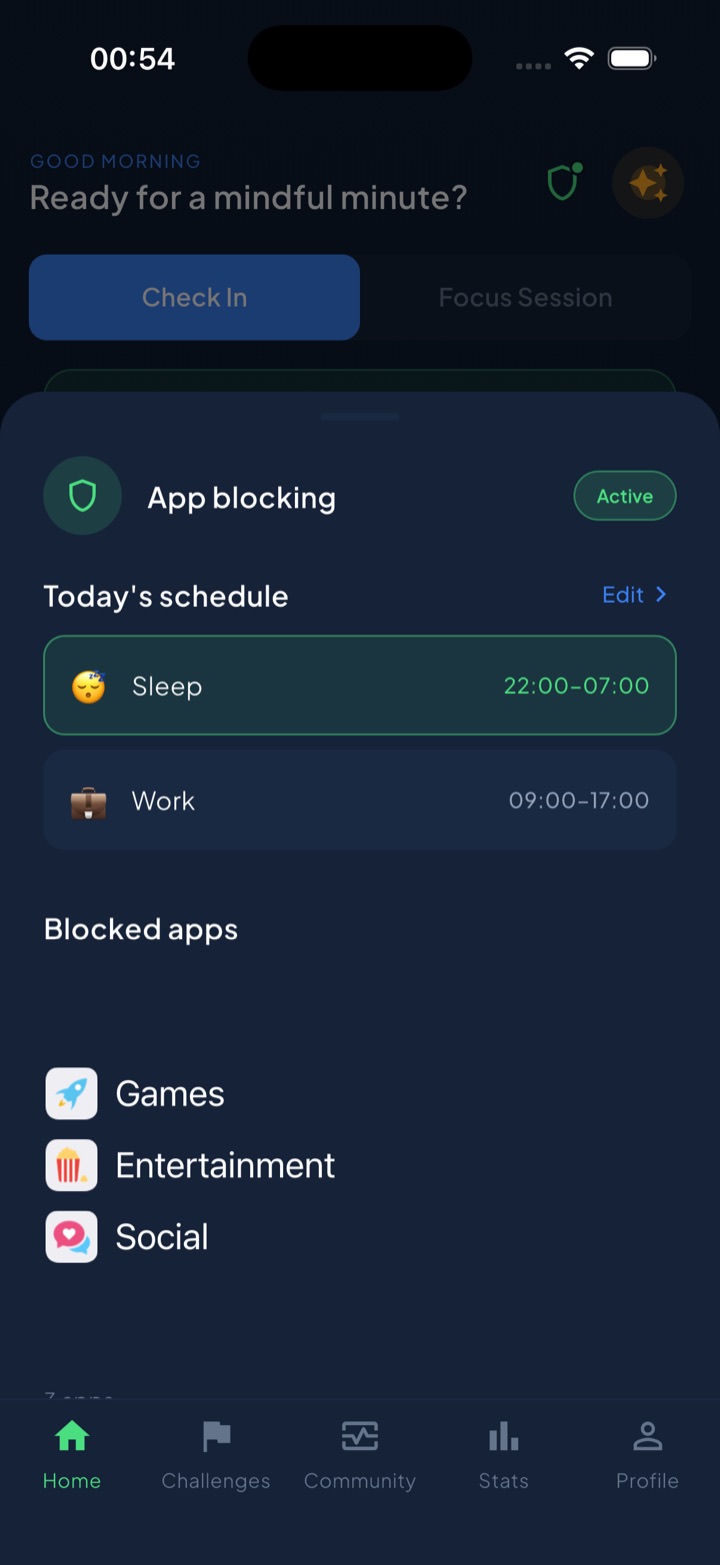
Because the whole timeline is really a consistency problem, Unscrol maps to it directly. Its 7-, 21-, and 30-day challenges line up with the real phases of the curve, and a unified daily streak counts any day you do a mood or urge check-in or complete a challenge — so progress builds even on a slow day. When you have one bad day, Streak Saver (part of Pro, 2 per week) rescues a single fully-missed day, so one slip doesn’t erase weeks of momentum — the “never miss twice” rule, built in. Block lists and usage stats are processed on-device by iOS and never reach Unscrol’s servers. It won’t do the hard days for you, but it makes the count honest and the schedule automatic — most of the battle.
Frequently asked questions
How long does it take to break phone addiction?
There's no fixed number. Most people notice the compulsion to grab their phone fading within one to four weeks of changing their environment, but the deeper habit rewiring takes longer. The most-cited research (University College London, 2010) found new habits took 18 to 254 days to become automatic, with a median around 66 days. A realistic expectation: uncomfortable for a week or two, easier by week three or four, and genuinely automatic somewhere in the second or third month — provided the cue that triggers reaching for your phone is actually removed, not just resisted.
Is phone addiction withdrawal real?
For most people it's behavioral, not chemical like a drug — but it feels real. In the first few days you get 'phantom reaches' (grabbing a phone that isn't there), restlessness, mild anxiety, boredom that feels urgent, and trouble concentrating. These peak around days one to three and shorten quickly after that. It's your brain protesting the loss of a reliable dopamine loop, not physical dependence. If anxiety, low mood, or compulsion feel severe or don't ease over weeks, that's worth discussing with a doctor rather than white-knuckling alone.
Does the 21-day rule for breaking a habit work?
No — 21 days is a myth. It comes from a 1960 self-help book, Psycho-Cybernetics, in which surgeon Maxwell Maltz noted patients took 'a minimum of about 21 days' to adjust to a new self-image. Later authors dropped the 'minimum' and sold it as a rule. Actual habit research shows an average nearer 66 days and a wide range of 18 to 254 days. Expecting to be 'cured' at day 21 mostly sets you up to quit early and conclude you failed, when you were simply still mid-process.