A 30-day social media detox is a structured month where you stop using recreational social apps — Instagram, TikTok, X, Facebook, Reddit — and replace the habit with something else. Almost everyone moves through the same arc: Week 1 is withdrawal (phantom reaches for your pocket, sharp FOMO), Week 2 your attention starts coming back, Week 3 brings the clearest mood and sleep gains, and Week 4 is intentional re-entry — deciding which apps return and under what rules. One honest caveat up front: the research on permanently quitting social media is genuinely mixed, and for most people blocking the apps during vulnerable hours works better than deleting them forever.
What actually happens during a 30-day social media detox?
The first thing to understand is that a detox is less about the apps and more about the automatic reach — the unconscious swipe-to-unlock-to-Instagram loop your thumb has memorized. When you remove the payoff, that loop doesn’t vanish quietly. It gets loud first, then fades.

This is why a detox feels harder than it sounds. You’re not just skipping an app; you’re interrupting a reward pattern your brain has practiced thousands of times. If you want the underlying neuroscience — why the variable rewards of a feed are so sticky — our breakdown of what a dopamine detox actually does covers the real science versus the wellness-influencer version. For the broader, non-time-boxed approach, the complete digital detox guide is the companion piece; this article is specifically the 30-day, week-by-week plan.
How do you prepare for a month off social media?
Willpower is the wrong plan. People who finish a 30-day detox almost always set it up in advance so the hard decisions are already made. Spend an evening on these steps:
- Announce it (lightly). Tell a couple of friends and post one final “taking a break, reach me by text” note. This turns quitting into a commitment other people expect you to keep — a mild but real accountability lever.
- Decide: delete vs. block. Deleting is dramatic but reversible in ten seconds and wipes your logins and DMs. Blocking is the better default for most people — high friction, no all-or-nothing pressure. Keep messaging apps if that’s how you actually reach people.
- Pre-load replacement activities. A vacuum gets filled by whatever’s easiest, and the easiest thing is usually another app. Line up the alternatives now: a paperback on the nightstand, running shoes by the door, a friend to call on your old scroll-commute.
- Protect the danger zones. Note your three weakest moments — waking up, the post-lunch slump, and bed — and plan exactly what you’ll do instead. Most relapses happen in those windows, not at random.
What does the 30-day detox timeline look like, week by week?
Here’s the arc most people report. Your mileage varies, but the order rarely does — discomfort comes first, the payoff comes later.
| Week | What’s happening | What it feels like |
|---|---|---|
| Week 1 | Habit withdrawal | Phantom phone reaches, FOMO spikes, boredom, irritability |
| Week 2 | Attention returning | Longer focus, less twitchiness, mild boredom you can sit with |
| Week 3 | Mood & sleep gains | Calmer evenings, easier sleep, more present in conversations |
| Week 4 | Intentional re-entry | Clarity on which apps matter and which you don’t miss at all |
Week 1 — withdrawal. Expect to reach for your phone dozens of times a day and find nothing there. FOMO peaks; you’ll be convinced you’re missing something urgent. You almost never are. This is also when doomscrolling urges hit hardest, because the brain wants its old soothing loop back. Ride it out — it’s the shortest phase.
Week 2 — attention returns. The twitch quiets down. You’ll notice you can read a few pages, sit through a meal, or wait in a line without reflexively unlocking your screen. Boredom is still there, but it feels less like an emergency.
Week 3 — mood and sleep. This is where most people report the real payoff. Freeing up the late-night scroll tends to improve sleep, and a calmer nervous system shows up as steadier mood and more presence with the people around you.
“I did the first three days white-knuckling it — I genuinely kept unlocking my phone to an empty home screen. But by week three I was falling asleep before midnight for the first time in years, and I didn’t miss the feed at all. The surprise was how much time I got back.” — Marcus, product designer, 31
Week 4 — intentional re-entry. Don’t just flip everything back on. Decide, app by app, which ones earned their place and which you genuinely didn’t miss. This is the whole point: not a permanent quit, but regaining choice over when and why you open them.
Do the benefits actually last?
Here’s the part the challenge-culture posts skip: the evidence on quitting social media is mixed. Some studies find modest improvements in wellbeing, focus, and sleep; others find small or short-lived effects, and a few find people simply migrate the habit elsewhere. It’s a contested area, so be skeptical of anyone quoting a dramatic single statistic.
What’s clearer is the pattern that hurts: heavy, passive, late-night scrolling. That points to a more sustainable conclusion than “delete forever.” For most people, the durable win is blocking the apps during vulnerable hours — the first hour awake, the evening wind-down, and bedtime — rather than white-knuckling a permanent ban that quietly collapses in month two. A 30-day detox is best treated as a reset experiment: it breaks the automatic reach and shows you what “enough” actually looks like, so your re-entry rules are built on experience instead of guilt.
How Unscrol helps you finish a 30-day detox
Let’s be honest first: you can start a detox today for free. On iPhone, Screen Time lets you set app limits and a Downtime schedule at no cost, and for a lot of people that’s a fine place to begin. The catch is consistency — Screen Time’s limit screen has a one-tap “Ignore Limit” button, and on day 12, at 11pm, most people tap it. That’s the exact moment a detox quietly dies.
Unscrol is built for that moment. It uses Apple’s official Screen Time frameworks to put real, system-enforced shields on the apps and categories you choose, and it lets you set scheduled blocking routines — auto-block Instagram and TikTok every morning until 9am and every night after 10pm — so your vulnerable hours are protected without a daily decision.
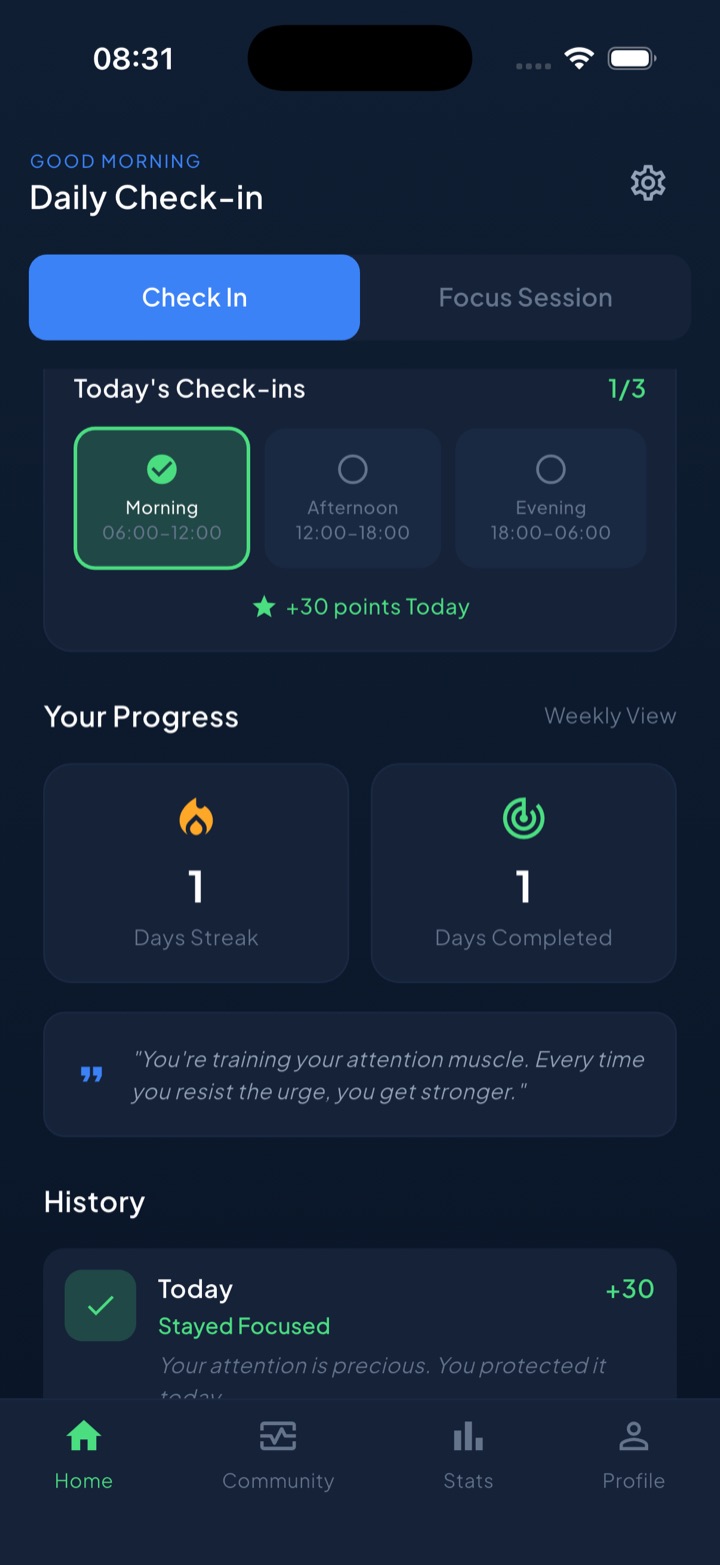
The other half is momentum. A 30-day detox lives or dies on not breaking the chain, which is why streaks work: our take on why streaks build habits explains the psychology. Unscrol gives you a unified daily streak (a day counts if you check in or finish a challenge), mood and urge check-ins for those week-one cravings, and 30-day challenges built to carry you across the finish line. There’s also a deliberate “take a break” bypass — a short middle ground between a soft nudge and a prison lock — for when you genuinely need the app, without blowing up the whole month. Which apps you block and your usage stats stay on your device; iOS processes them and they never reach Unscrol’s servers.
The tool doesn’t do the detox for you. It just makes day 12 at 11pm a little harder to quit — which, most weeks, is the whole game.
Frequently asked questions
What happens during a 30-day social media detox?
Most people move through a predictable arc. Week 1 is withdrawal: you reach for your phone dozens of times a day out of pure habit and feel real FOMO. Week 2, your attention starts returning — you can read a few pages or hold a conversation without twitching for a screen. Week 3 tends to bring the clearest mood and sleep gains as your evenings free up. Week 4 is intentional re-entry, where you decide which apps come back and under what rules. The exact timeline varies, but the ordering — discomfort first, benefits later — is remarkably consistent.
Is a 30-day social media detox actually worth it?
For most people, yes — but not in the way influencers promise. The research on permanently quitting social media is genuinely mixed: some studies find modest improvements in mood, focus, and sleep, others find small or short-lived effects. What's clearer is that heavy, passive, late-night scrolling is the harmful pattern. A 30-day break is worth it mainly as an experiment: it shows you what life feels like without the habit, breaks the automatic reach, and lets you rebuild a lighter relationship afterward. The goal isn't a permanent quit — it's regaining choice over when and why you open the apps.
Should I delete social media apps or just block them?
Blocking beats deleting for most people. Deleting feels dramatic, but it's easy to reinstall in ten seconds during a weak moment, and it wipes your saved logins and messages. Blocking the apps — especially during your vulnerable hours like mornings, evenings, and bedtime — keeps the friction high without the all-or-nothing pressure. On iPhone you can do a basic version free with Screen Time app limits. The one honest catch: Screen Time's limits show an 'Ignore Limit' button that's one tap away, so pair it with scheduled blocking or an app that adds real friction.