A habit tracker is a simple record of whether you did a behavior each day — a row of boxes you tick, a calendar you mark, a streak counter that climbs. It works for a reason that surprises people: the act of tracking itself changes behavior. Decades of research in behavior therapy on self-monitoring show that when people start recording a habit, the habit tends to shift in the direction they want, before they’ve done anything else. Tracking makes an invisible pattern visible, hands you a small daily reward, and creates quiet accountability. The trap is doing too much — track a few things, forgive the misses, and don’t let the number become the whole point.
What is a habit tracker, and why does it work?
At its core a tracker does one job: it turns “I’ve been meaning to focus more” into a concrete, dated record you can see. That visibility does real cognitive work.
- It closes the gap between belief and reality. People are terrible at estimating their own behavior. You feel like you’ve been studying regularly; the tracker shows you did it twice in ten days. Data beats vibes.
- It provides an immediate reward. Most good habits pay off slowly. Marking the box gives you a tiny, guaranteed hit of satisfaction today, which is exactly the fast reward the habit loop needs. This is the same engine that makes streaks work for building habits.
- It creates a cue. A tracker on the fridge or a widget on your home screen reminds you to act, then rewards you for acting — the cue and reward in one object.
Why does just tracking change your behavior?
The key concept is the reactivity of self-monitoring: measuring a behavior changes it. In clinical studies, simply asking people to log how often they smoked, snacked, or bit their nails reduced the behavior somewhat, with no other intervention. Attention is a form of intervention.
Why? Recording forces a moment of awareness into an otherwise automatic act. A habit runs on autopilot precisely because you don’t notice it. The instant you have to mark “did I scroll after 10pm — yes or no,” the behavior stops being invisible, and you get a small pang of accountability at the exact moment you’d normally drift. Over days, that repeated flash of awareness pulls the behavior toward your intention. It’s a mild effect, not magic, but it’s free and it compounds — which is why tracking is one of the first tools worth adding when you’re learning how to build better habits.
Paper vs. app: which tracker should you use?
There’s no universally right answer; there’s the one you’ll actually check every day.
| Paper tracker | App tracker | |
|---|---|---|
| Friction to log | Very low, but you must have it nearby | Low, but on a distracting device |
| Reminders | None — you must remember | Automatic notifications |
| Streaks & history | Manual | Automatic, with stats and charts |
| Satisfaction | High — physical, tactile marking | High — animations, widgets |
| Risk | Easy to forget or lose | Opening the app can pull you into the phone |
| Best for | Screen-free habits, minimalists | Data lovers, people who need reminders |
For phone-reduction habits specifically, there’s a real irony: opening an app to log “I used my phone less” puts you back on the phone. Two clean solutions are a paper tracker on your desk, or a home-screen widget you can read without unlocking anything. Choose the format that removes friction rather than the one with the most features.
What should you actually track?
The single most common mistake is tracking too much. Motivated people build a 12-habit grid on January 1st, miss a few boxes by January 10th, and abandon the whole thing by February.
Follow three rules:
- Track one to three habits, maximum. Pick the behaviors with the highest leverage — the ones that, if consistent, would move everything else. For most people wanting their attention back, that’s something like “one focus session” and “phone out of the bedroom.” When those feel automatic (give it roughly two months, per habit-formation research), add another.
- Define the minimum generously. “Two minutes counts.” A low bar keeps the chain alive through sick days, travel, and bad moods, and you can always do more. A bar so high you fail on hard days is a bar designed to make you quit.
- Build in forgiveness. The famous “don’t break the chain” idea (attributed to Jerry Seinfeld) is powerful but has a dark side: one missed box can trigger total collapse. Pair it with the best rule in habit change — never miss twice. One blank day is noise; two in a row is a new pattern. Allow yourself a planned “rescue” or grace day so a single slip doesn’t feel like failure.
When does habit tracking backfire?
Tracking has two well-known failure modes worth naming so you can avoid them.
The first is Goodhart’s law: when a measure becomes a target, it ceases to be a good measure. Once the checkbox matters more than the behavior, people start gaming it — doing the laziest possible version to mark it done, or logging things that don’t really count. The tracker is a mirror, not the goal. If you find yourself optimizing for the number instead of the outcome (reading one sentence to tick “read,” or checking your feed less but doomscrolling news instead), the metric has drifted from what you actually care about.
The second is perfectionism and shame. For some people, a broken streak or a gap-filled calendar becomes a source of guilt that poisons the whole habit. If tracking is making you feel worse rather than more capable, that’s a signal to loosen it — track fewer things, lower the bar, or take a break from the counter and let the behavior run on its own. A tracker is scaffolding; if it’s causing more stress than it removes, the scaffolding has become the problem.
“I stopped trying to be perfect once I realized one missed day didn’t wipe out the two weeks before it. Now I just make sure I never skip twice, and the streak card is the first thing I check each morning.” — Priya, graduate student
How Unscrol tracks your day without the burnout
Unscrol is built around exactly this balance: enough tracking to trigger self-monitoring’s benefits, with the forgiveness that prevents burnout. The home screen shows your day at a glance — three check-in slots (morning, afternoon, evening), your current streak, and days completed — so logging is a few taps, not a chore, and a home-screen widget lets you see progress without opening the app.
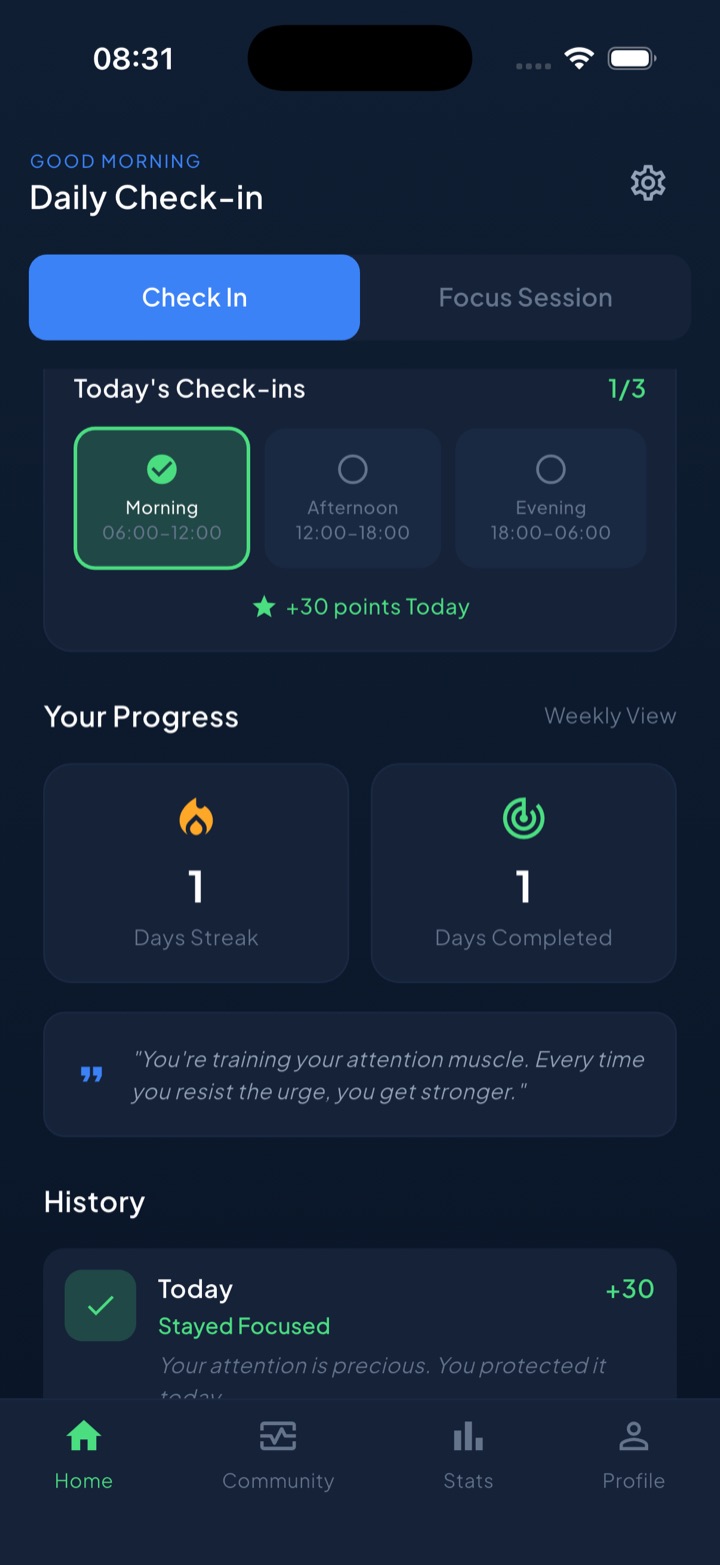
Crucially, the streak is designed to forgive the single miss. Any check-in or completed challenge keeps the day alive, and the premium Streak Saver can rescue one missed day, at most twice a week — but never two in a row. That last rule bakes “never miss twice” into the system, so a bad day doesn’t become the excuse to quit.
None of this requires an app. A paper habit tracker with one rescue mark per week does the same job, and the physical act of ticking a box is genuinely satisfying. Unscrol just removes the friction and handles the forgiveness math for you, so tracking stays a nudge rather than another thing to feel guilty about.
Track a little, forgive the slip, and never let the number become the point.
Frequently asked questions
Do habit trackers actually work?
Yes, for most people, because of a well-documented effect called self-monitoring reactivity: the simple act of recording a behavior tends to change it in the desired direction. Tracking makes an invisible pattern visible, adds a small daily reward when you mark it done, and creates gentle accountability. The catch is that trackers work best when you track only a few habits and forgive missed days rather than chasing a perfect record.
Should I use a paper habit tracker or an app?
Both work; the best one is the one you'll actually check daily. Paper is frictionless, screen-free, and satisfying to mark by hand, but easy to forget and lose. Apps offer reminders, automatic streaks, history, and widgets, at the cost of putting habit tracking on the same device that distracts you. If your habits are about reducing phone use, a paper tracker or a home-screen widget avoids opening a tempting app to log.
How many habits should I track at once?
Start with no more than one to three. Tracking too many habits at once spreads your attention thin, makes a bad day feel like total failure, and usually leads to abandoning the whole system within weeks. Pick the one or two behaviors that would matter most, build them until they feel automatic over roughly two months, then add another. Fewer habits tracked consistently beats many tracked briefly.
When does habit tracking backfire?
It backfires when the number becomes the goal instead of the behavior, an idea captured by Goodhart's law: when a measure becomes a target, it stops being a good measure. People start gaming the tracker, doing the bare minimum to mark it done, or quitting entirely after breaking a long streak. Tracking also backfires if it triggers shame and perfectionism, so build in forgiveness for the inevitable missed day.