FOMO — the fear of missing out — is the anxious feeling that other people are having rewarding experiences you’re not part of, plus the compulsive urge to stay constantly connected so you never miss the next one. It’s checking your phone mid-conversation, saying yes to plans you don’t actually want, refreshing stories at 1 a.m., and the small punch in the chest when you see the group photo you’re not in. FOMO isn’t a character flaw — it’s an old social-survival instinct being fed a brand-new diet of everyone’s highlight reels, all day long. And because it’s learned and amplified, it can be unlearned and dialed down.

Where does the word FOMO come from?
The acronym is younger than it feels. Patrick McGinnis coined “FOMO” in 2004 in an article for The Harbus, Harvard Business School’s student magazine, describing how his classmates triple-booked their evenings out of terror that the other party might be the better one. (He coined FOBO — fear of a better option — in the same piece.) The underlying concept had floated around marketing research a few years earlier, but McGinnis’s acronym is the one that stuck.
Two things happened in 2013 that made it official: the word entered the Oxford English Dictionary, and a research team led by Andrew Przybylski published the study that gave FOMO its standard psychological definition — “a pervasive apprehension that others might be having rewarding experiences from which one is absent.” That study also found what you’d guess: people higher in FOMO use social media more heavily, and the relationship seems to run in both directions.
The feeling, though, is ancient: for most of human history, exclusion from the group was genuinely dangerous, so your brain treats it as a threat worth monitoring. What’s new isn’t the fear — it’s the 24/7 feed of everything you’re missing.
Why does social media supercharge FOMO?
You missed things constantly before smartphones — you just didn’t have to watch them happen. Social media changed three specific things:
- You now see what you’re missing, in real time. A party you weren’t invited to used to be invisible. Now it’s a story, posted mid-party, served to you on the couch. The feed is a live broadcast of your alternatives.
- You’re comparing your everything to everyone’s best. Feeds are highlight reels — the one golden-hour photo from a mediocre trip, the celebration but not the breakup. Your ordinary Tuesday is measured against a composite of hundreds of people’s peak moments, a comparison no real life can win.
- The apps are built to exploit the fear. Stories that expire in 24 hours, “live” badges, streaks, “your friends are active now” — engineered urgency that turns mild curiosity into a now-or-never check.
That’s why FOMO deserves its own name rather than being filed under general worry. If social feeds are dragging your mood down more broadly, the social media and anxiety picture is bigger than FOMO — but FOMO is the specific gear that turns other people’s fun into your restlessness.
How does FOMO drive compulsive checking?
FOMO runs on a tight little loop, and understanding it is half of beating it:
Anxiety → check → brief relief → more anxiety.
You feel the itch (“what’s happening without me?”), you check, and the uncertainty briefly resolves — that tiny relief is a reward, and your brain files checking as the thing that fixes the feeling. But the check also restocks the fear: three more events, two inside jokes you weren’t part of, a couple at a rooftop bar. The anxiety returns sooner and stronger, and the checking interval shrinks. Psychologists call this negative reinforcement — the behavior is glued in place not by pleasure but by the removal of discomfort.
That’s why FOMO-checking feels involuntary: rehearsed hundreds of times a day, it becomes a reflex — the same mechanics behind why you can’t stop checking your phone. And the loop never delivers what it promises: the feed can’t prove you’re not missing anything, because there’s always another story. Certainty is the one thing the check can’t buy.
What are the signs FOMO is running your decisions?
FOMO is sneaky because it disguises itself as being social, informed, or spontaneous. A quick translation table:
| The FOMO thought | The reality check |
|---|---|
| ”Everyone’s out tonight and I’m home.” | You saw 15 seconds of footage from the two friends who posted. The twenty who are also home posted nothing. |
| ”I have to reply now or I’m out of the loop.” | Group chats reward presence, not speed. Nobody remembers who answered first. |
| ”If I skip this event, they’ll stop inviting me.” | Friendships survive missed parties. They don’t survive you showing up drained and resentful. |
| ”I’ll just check once so I don’t miss anything.” | The check restocks the fear. You’ll be back in 20 minutes, and you know it. |
| ”Their life is moving faster than mine.” | You’re comparing your full timeline to their trailer. |
If more than two of those thoughts sound like your inner monologue, FOMO isn’t an occasional visitor — it’s making your schedule.
“My tipping point was a Saturday I actually enjoyed — reading, gym, cooked a real dinner — until 11 p.m., when I opened Instagram and saw everyone at a festival. One minute of scrolling retroactively ruined ten good hours. That’s when I realized the problem wasn’t my Saturday. It was the audit.” — Lena, junior UX designer, 24
How do you get over FOMO? A 6-step plan
You don’t beat FOMO by arguing with it at 1 a.m. You beat it by changing the inputs and pre-deciding, while calm, what happens when the itch hits.
- Name it in the moment. When the restlessness hits, label it: “this is FOMO, not information.” Naming an emotion engages the reasoning brain and takes the edge off the urgency.
- Impose a 10-minute delay. Don’t forbid the check — postpone it. FOMO spikes and fades like any craving, and most urges don’t survive a ten-minute wait.
- Kill social notifications entirely. Every push alert is the app choosing when you feel FOMO. Remove the trigger and checking becomes something you initiate on your terms — far less often.
- Unfollow your triggers. Do one honest pass: mute or unfollow the accounts that reliably leave you feeling behind — not out of spite, out of hygiene. Your feed is an input diet, and you’re allowed to change the menu.
- Fill your calendar first. FOMO thrives in unstructured time. Plan two or three things a week you actually chose, so other people’s plans land on a full schedule, not an empty one. If your evenings are a void, start with things to do instead of scrolling.
- Do a reset if the loop is deep. When checking is fully automatic, a structured break recalibrates what “missing out” feels like. A 30-day social media detox is the deep-clean version: the fear tends to peak in week one, then quietly deflate.
What is JOMO, and does the reframe actually work?
JOMO — the joy of missing out — is the deliberate inversion of FOMO, popularized by tech writer Anil Dash in a 2012 essay. It’s not pretending parties are bad. It’s noticing that a night you chose is not a night you lost.
| FOMO | JOMO | |
|---|---|---|
| A free evening is… | proof you’re being left behind | time that belongs entirely to you |
| Your phone is… | a window you must keep watching | a tool you pick up on purpose |
| Missing an event means… | falling behind the group | trusting there will be more events |
| The scarce resource is… | invitations and experiences | your attention and energy |
The reframe works because FOMO’s engine is a hidden assumption: elsewhere is better, and everything is comparable. JOMO attacks the assumption instead of the feeling. You can only occupy one moment at a time; every yes is a thousand nos anyway. Choosing your no on purpose — and enjoying it — is the whole trick, and it’s much easier when your phone isn’t broadcasting the alternatives at you.
How does Unscrol help you beat FOMO?
Start with the free, built-in route — it genuinely works. On iPhone, use Screen Time to turn off notifications for social apps, set App Limits on your worst FOMO feeds, and schedule Downtime for evenings so the 1 a.m. story-check simply isn’t available. Pair that with the calendar-first step above and you’ve removed most of the loop’s fuel.
Unscrol is the iPhone app for the part willpower doesn’t cover: it uses Apple’s own Screen Time frameworks to put real, system-enforced shields on the apps you choose — and everything is processed on-device, so your block lists and usage never touch our servers.
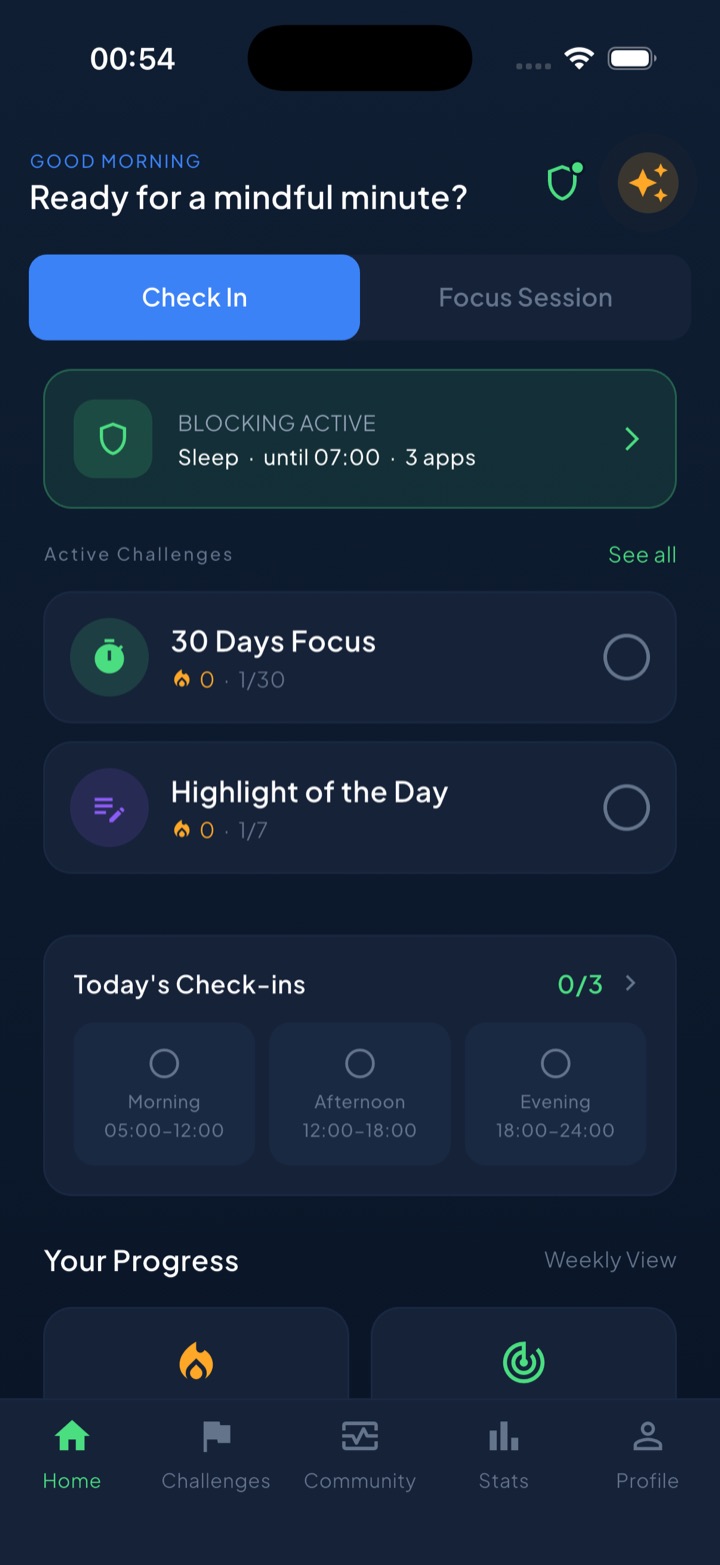
For FOMO specifically, three pieces do the heavy lifting:
- Scheduled block routines shield your feeds during the exact windows FOMO strikes hardest — a Sleep routine from 22:00 so the bedtime audit can’t happen, a Work or School routine so the group chat can’t hijack your afternoon. The urge can still arrive; the 40-tab spiral can’t.
- The “take a break” bypass keeps it honest. If there’s a real reason to check, you can — briefly, deliberately, a decision rather than a reflex. It’s the 10-minute rule, enforced by software instead of vibes.
- Streaks and check-ins flip the scoreboard. A daily streak, mood check-ins, and 45+ challenges give you a version of “not missing out” that’s about your own days — visible on a home-screen widget — not a feed of everyone else’s.
The honest version: Apple’s free tools plus one honest unfollow session will take you far. Unscrol is the layer that makes it stick on the nights the feed feels magnetic — because JOMO is a lot easier to enjoy when the window you’re supposed to keep watching is, for a few chosen hours, simply closed.
Frequently asked questions
What does FOMO mean?
FOMO stands for fear of missing out: the anxious feeling that other people are having rewarding experiences you're not part of, combined with a compulsive urge to stay constantly connected so you don't miss the next one. Researchers describe it as a pervasive apprehension that others might be having rewarding experiences from which one is absent. In daily life it looks like refreshing stories late at night, saying yes to plans you don't want, and feeling a sting when you see a group photo you're not in.
Where does the term FOMO come from?
The acronym was coined by Patrick McGinnis in a 2004 article for The Harbus, Harvard Business School's student magazine, describing his classmates' frantic overbooking of social plans. The underlying idea had circulated in marketing research a few years earlier. The word entered the Oxford English Dictionary in 2013, the same year a widely cited study led by Andrew Przybylski gave it a formal psychological definition and linked higher FOMO to heavier social media use.
How do I get over FOMO?
You reduce FOMO by cutting the inputs and refilling the gap deliberately: turn off social notifications, unfollow accounts that reliably trigger comparison, and delay the urge to check by ten minutes so the anxiety spike can pass. Then fill your calendar with things you chose on purpose, so other people's plans have less empty space to land in. Finally, practice JOMO — the joy of missing out — by treating a night in as something you picked, not something you were left out of.
What is JOMO?
JOMO is the joy of missing out — the deliberate opposite of FOMO. Instead of treating an unattended party or an unopened app as a loss, you reframe it as a choice: an evening that belongs to you. The term was popularized by tech writer Anil Dash in a 2012 essay. JOMO works because it attacks FOMO's core assumption — that elsewhere is always better — and replaces it with the observation that you can only ever live one moment at a time anyway.