Handing a toddler a phone or tablet mid-tantrum works almost instantly — and that’s not your imagination, and it’s not a parenting failure. A bright, fast-moving screen captures a young child’s attention at a level they can’t override, so the crying stops because the feeling gets interrupted, not resolved. Used occasionally — a flight, a waiting room, a sick day — it’s a perfectly reasonable tool. What researchers suggest watching is the pattern where the screen becomes the default response to every big feeling: ages 1 to 5 are the prime window for learning to handle frustration, and a child who is always calmed by a device gets fewer chances to practice calming themselves. Screens are a tool. The dose and the pattern matter more than any single moment.

Why does a screen stop a tantrum instantly?
Because it exploits hardware, not parenting. Human brains — especially very young ones — come with an orienting reflex: attention snaps to whatever is bright, moving, noisy, and new. A tablet is engineered to be all four at once, so it out-competes the internal storm in a way a toy or a soothing voice usually can’t. The tantrum doesn’t get processed; it gets preempted.
That’s the key distinction: this is distraction, not regulation. Distraction is an external off-switch. Regulation is the slow-growing skill of noticing a big feeling, riding it out, and coming back down — and it only develops through practice, mostly with a calm adult nearby.
It’s also worth being honest about who else gets trained. Tantrum → screen → silence is negative reinforcement for the parent: the awful noise stops, so your hand learns to reach for the phone faster next time. Meanwhile the toddler learns the mirror lesson: big feelings make the screen appear. Neither of you decided this; the loop built itself. That’s why it’s sticky — and why gentleness with yourself is part of the fix.
What can the “digital pacifier” cost?
First, the reassurance: no single tablet-in-the-tantrum moment harms a child, and anyone who makes you feel otherwise is selling guilt. The question researchers actually study is the habitual pattern.
Studies that followed families of young children suggest that frequently using devices to calm an upset child is associated with weaker self-regulation over time — and some researchers note the link looks strongest in kids who were already intense and reactive, exactly the kids who get handed the phone most often. That’s an association, not a verdict, and researchers are careful to say so. But the proposed mechanism is simple and plausible: emotion regulation is a practiced skill, and meltdowns are the reps. Every outsourced meltdown is a missed rep — for the child, who doesn’t practice recovering, and for you, who doesn’t get to learn what actually helps your particular kid.
There’s also a quiet escalation loop: a child with fewer regulation reps melts down more, which invites more device-calming, which means fewer reps. The habit feeds the problem it solves.
For context on overall amounts: pediatric bodies like the American Academy of Pediatrics and the WHO advise avoiding screen media (other than video chat) before roughly 18–24 months, and keeping it to about an hour a day of good content, ideally watched together, for ages 2–5. Our screen time recommendations by age breaks that down, and how much screen time is too much covers the honest limits of those numbers. The calming question, though, is less about minutes and more about what job the screen is doing.
When is handing over the screen genuinely fine?
Not all screen-calming is the same. It helps to sort the moments into three zones:
| Zone | Typical situations | The honest verdict |
|---|---|---|
| Rescue | Flights, long car or train rides, waiting rooms, sick days, one parent handling an emergency | Genuinely fine. This is what the tool is for. Zero guilt. |
| Convenience | Cooking dinner, restaurants, an important call | Fine in moderation. Rotate in non-screen options so the screen isn’t the only script. |
| Emotion | Every tantrum, every frustration, every bedtime battle | The pattern to gently change — this is where regulation practice lives. |
The rule of thumb hiding in that table: screens for logistics and boredom, occasionally, is normal life. Screens as the standard answer to feelings is the one habit worth changing — not overnight, and not to zero, but deliberately.
“The turning point was noticing I reached for my phone before she even hit full meltdown — it was my reflex, not hers. We kept the tablet for flights and I packed a little calm bag for everything else. The first week was rough, I won’t lie. By week three she was asking for the bag.” — Megan, mother of a three-year-old, 34
How do you calm a toddler without a screen in the moment?
You can’t reason a toddler out of a tantrum — the thinking parts of their brain are briefly offline. What works is co-regulation: they borrow your calm because they can’t yet generate their own.
- Rule out the basics. Hungry, tired, overstimulated? A lot of “behavior” is biology. If it’s 6 p.m. and lunch was small, no technique beats a snack.
- Get low and slow. Crouch to their level, drop your voice and your shoulders. Your steady nervous system is the actual tool here; an escalating adult escalates the child.
- Name the feeling in a few words. “You’re angry. You wanted the red cup.” Short naming helps children feel understood; lectures don’t land mid-storm, so save the teaching for later.
- Offer the body something. Big feelings are physical. A tight hug (if wanted), rocking, stepping outside for air, a sip of cold water, “squeeze my hands as hard as you can.”
- Ride the wave, then reconnect. Most tantrums crest and pass within minutes when they’re not fed. Stay present, keep everyone safe, and reconnect warmly afterward — that repair is where the learning sticks.
You will not do this perfectly, and you don’t need to. Good-enough, most of the time is how the skill gets built — in both of you.
How do you gradually replace the screen habit?
Cold turkey usually fails with toddlers, and it doesn’t need to be the goal. A gradual swap works better:
- Change one context at a time. Pick a single setting — say, the supermarket — and make it screen-free while everything else stays the same. Win there for a week or two, then take the next context.
- Pack a boredom kit. A small bag with stickers, a board book, a snack, crayons, one small car. Rotate the contents so novelty stays on your side — novelty is most of what the screen was offering anyway.
- Announce the plan and keep a script. Toddlers do better with predictability: “The phone stays in my bag at the shop. If you feel upset, we hug and count to ten.” Same words every time.
- Expect the extinction burst. When a button that always worked stops working, kids press it harder — tantrums often get louder for a few days before they fade. That spike is the habit breaking, not proof the plan failed. Hold the line kindly.
- Let boredom back in. Unstructured, slightly bored time is where toddlers practice generating their own ideas — boredom is genuinely good for their brain, and for yours.
- Watch your own phone. Toddlers copy what they see far more than what they’re told. A parent who scrolls through every dull moment is teaching the exact habit the calm bag is trying to replace.
How does Unscrol help parents of toddlers?
An honest note first: Unscrol is not a parental-controls app for your toddler’s iPad — it’s a focus app for your iPhone. And the parent’s phone turns out to be half of this story.
Start with the free, built-in route. On your child’s device, Apple’s Screen Time gives you Downtime, App Limits, and content restrictions — our iPhone parental controls guide walks through it — and Guided Access can lock an iPad to a single app for those rescue-zone flights. On your own phone, the same Screen Time tools can limit your worst apps during family hours.
Unscrol is the iPhone app (iOS 16+) that makes the your-phone half stick, using Apple’s own Screen Time frameworks for real, system-enforced blocking — processed entirely on-device, so your block lists and usage never touch our servers.
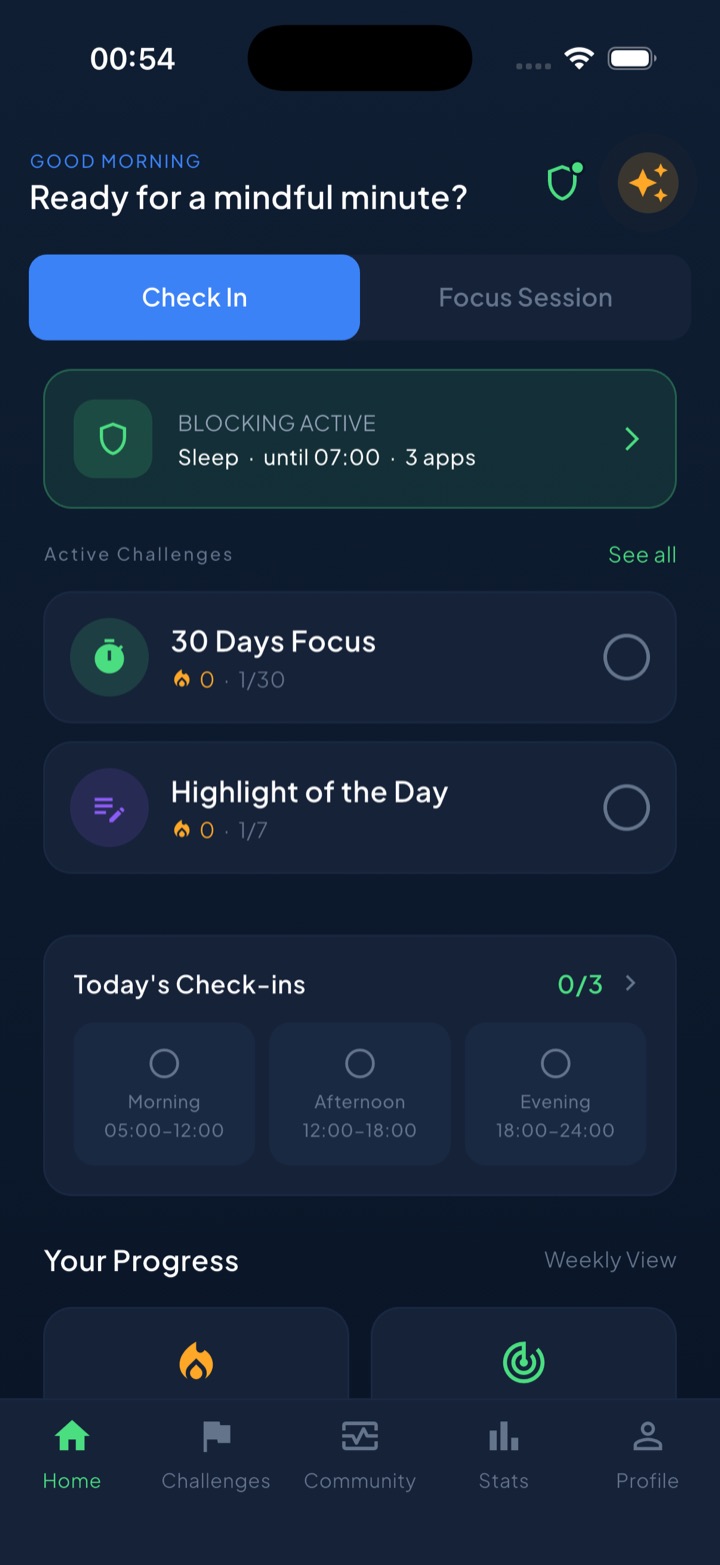
Here’s why that matters for the tantrum loop:
- Scheduled block routines for family hours. Shield your feeds from, say, 17:30 to 20:00 — dinner, bath, bedtime. When your phone is genuinely boring, handing it over stops being the zero-effort option, and the calm bag wins by default.
- A deliberate middle ground, not a wall. The short “take a break” bypass exists for the real exceptions — a video call with grandma is two taps away, doomscrolling isn’t.
- A streak that keeps you honest. Daily check-ins and a visible streak turn “I should be on my phone less around the kids” into a habit you can actually see — including on a lock-screen widget, so the phone itself reminds you to put it down.
The truthful version: the toolkit above — calm bag, scripts, one context at a time — needs no app at all. Unscrol’s job is to handle the adult half: making your phone the boring object in the room, so the patient option is also the easy one.
Frequently asked questions
Is it bad to give my toddler a phone to stop a tantrum?
Occasionally, no — a flight, a waiting room, or a sick day is exactly what the tool is for, and no researcher is worried about those moments. The pattern worth changing is habitual use: when a screen becomes the default answer to every big feeling, researchers suggest toddlers get fewer chances to practice calming themselves, and some studies link frequent device-calming with weaker self-regulation over time. Dose and pattern matter far more than any single moment.
Why does a screen calm a toddler so instantly?
Young brains are wired to lock onto bright, fast-moving, novel stimuli — an orienting reflex a toddler can't override. The screen out-competes the internal storm, so the crying stops because the feeling is interrupted, not resolved. That's distraction, which is different from regulation: the skill of noticing a big feeling, riding it out, and recovering. It also trains the parent — tantrum, screen, silence is a powerful loop for both of you.
When is it genuinely okay to use a screen to calm my toddler?
Rescue moments: flights and long journeys, waiting rooms, illness, or when one parent has to handle something urgent and safety matters. Those are logistics, not emotional education, and using a tablet there is reasonable parenting, not failure. A useful rule of thumb: screens for boredom and logistics occasionally is fine; screens as the standard response to feelings — every tantrum, every frustration, every bedtime battle — is the one habit worth gently changing.
How do I calm a toddler meltdown without a screen?
Rule out hunger and tiredness first, then get low, slow, and calm — toddlers borrow their parent's nervous system, so your steadiness is the tool. Name the feeling in a few words, offer the body something (a hug, rocking, stepping outside, a sip of water), and let the wave crest and pass, which usually takes minutes. Afterward, reconnect. You won't do this perfectly every time; good-enough consistency is what builds the skill.