Recommended screen time by age comes down to a short, well-established chart. The World Health Organization and the American Academy of Pediatrics (AAP) broadly agree: children under 18–24 months should avoid screens except live video chat; toddlers 18–24 months should only see high-quality content watched with a parent; ages 2–5 get about one hour a day of quality programming, co-viewed; and from age 6 onward there is no single magic number — the goal becomes consistent limits that protect sleep, activity, homework and real-world time. For teens and adults, the official guidance drops the stopwatch entirely and asks a better question: what is the screen time replacing?

What is the recommended screen time by age? (the chart)
Here is the guidance parents actually search for, in one table. Treat the numbers for young children as firm, and the older bands as principles rather than precise caps.
| Age band | WHO / AAP guidance | What it means in practice |
|---|---|---|
| Under 18–24 months | Avoid screens except live video chat | Babies learn from faces and voices, not feeds. FaceTime with grandma is fine; background TV and solo tablet time are not. |
| 18–24 months | Only high-quality content, watched together | If you introduce media, sit and narrate it. Co-viewing is what turns a screen into a shared experience. |
| 2–5 years | About 1 hour/day of quality content, co-viewed | One hour is a ceiling, not a target. Prioritise slow, ad-free, educational content over fast-cut entertainment. |
| 6–12 years | No single number; consistent limits | Protect sleep, physical activity and homework first, then let the rest fit around them. Build a Family Media Plan together. |
| Teens (13–18) | Focus on displacement, not a stopwatch | Ask what the time crowds out. Late-night phone use is the biggest lever — it steals sleep first. |
| Adults | No official cap | Judge by what it replaces: rest, movement, and people. If screens are winning those trades, that’s the signal. |
Notice the shape: hard numbers for the youngest kids, and a shift to judgment as children get older. That shift is intentional, and it’s the part most chart pages get wrong.
Why did the AAP drop hard limits for older kids?
The old “two hours a day for everyone” rule was memorable and mostly ignored. The AAP retired it for kids 6 and up because a rigid cap does two unhelpful things: it treats a video call to a cousin the same as three hours of autoplay, and it pretends a 6-year-old and a 15-year-old need the same rule.
In its place came the Family Media Plan — a personalized set of limits built around your household’s sleep, meals, activity and homework. The AAP’s own language for older kids is telling: place consistent limits, and make sure media doesn’t displace adequate sleep, physical activity and other behaviors essential to health. In other words, the cap became relative. You start from the non-negotiables — a bedtime that protects sleep, time for exercise, space for homework and phone-free studying — and screen time gets what’s left.
This is also why generic screen-time limits so often fail: a number with no plan behind it is just a wish.
What counts as “quality” screen time?
For every age band, the AAP stresses quality over quantity, and two factors decide quality:
- Co-viewing. A parent watching and talking through content turns passive screen time into learning. This matters most for toddlers, where solo screen time has little educational value but co-viewed content can.
- Pace and purpose. Slow, story-driven, ad-free content is gentler on developing attention than fast-cut, algorithm-fed clips. A video call, a drawing app, or a documentary is a very different “hour” than an endless short-form feed.
The practical upshot: one curated hour beats three passive ones, and what’s on the screen matters as much as how long it’s on.
“I spent years fighting my son over ‘how many minutes.’ Switching to a Family Media Plan changed everything — we agreed screens go off an hour before bed and homework comes first, and the minute-counting arguments basically disappeared. The limit finally felt like ours instead of a rule I was policing.”
— Marcus, dad of two, 41
How much screen time is healthy for adults?
Here’s the honest answer: there is no official numeric limit for adults. Neither the WHO nor the AAP publishes an adult cap, because the risk isn’t the screen itself — it’s what the screen crowds out.
The useful frame is displacement. Reported global averages hover around six to seven hours of total daily screen time, much of it on phones — but those figures are contested, vary widely by country, and depend heavily on how they’re measured, so don’t anchor your self-worth to them. (We dig into how much the average person actually spends on their phone separately.) The more useful test is personal: does your phone use leave you rested and connected, or drained and behind? If it’s routinely eating your sleep, your workouts, or your evenings with people, that’s the line to redraw — and the best place to start is reducing screen time around bedtime.
How do you set age-appropriate screen time limits on iPhone?
Apple’s built-in Screen Time covers the basics for free, and it’s genuinely good. Here’s the age-aware setup:
- For a young child’s device, use Family Sharing and set up the child’s Apple ID, then configure Screen Time limits from your own phone — Downtime, App Limits and Content restrictions.
- Set Downtime around sleep. Pick a window (say 21:00–07:00) where only calls and a few chosen apps work. For every age band, protecting sleep is the single highest-value limit.
- Add App Limits by category, not just single apps — “Social” or “Games” as a group is harder to game than one app at a time.
- Agree the plan out loud. For older kids, the limit sticks far better when it’s a shared Family Media Plan than a silent restriction they discover at a bad moment.
- Know the escape hatch. On iOS, when an App Limit is reached the child (or you) can tap “Ignore Limit” and keep scrolling. That one button is why so many limits quietly stop working — the friction is a tap away.
How Unscrol helps you keep the limits you set
To be clear about what Unscrol is and isn’t: it’s a personal screen-time and app-blocker app for your own iPhone and Apple Watch — not a parental-control tool, and it doesn’t manage a child’s device remotely. For young kids, Apple’s Family Sharing and Screen Time are the right (and free) starting point. Where Unscrol earns its place is with teens and adults holding the limits they already chose — the exact group where a hard number stopped applying and consistency became the whole game.
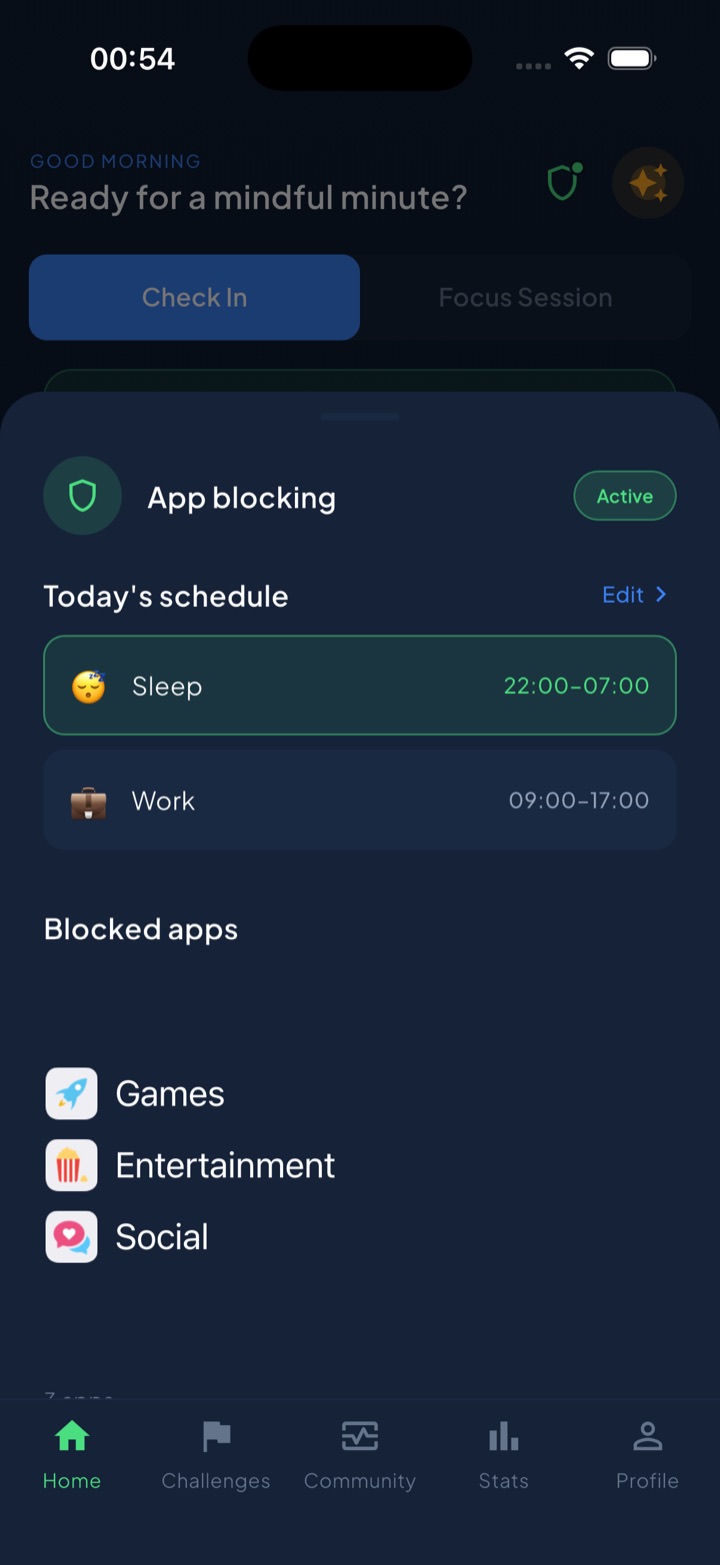
The pieces that help you keep a limit rather than just set one:
- Scheduled blocking routines — a Sleep block from 22:00–07:00 or a Work block from 09:00–17:00 that auto-shields chosen apps and whole categories, enforced by Apple’s own Screen Time frameworks (real system shields, not overlay reminders).
- A short “take a break” bypass — a deliberate middle ground between a soft nudge you’ll ignore and a lock that makes you resent the app. You can step past a block when you truly need to, without it becoming the default.
- A daily streak and check-ins that reward the consistency the AAP’s Family Media Plan is really asking for — showing up day after day, not hitting a perfect number once.
Apple’s Screen Time can set the limit for free. Unscrol’s job is to make it stick — with schedules that fire on their own, and a streak that turns a limit into a habit instead of a daily argument.
Frequently asked questions
How much screen time is recommended by age?
The two most-cited guidelines come from the WHO and the American Academy of Pediatrics (AAP). Under 18–24 months: avoid screens except live video chat. 18–24 months: only high-quality content, watched together. Ages 2–5: about one hour a day of quality programming, co-viewed. Ages 6 and up: no single number — instead, consistent limits that protect sleep, physical activity, homework and in-person time. Teens and adults have no official cap; the guidance shifts to what screen time displaces rather than a stopwatch reading.
Did the AAP remove its screen time limits for older kids?
Not exactly. The AAP still recommends about one hour a day for ages 2–5. For children 6 and older it deliberately moved away from a single hard number and toward a Family Media Plan — consistent, personalized limits that make sure media doesn't crowd out sleep, exercise, homework and face-to-face time. The reasoning is that a 7-year-old and a 16-year-old need very different rules, and a one-size number was widely ignored anyway. So the cap became a conversation, not a stopwatch.
How much screen time is healthy for adults?
There is no official numeric limit for adults from the WHO or AAP. Health guidance judges adult screen time by displacement: is it crowding out sleep, movement, or real-world relationships? A practical test is whether your phone use leaves you rested and connected or drained and behind. Reported global averages sit around six to seven hours of total screen time a day, much of it on phones — but averages are contested and vary by country and how they're measured. Protecting sleep is the highest-value place to draw a line.