The most effective thing a parent can do is help build the structure, not police the outcome. Sit down with your teen and co-design phone-free study windows rather than imposing them; let them help choose which apps get blocked and when; set up a phone parking spot the whole family uses, yours included; and keep the tone supportive rather than punitive. Rules a teenager helped create get followed, while rules handed down get resented and worked around. Your job is the environment and the encouragement — a good workspace, a phone-free window, a calm presence — not doing the studying or standing guard over it. Aim for a teen who can eventually manage the phone themselves.
Why does nagging about the phone usually backfire?
Because “put your phone away and study” is a demand for control, and adolescence is largely the project of gaining control over one’s own life. When teens feel a rule is imposed on them, many respond with reactance — the well-documented urge to protect autonomy by doing the opposite, even against their own interest. You’ve likely seen it: the more you push the phone issue, the more the phone becomes the battlefield, and studying gets lost in the fight.
Self-determination researchers Edward Deci and Richard Ryan spent decades showing that motivation is strongest when three needs are met: autonomy (a sense of choice), competence (a sense of progress), and relatedness (feeling supported). Nagging attacks all three at once — it removes choice, implies the teen is failing, and turns you into an adversary. The alternative isn’t permissiveness. It’s being autonomy-supportive: setting real limits, but explaining the reason, offering choices within them, and acknowledging your teen’s perspective. Same limit, completely different reception.
What is the parent’s role, really? The “three legs”
One Turkish father, whose 14-year-old reportedly topped the 2026 LGS (Turkey’s national high-school entrance exam), described the achievement as resting on “three legs — the student, the school, and the parent, working together.” It’s a useful frame precisely because of what it doesn’t say. The parent is one leg of three, not the whole stool. Your leg is not to learn the material, chase every grade, or hover over each session. It’s to hold up the part of the structure the student can’t build alone: a workable environment, steady encouragement, and the removal of obstacles — the biggest of which is usually the phone.
Notice, too, that in the same family the mother credited the teacher’s motivation and follow-up. The legs support each other; none carries the weight alone. The practical takeaway for you is modest and freeing: you don’t have to be your teen’s tutor or their warden. You have to be the person who makes focused study possible and then gets out of the way so they can own the result — and the pride that comes with it.
How do you co-design the rules instead of imposing them?
The shift from “my rule” to “our rule” is the single highest-leverage move available to you. A teenager who helped design a limit has a reason to defend it; one who had it dropped on them has a reason to beat it. Co-design looks like this:
- Start with a shared goal, not a restriction. “You said you want to get into that program — let’s figure out what would actually protect your study time” beats “no phone after 8.”
- Let them choose the specifics. Which apps get blocked, which windows, where the phone parks. Ownership of the details buys compliance with the rule.
- Make it mutual. If the study window is phone-free, your phone parks too. A rule that applies to the whole family reads as a norm; one that applies only to them reads as a punishment.
This is the same logic behind helping any student build study discipline through design rather than willpower — you’re arranging the environment so the good choice is the easy one. When your teen helps set up a scheduled block themselves, they’re not being controlled; they’re using a tool they chose, which is exactly the autonomy that makes it stick.
A family phone-during-study agreement you can write tonight
You don’t need an app or an expert for this. A single sheet of paper, filled in together, does most of the work. Draft something like:
- The window. “Homework happens [time]–[time] on school nights, phone-free.” Agree it together.
- The parking spot. A named place the phone lives during the window — a box in the kitchen, a drawer — used by everyone in the house during that time.
- The exception rule. How your teen reaches you or a study partner if genuinely needed, so the block doesn’t feel like a trap.
- The review date. “We’ll check in every two weeks and adjust.” Rules that can flex don’t have to be broken to change.
- The trust ladder. Spell out how limits loosen as the routine holds: fewer blocked hours, more self-management, as they demonstrate it.
Protecting sleep belongs in the same agreement — screens late at night quietly erode both focus and grades, and the link between screen time and sleep is one of the most robust findings in this whole area. A phone that charges outside the bedroom overnight is often the highest-return rule on the page.
What does the research on parental mediation suggest?
Here honesty matters, because the evidence is genuinely mixed and you should be wary of anyone selling certainty. Broadly, researchers distinguish restrictive mediation (hard limits and bans) from active mediation (talking about content, co-viewing, explaining the why). Restrictive rules can reduce screen time in the short term, but studies suggest they work better when paired with active, conversational involvement — and that purely restrictive approaches can lose their grip as teens get older and find workarounds. The headline teen-screen statistics from groups like Common Sense Media and Pew are real but should be held loosely; they describe averages across huge populations, not your specific kid.
The defensible summary: limits plus conversation beat limits alone. Use controls as scaffolding your teen understands and helped build, keep talking about why focus matters rather than only enforcing rules, and treat the goal as self-regulation they’ll eventually carry without you. You are trying to work yourself out of the enforcement job.
“The change wasn’t a stricter rule, it was sitting down together and letting him pick the study hours and which apps got blocked. Once it was his plan instead of mine, the nightly argument basically disappeared. I park my phone in the same box now too, which honestly helped me as much as him.” — Rachel, parent of a high-schooler
How Unscrol can help a family set this up
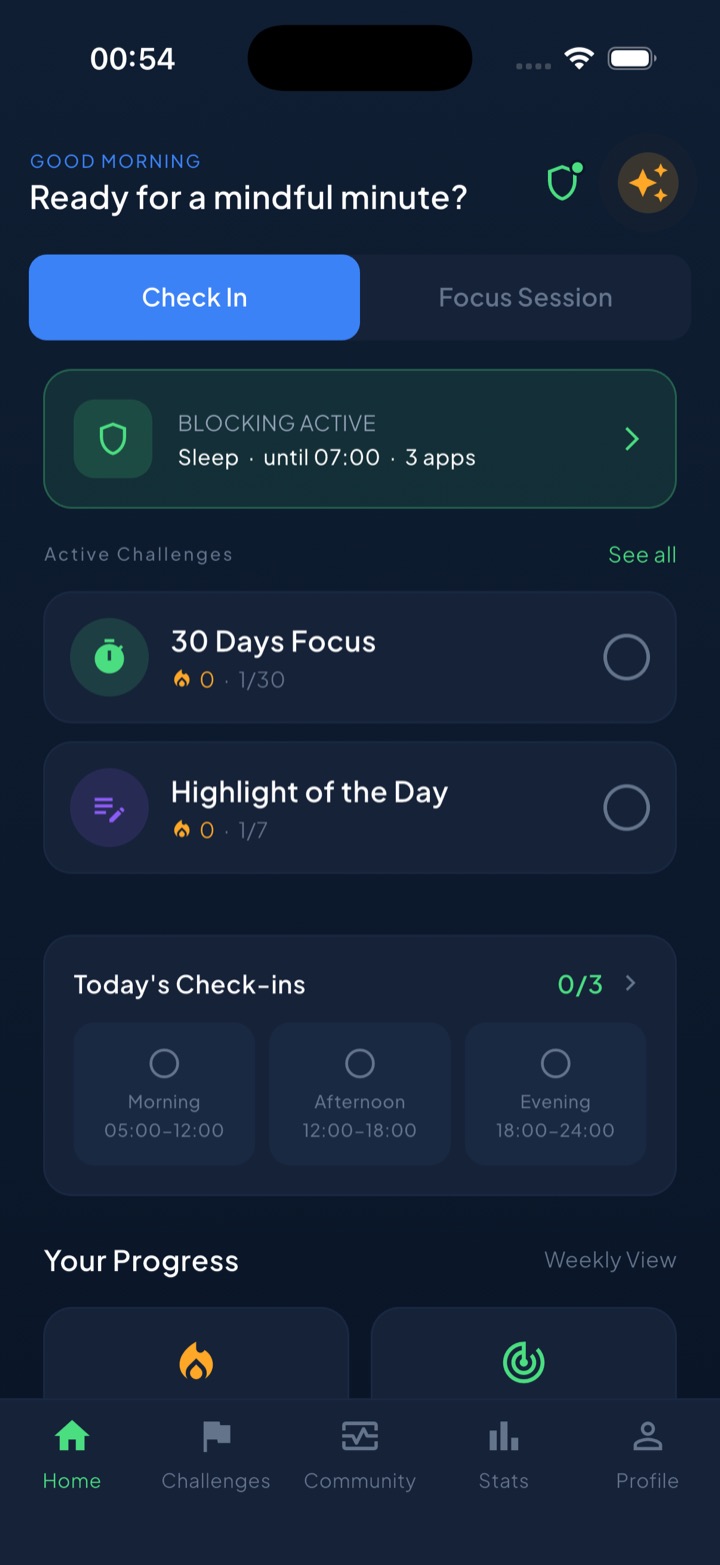
If your family wants a tool to enforce the window you agreed on, Unscrol, the screen-time app we build, is designed for exactly this — and ideally set up by the teen, not done to them. Its scheduled blocking routines let you create a recurring study window (say, 17:00–19:00 on school nights) that automatically blocks chosen apps and categories using Apple’s Screen Time frameworks, so the rule holds without anyone standing over it. The blocking is real and system-level, and the app’s blocked-app choices and usage data are processed on-device by iOS — they never reach our servers, which matters for a young person’s privacy.
You do not need it. Apple’s built-in Screen Time can create similar downtime schedules for free, and a phone parked in a kitchen box needs no software at all. What a shared, teen-owned setup adds is that the limit is visible, mutual, and chosen rather than nagged — which is the difference between a rule your teen defends and one they try to defeat. Whatever tool you use, keep your leg of the stool where it belongs: supporting the structure, not policing the person.
Frequently asked questions
How do I get my teenager to study without the phone?
Co-design the rule instead of imposing it. Sit down together, agree on phone-free study windows, and let your teen help choose which apps get blocked and when. Rules a teen helped make get followed; rules handed down get resented and worked around. Pair it with a phone parking spot during study time, and keep your own phone parked too so it reads as a family norm, not a punishment.
Does taking away my teen's phone help their grades?
Confiscation can protect a single study session, but as a long-term strategy it tends to trigger resentment and workarounds without teaching self-regulation. The more durable win is removing the phone from the study environment by agreement, so it's not a battle each night. The goal is a teen who can eventually manage the phone themselves, not one who only studies under surveillance.
Should I use screen-time controls or trust my teen?
It's not either-or. Think of controls as scaffolding, not surveillance: helpful early or during exam sprints, and best when your teen helped set them up and understands why. Autonomy-supportive limits, explained and co-owned, tend to land better than controlling ones imposed without a reason. Loosen them as your teen shows they can hold the routine on their own.
How much should I be involved in my teen's studying?
Enough to support the structure, not so much that you own the outcome. One Turkish father of a top exam scorer described success as having three legs: the student, the school, and the parent. Your leg is the environment and the encouragement, not the studying itself. Help set up phone-free windows and a good workspace, then let your teen do the work and take the credit.