Study discipline is not a personality trait you either have or lack — it’s a system you design so the studying choice takes as little willpower as possible. The disciplined-looking student usually isn’t grinding through raw self-control; they’ve removed the phone from the room, shrunk the start to something trivially small, tied studying to a fixed daily cue, and turned consistency into a streak worth protecting. Willpower is finite and unreliable, so the goal is to need less of it. Build the environment and the routine first, and the discipline shows up as a by-product. You don’t summon it each morning; you engineer it once and maintain it.
Is study discipline something you’re born with?
It rarely is. When we watch a consistent student and call them “disciplined,” we’re usually seeing the output of good routines, not a rare inborn strength. Research on self-control points to something counterintuitive: people who score high on self-control often report experiencing fewer temptations in the first place — not because they resist harder, but because they’ve arranged their lives to avoid the fight. Their discipline lives in the setup, not in a heroic act of will at 8pm.
The most useful evidence you’ll find is in how top performers actually build up. One Turkish 8th-grader who reportedly topped the 2026 LGS (Turkey’s national high-school entrance exam) didn’t describe a sudden leap into monk-like focus. He described a gradual ramp — starting prep in 7th grade, increasing the pace through 8th, and pushing hardest only in the last few months. That’s the real shape of discipline: not a switch you flip, but a load you increase slowly enough that your routines can carry it. Habit-formation research backs this up, finding that behaviors take on average around two months of repetition to feel automatic, with big variation. You are not failing because it feels effortful early. It is supposed to.
Why is willpower the wrong thing to rely on?
Because willpower is a terrible daily strategy. It fluctuates with sleep, stress, hunger, and how many decisions you’ve already made that day, and it tends to be lowest exactly when you need it — evenings, after school, when you’re tired. If your study plan depends on winning a willpower battle every single day, you will lose often, and each loss feeds the story that you’re “just not disciplined.”
The reliable alternative is to make the environment do the work. There’s a strong case that environment design beats willpower for almost everyone, because a good environment removes the decision entirely. A phone in another room isn’t a temptation you’re resisting; it’s a temptation that isn’t there. The point isn’t to become someone with superhuman self-control. It’s to arrange things so ordinary self-control is enough.
How do you design an environment where studying is the default?
Discipline by design means changing what’s easy and what’s hard, so the good choice is the path of least resistance. Work on two fronts at once:
- Add friction to the distraction. Phone in another room or a drawer, not face-down on the desk. Log out of the feeds. If you study on a laptop, block the sites for the session. Every extra step between you and a scroll is a step your tired brain often won’t take.
- Remove friction from the work. Books open and on the desk before you sit. Tomorrow’s first task decided tonight. Materials in one place so starting doesn’t require a setup ritual you’ll use as an excuse.
A useful test: make the first ten seconds of studying require zero decisions. If sitting down means an open book and a known first problem, you start. If it means finding your notes, charging your laptop, and deciding what to do, you scroll. The environment, not your character, usually decides which of those happens.
How do you start when you really don’t want to?
Discipline is mostly about winning the first minute, because resistance attacks the start, not the work itself. Once you’re three problems in, continuing is easy; it’s the sitting-down that hurts. So shrink the start until refusing it feels absurd. The two-minute rule captures this: commit only to two minutes — one page, one problem, one card. Almost always, momentum carries you past the two minutes, and if it genuinely doesn’t, you still logged a rep and kept the routine alive.
Pair the tiny start with a fixed cue so you’re not deciding whether to study, only doing the thing your schedule already decided. “After dinner, first problem set” beats “I’ll study at some point tonight” every time. And when the problem isn’t the start but a flat, motivationless dread, that’s worth addressing directly — motivation reliably follows action rather than preceding it, which is the core move for getting past having no motivation to study. You don’t wait to feel ready; you start small and let the feeling catch up.
What do you do after you slip?
You will miss a day. The entire difference between disciplined and undisciplined students is what happens next — and it is not what most people think. The instinct is to punish yourself: “I’m so lazy, I ruined it.” But shame is fuel for avoidance, not effort. The psychologist Michael Wohl and colleagues found that students who forgave themselves for procrastinating before one exam went on to procrastinate less before the next. Letting go of the guilt freed them to get back to work; the ones who stewed in self-blame stayed stuck.
So handle a slip mechanically, not emotionally:
- Name it small. A missed session is a missed bus, not a verdict on your character.
- Do the minimum next. Two minutes the following day keeps the chain alive and rebuilds trust with yourself.
- Never miss twice. One skipped day is noise; two in a row is a new habit forming in the wrong direction. This single rule protects more study routines than any productivity system.
A streak makes this concrete: it gives showing up a visible, immediate reward that studying itself withholds for months, and it makes the “never miss twice” line something you can actually see.
“I always thought disciplined people just wanted it more than me. What actually changed things was boring stuff — phone in the kitchen, book already open, and a two-minute rule so I’d at least sit down. Watching my streak survive the days I didn’t feel like it was what convinced me I could actually do this.” — Daniel, high school senior
Building the system with Unscrol
If discipline is a system, Unscrol, the screen-time app we build, is a set of parts for that system. A focus session blocks the apps competing for your attention using Apple’s Screen Time frameworks, so during a study block the scroll option simply isn’t available — that’s environment design, not willpower. The unified daily streak turns showing up into an immediate reward: any check-in or completed challenge keeps the day, and a Streak Saver can rescue a single missed day so one bad night never becomes a spiral (it deliberately can’t fix two in a row, encoding “never miss twice”).
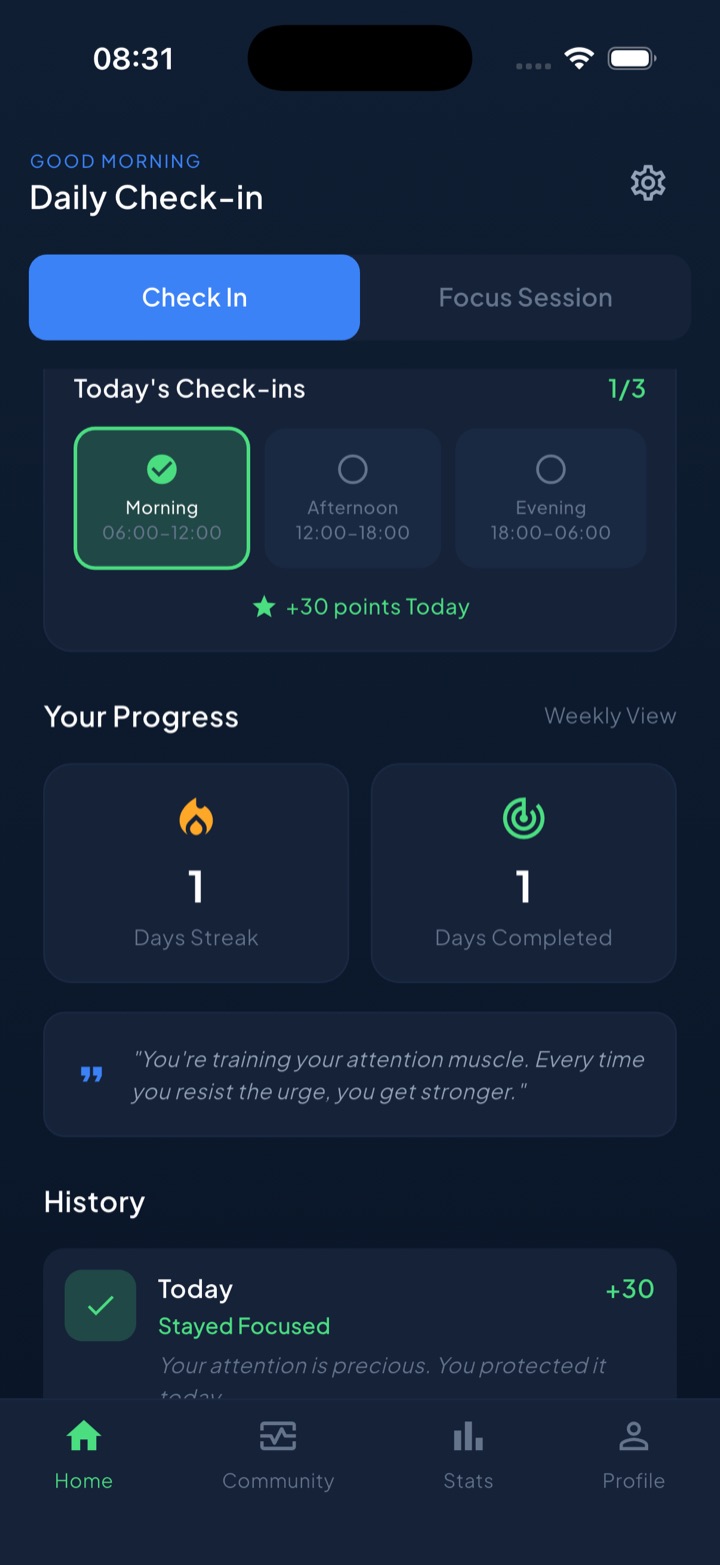
You do not need the app to build discipline, and we’ll say so plainly: a phone left in another room, an open book on the desk, and an X on a wall calendar for every day you studied is the same system for free. What Unscrol adds is enforcement you don’t have to supply yourself — the block holds even when your willpower doesn’t — and a streak that’s harder to ignore than a private promise. The principle underneath is the whole point: design the setup once, and let it carry the discipline you’d otherwise have to summon every day.
Frequently asked questions
How do I build study discipline when I have none?
Stop trying to feel disciplined and start designing for it. Remove the phone from the room so scrolling isn't an option, shrink the start to two minutes so beginning is nearly effortless, attach studying to a fixed daily cue, and track it as a streak so showing up has a reward. Discipline is the result of a good setup repeated, not a trait you summon each day.
Is discipline something you're born with?
The evidence says mostly no. What looks like inborn discipline is usually a person who has built strong routines and a low-temptation environment, so the 'disciplined' choice takes little willpower. People who resist temptation well often report facing less of it — they arranged their lives to avoid the fight. Discipline is far more designed than inherited.
What's the difference between motivation and discipline?
Motivation is the feeling that makes you want to study; discipline is the structure that gets you studying whether or not the feeling shows up. Motivation is real but unreliable, it comes and goes. Discipline replaces the daily decision with a routine and an environment, so on low-motivation days you fall back on a system instead of a mood.
I keep breaking my study routine after one bad day. How do I stop?
Treat the slip as one missed rep, not proof you failed. Research on procrastination found students who forgave themselves after slipping went on to procrastinate less next time. Do the minimum version the next day to keep the chain alive, and follow one rule: never miss twice. One skipped day is noise; two in a row is a new pattern forming.