If you have no motivation to study, stop waiting for it, motivation reliably follows action rather than preceding it. The most consistent students don’t feel more inspired; they’ve built systems that make starting nearly automatic and don’t depend on feeling like it. The fix has four parts: shrink the starting line to something almost too small to refuse, prepare your environment the night before so there’s no friction, use streaks or accountability to make showing up its own reward, and forgive past procrastination, which research shows actually reduces future procrastination. Feeling motivated is the result of starting, not the requirement for it. Build the system and the motivation shows up on its own.
Why do you have no motivation to study?
Because motivation is a feeling, and feelings are a terrible foundation for anything you have to do regularly. It swings with your sleep, mood, stress, and blood sugar, and none of those are reliable on a Tuesday night before an exam. Worse, studying is a slow-reward activity: the payoff is a grade weeks away, while your phone offers a payoff in seconds. In that matchup, “not feeling like it” is the default, not a malfunction.
A few things quietly drain study motivation:
- The task is too big. “Study for the exam” is vague and enormous, and vague enormous tasks trigger avoidance. Your brain doesn’t know where to grab it.
- The reward is invisible. Nothing happens when you study for an hour, no ding, no like, no number goes up. Compare that to the feed.
- Shame is in the way. If you’ve fallen behind, opening the book means facing how behind you are, so you avoid the book to avoid the feeling, the core loop behind how to beat procrastination.
The important reframe: you will almost never feel like studying at the start. Building a routine that expects that, instead of being surprised by it, is the whole game.
Does motivation come before or after action?
After. This is the single most useful thing to understand about motivation, and it’s backed by how behavior actually works: action generates motivation more reliably than motivation generates action.
You’ve felt this. The hardest part of a run is putting on your shoes; ten minutes in, you’re fine. The hardest part of studying is opening the book; twenty minutes in, you’re absorbed. The feeling you were waiting for was on the other side of starting the whole time.
This flips the standard advice on its head. Don’t try to feel motivated. Try to start in a way so small that motivation is irrelevant:
- Not “study biology” but “open the textbook to chapter 4.”
- Not “write the essay” but “write one bad sentence.”
- Not “do the problem set” but “read problem one.”
This is the logic of the two-minute rule: commit only to two minutes, because starting is the entire battle and the Zeigarnik effect (our discomfort with unfinished tasks) tends to pull you onward once you’ve begun. You’re allowed to quit after two minutes. You usually won’t.
How do you start when you don’t feel like it?
Design the start so it needs no willpower. Two moves do most of the work: prepare the environment in advance, and remove the competition.
- Prep the night before. Decide tonight exactly what you’ll study, and set it out: book open to the right page, notes ready, pen on the desk. In the morning or evening, you sit down to a runway, not a decision. Deciding-what-to-do is itself a motivation tax; pay it in advance when you’re calmer.
- Shrink to a first action. Write the smallest possible first step on a sticky note: “open notes, read one page.” Small enough that saying no feels absurd.
- Remove the easy alternative. The phone is the default escape hatch. Put it in another room before you sit down, not on the desk face-down, in another room. If the easy pleasure is one tap away, the two-minute start rarely survives.
- Use a timer. Tell yourself “just 25 minutes,” a visible finish line makes a dreaded session feel survivable, and it pairs naturally with protecting your study focus.
| Motivation-based approach | System-based approach |
|---|---|
| Wait until you feel like studying | Start small regardless of how you feel |
| ”Study for the exam” (vague, huge) | “Read one page” (specific, tiny) |
| Decide what to do in the moment | Prep the desk and plan the night before |
| Phone on the desk, resist it | Phone in another room, nothing to resist |
| Rely on discipline each time | Rely on a routine that runs itself |
The right column doesn’t require more willpower. It requires less, which is exactly why it holds on the days you have none.
Why does self-compassion beat self-criticism?
Because shame is fuel for avoidance, not for effort. When you miss a study session and respond with “I’m so lazy, I always do this,” you attach pain to the subject, and your brain does what brains do with pain: it steers you away. So you avoid studying even more, which produces more shame, a tidy downward spiral.
The research here is striking. Michael Wohl and colleagues found that students who forgave themselves for procrastinating before a first exam went on to procrastinate less before the next one. Letting go of the guilt freed them to get back to work, while the students who stewed in self-blame stayed stuck. Self-compassion isn’t going soft; it’s removing the shame that keeps you from restarting.
Practically: treat a missed session like a missed bus, mildly annoying, not a verdict on your character. The rule that captures it is “never miss twice.” One skipped day is noise; just don’t let it become two, which is the exact logic behind why streaks build habits. Get back to the two-minute start and let the past session go.
How do streaks and accountability replace motivation?
When the internal reward for studying is invisible and delayed, you borrow an external one. Two mechanisms work especially well:
- Streaks. A visible count of “days I showed up” gives studying the fast reward it otherwise lacks, the number goes up today, every day you start. You’re no longer studying for a distant grade; you’re protecting a chain you don’t want to break. Keep the minimum generous (“any real study counts”) so bad days don’t shatter it.
- Accountability and mild competition. Knowing someone will notice whether you showed up, a study partner, a group, a leaderboard, converts a private, skippable task into a social commitment. We reliably perform differently when our effort is visible to others.
“I stopped trying to feel motivated and just told myself ‘two minutes, one page.’ The night-before prep was the real unlock, sitting down to an already-open book instead of a blank decision. Watching my streak climb, and honestly not wanting to drop on the leaderboard, got me to the desk on the days I really didn’t want to.” — Priya, first-year student, 19
Making showing up the reward with Unscrol
The trap with study motivation is that studying gives you nothing in the moment while your phone gives you everything. Unscrol is built to rebalance that. Its unified daily streak means any check-in or completed challenge keeps the day alive, so showing up produces an immediate, visible reward the study itself doesn’t. The Streak Saver can rescue a single missed day so one slip never becomes a spiral (it deliberately can’t fix two misses in a row, encoding “never miss twice”).
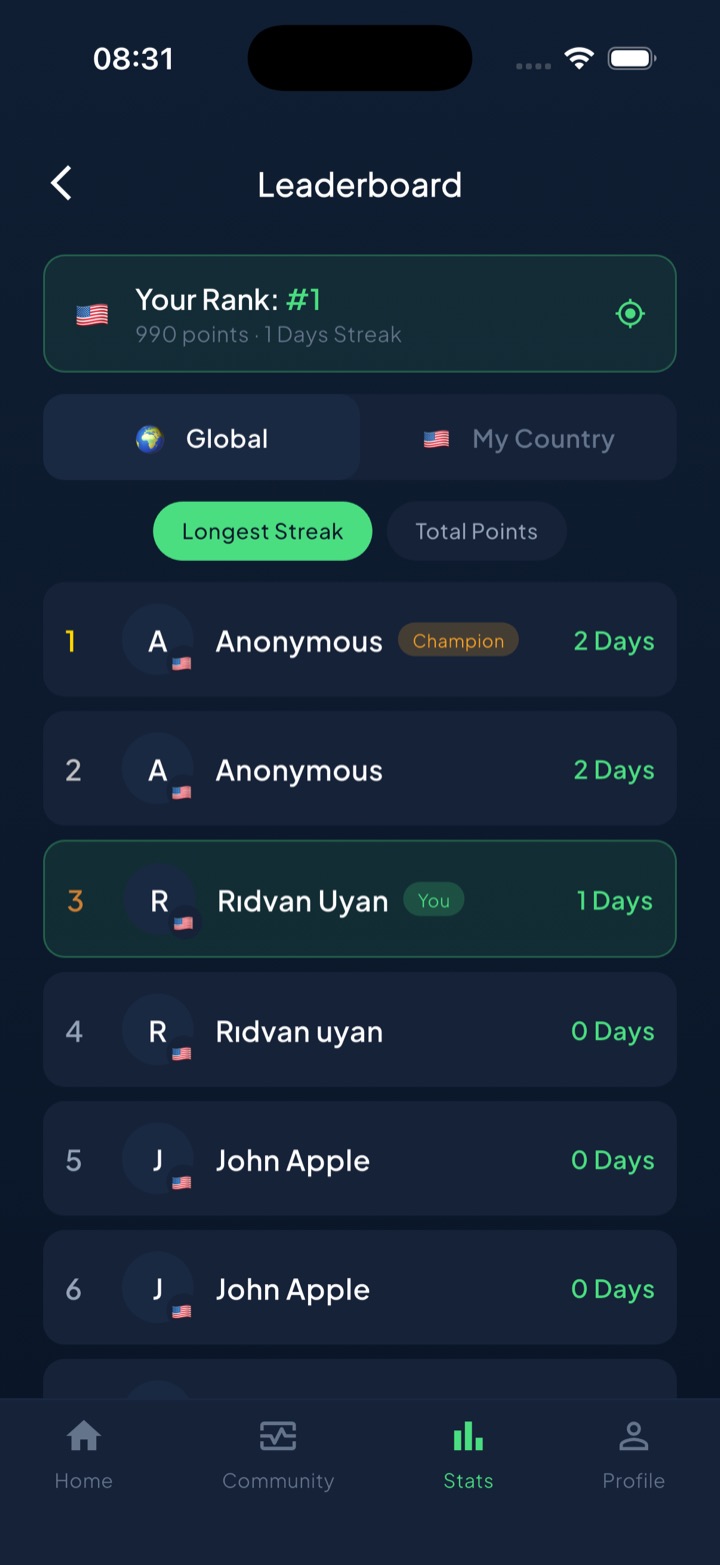
The leaderboard, global and by country, adds the mild accountability of knowing your consistency is visible, ranked by longest streak or points. When you sit down, a focus session blocks the apps competing for your attention using Apple’s Screen Time frameworks, and your usage stays on-device. You can build this yourself too, a wall calendar with an X for every day you studied and a friend you text after each session is the same system for free. The point isn’t the app; it’s the principle: stop waiting to feel like it, and give yourself a reason to show up today.
Frequently asked questions
Why do I have no motivation to study?
Usually not because something is wrong with you. Motivation is unreliable by nature, it rises and falls with mood, sleep, and stress, and studying rarely offers the fast reward your brain craves, so it loses to your phone. Waiting to feel motivated is the actual problem, because for most tasks the feeling arrives after you start, not before. The people who study consistently rely on systems and environment, not on summoning a feeling.
How do I study when I have zero motivation?
Shrink the task until refusing feels silly: commit to just two minutes or a single page, not the whole chapter. Prepare everything the night before so there's no friction to fight in the moment. Remove your phone from the room so the easy alternative is gone. Once you've started, momentum usually carries you past the two minutes. The goal is to make starting nearly automatic, not to wait for inspiration.
Does being hard on myself help me study more?
The research suggests the opposite. In a study by Michael Wohl and colleagues, students who forgave themselves for procrastinating before one exam procrastinated less before the next. Self-criticism tends to add shame, and shame drives avoidance, you dodge the subject that makes you feel bad. Treating a missed session as a normal slip rather than proof of failure makes it far easier to sit back down and start again.