Distracted parenting is what happens when the phone habitually splits your attention while you’re with your kids — half-listening at the playground, scrolling during a bedtime story, drifting mid-sentence toward a notification. Researchers call these small tech interruptions in family time technoference, and the evidence, read carefully, says two things at once: ordinary moments of divided attention are normal and not damaging, and the pattern still matters, because young children read our attention constantly and build both their sense of connection and their own future phone habits from what we do, not what we say. The realistic goal isn’t a phone-free parent. It’s protecting a few moments that matter — and repairing the ones we miss.

What is technoference — and is it the same as phubbing your child?
Technoference was coined by family-media researchers in the mid-2010s to describe everyday device interruptions in face-to-face interaction: the ping that pulls your eyes away mid-story, the “one quick reply” that turns into three minutes of silence over dinner. Nothing dramatic — that’s the point. It’s the accumulation of small breaks in attention, not any single one.
You may also have heard the word phubbing — snubbing someone by looking at your phone. We’ve covered phubbing in adult relationships separately, and the dynamic there is different: your partner can name it, complain about it, negotiate about it. Phubbing your child is the same behavior aimed downward, at someone who often can’t name it. A four-year-old doesn’t say “I feel deprioritized when you check Slack.” They just feel something, draw a small conclusion about how interesting they are, and either escalate or go quiet.
One more thing worth saying plainly: everyone does this. Technoference research consistently finds device interruptions in parent-child time to be the norm across families, not a failing of bad parents. This article is about the pattern, not the glance.
What does research cautiously say about parents on phones?
The research here is young, and the honest summary is more modest than the headlines.
- It’s common. In surveys, most parents report that devices interrupt time with their children regularly — often daily. If you feel caught, you’re in the majority.
- Absorbed parents respond differently. Observational studies — including researchers quietly watching caregivers at restaurants and playgrounds — suggest that parents deep in a phone respond to children less often, more slowly, and with flatter tone, and sometimes react more harshly when interrupted mid-scroll.
- Heavier technoference is associated with more difficult child behavior. Several studies have found links between frequent phone interruptions and more whining, frustration, and attention-seeking in young children. But these are correlations with generally small effects, and the arrow likely points both ways: a child having a hard week drives a tired parent into the phone, too. Researchers themselves flag this repeatedly.
- No study shows that normal phone use damages children. That claim simply isn’t in the literature. What the literature supports is narrower and more useful: the dose and the timing of divided attention matter, especially in the handful of daily moments when a young child is actively seeking you.
So the takeaway isn’t fear. It’s focus: not less phone, always, but full attention, sometimes, predictably.
What can the still-face experiment teach phone-era parents?
In 1975, developmental psychologist Edward Tronick ran what became one of the most replicated demonstrations in child psychology: the still-face experiment. A mother plays face-to-face with her baby — cooing, mirroring, responding. Then, on cue, she holds a completely blank, unresponsive expression for about two minutes. The babies’ reaction is fast and unmistakable: they smile harder, point, shriek, reach — working to win her back — and when nothing works, they become visibly distressed and eventually turn away.
Two honest caveats before drawing any phone conclusions. A parent on a phone is not performing a still face — your face isn’t frozen, you murmur “mm-hmm,” you look up. And the experiment is a short, deliberate lab setup, not a model of daily life. Researchers who study technoference are careful about stretching the comparison, and we should be too.
But two insights transfer beautifully:
- Even pre-verbal babies actively monitor whether your attention is available — and work hard to get it back when it isn’t. Attention isn’t an extra; it’s the channel the whole relationship runs on.
- Repair is the real lesson. When the mother re-engages, most babies recover quickly. Tronick spent much of his career on exactly this point: mismatches between parent and child happen constantly, in every family, and the repair — not the absence of rupture — is where trust is built. That’s the anti-perfectionism finding, straight from the source.
How do kids read our attention — and copy our habits?
Young children make bids for attention all day: “look at this,” a tug on your sleeve, a drawing held up. What studies of parent-child interaction suggest is that when bids repeatedly land on a phone-absorbed parent, kids don’t shrug — they escalate (whining and acting out are often just bids at higher volume) or, over time, bid less.
When researchers ask school-age children directly about parents’ phones, many say versions of the same thing: they notice, and they mind — especially at meals, in the car, and at pickup.
Then there’s modeling, the quiet long game. Kids’ media norms are learned mostly by watching: whether phones belong at the table, whether a buzz always wins, whether boredom is something you sit with or instantly medicate with a screen. Studies of family media use consistently suggest that parents’ habits are among the strongest predictors of kids’ habits. If you’re thinking about your child’s own screens, our screen-time recommendations by age covers that side — but the uncomfortable, empowering truth is that the most effective parental control is the one you apply to your own phone.
What are realistic phone boundaries for parents — not perfection?
You don’t need eight phone-free hours. You need a few anchor moments protected, and permission to be human the rest of the day.
| Moment | Why it counts | Phone plan |
|---|---|---|
| Reunion (school/daycare pickup, coming home) | Kids often save their day’s feelings for the first minutes back with you | Phone in bag or pocket until you’re settled |
| Mealtimes | Highest-density conversation window of the day | Phone off the table, charger in another room |
| Bedtime routine | Attention here reads as safety; scrolling here reads loudest | Leave the phone outside the bedroom |
| Kid absorbed in independent play | Independent play is good for them — hovering isn’t the goal | Fine to use your phone; you’re off duty |
| Naps, after bedtime, your own downtime | Your rest matters too | Scroll guilt-free |
And a simple way to start this week:
- Pick two anchors, not five. Usually reunion + bedtime, or dinner + bedtime. Small enough to actually keep.
- Give the phone a home — a charger in the hallway or kitchen. Distance beats discipline every time.
- Narrate necessary use. “I’m texting Grandma about Saturday, then I’m done.” Kids handle purposeful use fine; it’s the silent vanishing that confuses them.
- Make it automatic. A schedule that blocks your feeds during those windows removes the decision entirely — more on this below.
- Repair out loud when you slip. “Sorry, I disappeared into my phone. I’m back — show me again.” One sentence. It’s the still-face recovery, on demand.
“I stopped aiming for ‘less phone’ because I failed every day and felt awful. Now I have two rules: no phone from school pickup until we’re home, and none during bath-and-books. Maybe forty minutes total. My six-year-old stopped tapping my arm and saying ‘Mum. Mum. Mum’ — that alone sold me.” — Hannah, mother of a 4- and 6-year-old, 36
Isn’t this just more guilt for parents?
No — and it’s worth pushing back on the doom framing directly. Time-use studies suggest today’s parents spend more focused time with their children than parents did decades ago, not less. Your phone is also how you work, coordinate pickups, order groceries, and stay sane; a parent decompressing with a feed while a child plays happily nearby is not a crisis, and children genuinely benefit from stretches where nobody is entertaining them — boredom does useful work in a developing brain.
The research, read fairly, doesn’t say “be always available.” It says be predictably available in the moments your child seeks you, and reconnect when you miss one. That’s a standard a tired, working, ordinary parent can actually meet.
How does Unscrol help with distracted parenting?
Start free. Give your phone a charging spot outside the kitchen and bedroom, and use Apple’s built-in Screen Time: schedule Downtime across your dinner-to-bedtime window and set App Limits on your own worst feeds — the same tools our iPhone parental controls guide covers for kids’ devices work just as well pointed at yourself. For many parents, that plus two named anchor moments is enough.
Unscrol is the iPhone app for the parents who keep tapping “Ignore Limit” — it uses Apple’s Screen Time frameworks to make the boundary real, and everything is processed on-device: your block lists and usage never touch our servers.
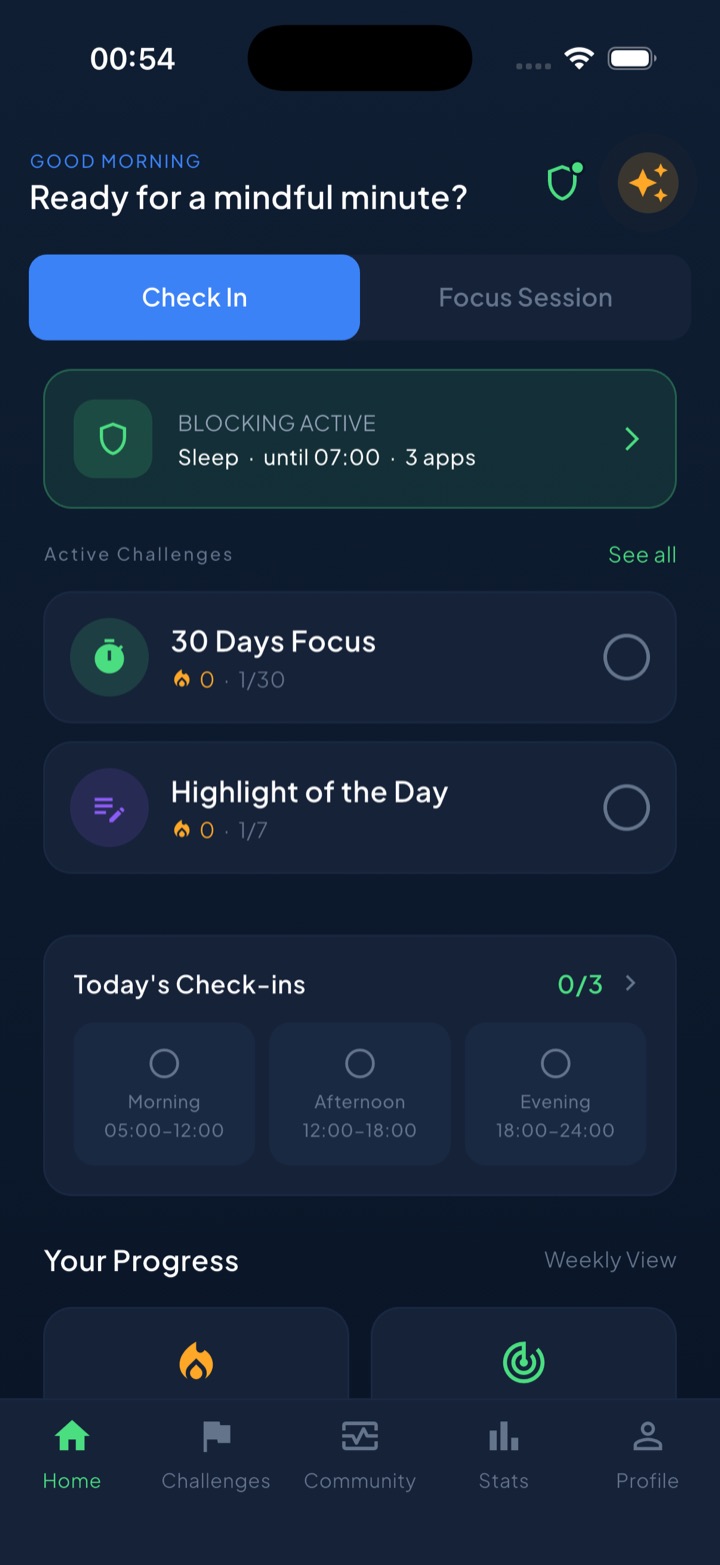
Here’s how it maps onto the anchors above:
- A scheduled block routine for family hours. Create a recurring window — say 17:30 to 20:00 — where your feeds are shielded at the system level. The decision is made once, in a calm moment, instead of renegotiated nightly against a notification.
- A “take a break” bypass for real life. Need the recipe, the class WhatsApp, a call to the pediatrician? A short, deliberate bypass lets you do the necessary thing and then re-shields — a middle ground, not a wall, which is exactly what narrated, purposeful phone use should feel like.
- Check-ins and a streak that make it stick. A quick evening check-in plus a visible daily streak turns “phone-free bedtime” from a resolution into a habit you can see — and one your kids can see you keeping.
The honest version: paper rules, a hallway charger, and Apple’s own tools can absolutely do this. Unscrol is the layer that makes it automatic on the tired days — which, if you’re parenting young children, is most of them.
Frequently asked questions
What is technoference?
Technoference is the term researchers use for the small, everyday interruptions that devices cause in face-to-face interactions — a notification mid-conversation, a quick scroll during play, an email checked at dinner. In parenting research it specifically describes moments when a phone or screen breaks into parent-child time. Studies suggest these interruptions are common enough to be the norm in most families, which is exactly why researchers study the pattern rather than shaming any single glance at a screen.
Does being on my phone around my kids actually harm them?
The honest answer: occasional phone use around your kids is normal and there's no evidence it damages them. What studies cautiously suggest is that a heavy, habitual pattern of technoference is associated with more child frustration and attention-seeking — but these findings are correlational, effects are generally small, and causality likely runs both ways, since stressed parents retreat into phones more. Researchers themselves urge caution. The dose, the timing, and whether you reconnect afterward matter far more than total abstinence.
What does the still-face experiment have to do with phones?
In Edward Tronick's 1975 still-face experiment, a mother plays with her baby, then holds a blank, unresponsive face for about two minutes. Babies quickly protest, try to win her back, and become distressed — showing that even pre-verbal infants actively track whether attention is available. A parent on a phone is not doing the still-face experiment; phone use is milder and shorter. But the insight transfers: children notice unavailable attention early, and — the hopeful half — they recover quickly when connection resumes.
How can parents set realistic phone boundaries?
Skip perfection and protect anchor moments instead: the reunion after school or daycare, mealtimes, and the bedtime routine are the windows where undivided attention pays the most. Put the phone in another room during those, narrate necessary phone use out loud so kids know it's purposeful, and use tools like Apple's Downtime or a scheduled app blocker to make the boundary automatic. When you slip — and you will — repair out loud: put the phone down, name it, and reconnect.