ADHD task paralysis is when you fully intend to do a task — you know what it is, you want it done, the deadline is real — and you still can’t start. You sit frozen in the gap between intending and beginning, often doing something trivially easy instead. It is not laziness. Lazy people don’t care; you care intensely and still can’t move. It’s an initiation failure: ADHD brains struggle to generate the activation that turns a decision into a first physical action, especially when the task is boring, vague, or big. And the smartphone makes it dramatically worse, because it puts an infinitely easier alternative permanently within arm’s reach. The fix isn’t more willpower — it’s lowering the cost of starting and raising the cost of the escape hatch.

Why is task paralysis not laziness?
Laziness means you don’t want to do the work. Task paralysis means you want to — sometimes desperately — and the starting mechanism doesn’t fire. The email stays open. The cursor blinks. You reread the first line of the assignment for the fourth time, “about to start,” while forty minutes evaporate. Then comes the shame spiral: anyone else would have just done it by now.
Researchers who study ADHD, like Russell Barkley, describe it as a disorder of executive function — the brain’s management layer that plans, sequences, inhibits impulses, and, crucially, initiates. Task initiation is a distinct skill, and in ADHD it’s often the weakest link. That’s also what separates this from garden-variety procrastination (which we cover in general form in how to beat procrastination): ordinary procrastination usually melts under a deadline. ADHD paralysis can hold while you’re actively panicking about the deadline — full intention, no ignition, until last-minute adrenaline finally does what willpower couldn’t.
The reframe matters practically, not just emotionally: if the problem were motivation, pep talks would work. Because the problem is activation, what works is structure.
Why is starting the hardest part with ADHD?
Think of every task as having an activation cost — the mental energy needed to go from zero to doing. Several ADHD traits inflate that cost at the exact moment of starting:
- Interest-based ignition. ADHD motivation runs less on importance and more on interest, novelty, urgency, and challenge. A genuinely important-but-boring task offers none of those, so the engine doesn’t turn over — no matter how much you want it done.
- Vagueness tax. “Do the report” isn’t an action; it’s a fog. Before your hands can move, your brain must decide where to start, which file to open, what the first sentence is. Each micro-decision is a small wall, and ADHD makes walls expensive.
- Time blindness. “I’ll start in five minutes” feels safe because five minutes has no texture. An hour later, nothing has started and it’s genuinely surprising.
- Emotion amplification. The dread attached to a stalled task grows the longer it stalls, and dread raises the activation cost further. Paralysis compounds itself.
None of this is an excuse; it’s a mechanism. And mechanisms can be engineered around.
Why is your phone the ultimate initiation-killer?
Every stalled start is secretly a competition between two possible actions. Here’s the matchup your task is supposed to win:
| Starting the task | Picking up the phone | |
|---|---|---|
| Decisions needed before reward | Several (where? which file? first sentence?) | Zero |
| Time to first reward | Minutes to hours | About one second |
| Reward certainty | Uncertain | Guaranteed |
| Physical effort of step one | Open app, find doc, think | One thumb movement |
For a brain that ignites on interest and struggles with initiation, that’s not a fair fight — it’s a rigged one. The feed is a zero-decision, instant-certain-reward machine parked next to a multi-decision, delayed-uncertain-reward task. Worse, the phone doesn’t wait for you to fail; researchers have found its mere presence on the desk drains attention (the 2017 Ward “brain drain” study), so it taxes you even face-down and silent. And every “quick check” during a stalled start resets your warm-up to zero.
This is why phone habits hit ADHD brains disproportionately hard — a pattern we unpack fully in ADHD and phone addiction. For initiation specifically, the conclusion is blunt: as long as the infinitely easier alternative is within reach, “just start” is asking your weakest function to beat a machine built to exploit it.
How do you actually start? Four activation strategies
The strategies that work all share one principle: move the effort out of the moment of ignition and into the environment.
- Shrink the first step until it’s almost silly. Not “write the report” — “open the doc and type the title.” Not “clean the kitchen” — “put one cup in the dishwasher.” You’re not committing to the task; you’re committing to a step so small it costs less than reaching for the phone. This is the two-minute rule, and for ADHD it isn’t a cute trick — it’s a ramp over the wall.
- Borrow someone else’s presence. Working next to another person — in a library, on a video call, in a body doubling session — supplies external activation your brain won’t generate alone. Many people with ADHD find that starting is nearly effortless with a body double and nearly impossible without one. Use that; it’s leverage, not weakness.
- Use a timer as a starting gun, not a stopwatch. Don’t time how long you work; set a countdown to when you begin. “When this 2-minute timer hits zero, my hands touch the keyboard.” An external cue replaces the internal ignition that isn’t firing. Then set a second, short one — “just until the timer rings” — because ten committed minutes usually outlasts the wall.
- Remove the phone from the launch zone. During your starting window, the phone goes in another room, in a drawer, or behind a blocker. This is the highest-yield move because it doesn’t strengthen you — it removes the competitor. Bonus: when you do get a natural ignition window (for many people, the first calm hour of the morning), spend it on the hardest thing first — the eat the frog principle — instead of donating it to the feed.
“I used to sit at my desk for 40 minutes ‘about to’ answer one email, phone in hand the whole time. What finally worked was embarrassing in its smallness: phone in the hallway, a 2-minute countdown, and the rule that at zero I just type the greeting. That’s it. The email takes four minutes. It was never about the email.” — Marcus, software engineer, 34
When is it more than a productivity problem?
An honest boundary: this article is not medical advice. Task initiation strategies are scaffolds, and scaffolds help — but if paralysis is disrupting your work, studies, or relationships across many areas of life, that’s a conversation for a qualified clinician, not a blog post. Many people with ADHD find that treatment (medication, therapy, coaching) is what makes strategies like these actually usable. Scaffolds work best on a treated foundation, and there is no shame in needing either.
How does Unscrol help with ADHD task initiation?
Start with the free route, because it genuinely works: put your phone in another room during launch windows, write tomorrow’s stupid-small first step on paper tonight, and use Apple’s built-in Screen Time to set Downtime or App Limits on your worst apps during the hours you most need to start things.
The ADHD-honest problem with the DIY route is consistency — the system you built in a strong moment is easy to dismantle in a weak one. Unscrol is an iPhone app (iOS 16+) that adds the enforcement layer, using Apple’s own Screen Time frameworks — real, system-level shields, processed entirely on-device, so your block lists and usage never touch our servers.
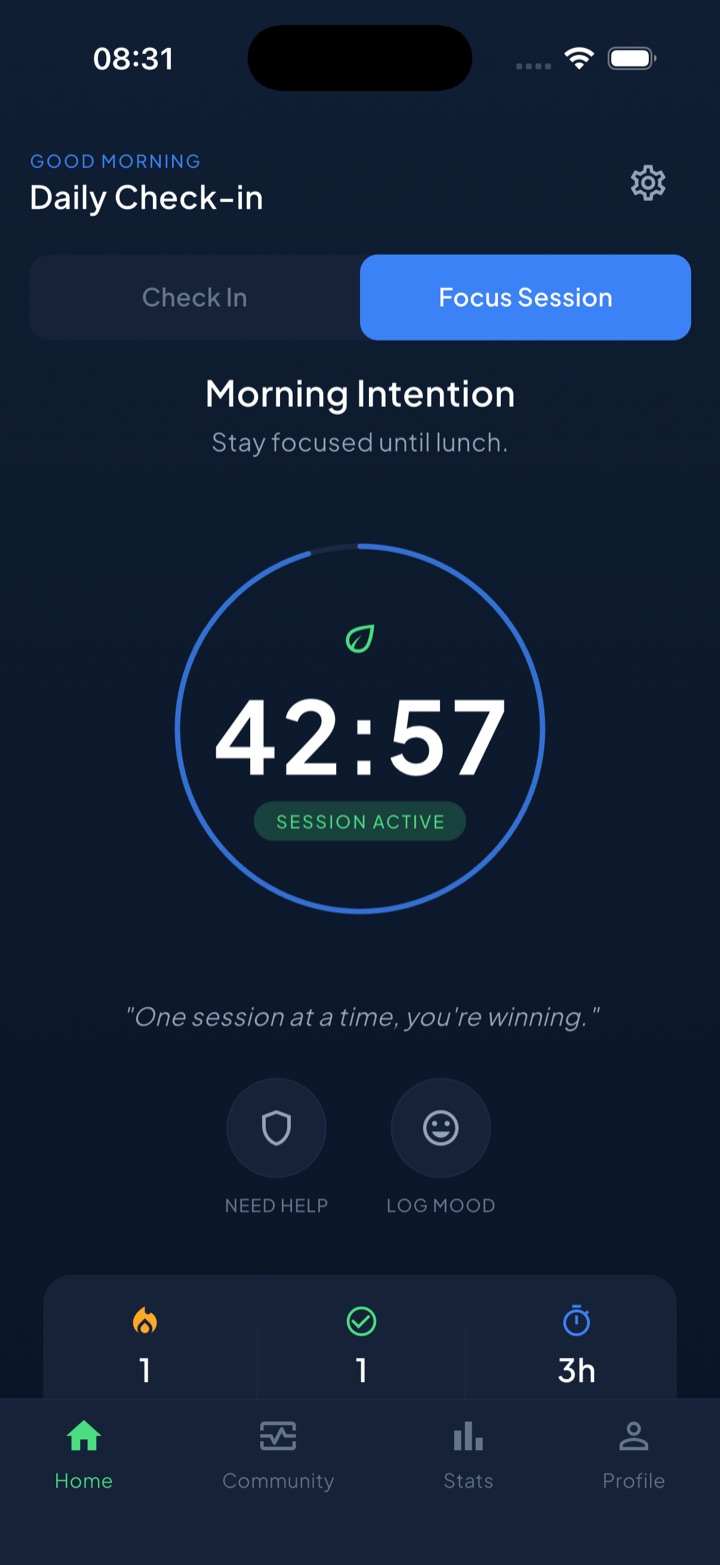
For initiation specifically:
- Scheduled block routines close the escape hatch in advance. A Work block from 9:00 to 12:30 or a School block during study hours means the zero-decision alternative simply isn’t available at launch time — decided once, while calm, enforced when it counts.
- Focus sessions are a starting gun you can see. Start a session and a Live Activity with a draining timer sits on your Lock Screen — an external cue doing the ignition your brain won’t.
- A short “take a break” bypass handles genuine exceptions without tearing the whole system down — a deliberate middle ground for brains that will otherwise delete the blocker entirely.
- Streaks and daily check-ins make starting visible. One started session a day keeps the streak alive, which turns “I began” — the actual hard part — into the thing that gets rewarded.
The honest version: paper, a countdown timer, and Screen Time can absolutely carry you. Unscrol exists for the days they don’t — when the wall is high, the phone is close, and the difference between intending and starting needs to be enforced by something other than willpower.
Frequently asked questions
What is ADHD task paralysis?
Task paralysis is being unable to start a task you fully intend to do — you know what it is, you want it done, the deadline is real, and you still sit frozen between intending and beginning. It's an initiation failure linked to executive function, not a motivation failure. People with ADHD describe being 'about to start' for an hour while doing trivially easy things instead, usually on their phone, and feeling worse the longer it lasts.
Why can't I start tasks even when I want to?
Because wanting and starting run on different systems. Starting requires executive functions — defining the first physical action, ignoring alternatives, and generating activation in the absence of interest or urgency — and those are exactly the functions ADHD taxes. Boring, vague, or big tasks demand the most activation, so they stall hardest. Add a phone within reach offering a guaranteed reward for one thumb movement, and the harder start loses almost every time. It's mechanics, not character.
How do you start tasks when you have ADHD?
Lower the cost of starting and raise the cost of escaping. Shrink the first step until it's almost silly — 'open the document and type the title,' not 'write the report.' Work next to another person, in person or on a video call (body doubling). Use a countdown timer as a starting gun: when it hits zero, your hands move. And put the phone in another room or behind an app blocker during your launch window, so the easier alternative isn't in reach.
Is task paralysis the same as procrastination?
They overlap but aren't identical. Ordinary procrastination is usually avoidance of discomfort, and it tends to yield to deadlines. ADHD task paralysis is an initiation failure that can persist even while you're panicking about the deadline — full intention, no ignition. That's why generic advice like 'just get started' lands so badly. Task paralysis responds better to external structure: smaller first steps, other people, timers, and an environment with no easier alternative in reach.