Eat the frog means doing your most important, most dreaded task first thing, before email, meetings, or your phone can hijack the day. The name comes from a line often attributed to Mark Twain (its real source is unverified) and popularized as a method by Brian Tracy: if you eat a live frog first thing, nothing worse will happen all day. It works for two reasons. First, your hardest task gets your freshest attention and fullest self-control, before the day’s decisions wear you down. Second, finishing it early kills the low-grade dread that drains focus while you avoid it. The task you most want to postpone is usually the one that matters most.
What does “eat the frog” actually mean?
The “frog” is your Most Important Task, the one thing that would make the biggest difference if you finished it, and that you’re most tempted to avoid. It’s rarely the urgent stuff (email, Slack, small errands). It’s the report you’re dreading, the hard conversation, the chapter you keep not writing, the problem set you don’t understand yet.
The method is deliberately simple:
- Identify one frog the night before, or first thing in the morning.
- Do it first, before you open your inbox or your phone, while your mind is uncluttered.
- Don’t negotiate. No “I’ll just quickly check messages first,” which is how the frog stays on the plate all day.
Tracy’s version adds a memorable rule: if you have two frogs, eat the ugliest one first. The point isn’t to do more; it’s to make sure the one thing that matters actually happens, instead of being crowded out by a busy day of small, easy, forgettable tasks. It’s a direct antidote to the avoidance pattern described in how to beat procrastination.
Why does doing the hardest task first work?
There are two mechanisms, one about energy and one about emotion.
The energy argument: decision fatigue. Roy Baumeister’s research popularized the idea that self-control behaves like a resource that depletes as you make choices throughout the day, an idea now debated (the “ego depletion” effect has been hard to replicate cleanly). But even skeptics agree on the practical version: for most people, focus, motivation, and cognitive freshness are highest early and erode as the day fills with interruptions, meetings, and thousands of micro-decisions. Spending your best hour on your hardest task, rather than on triaging email, is simply better allocation. You don’t waste your peak on things a tired brain could handle.
The emotional argument: the open loop. An unfinished important task doesn’t sit quietly. It hums in the background as dread and attention residue, the incomplete-task tension that psychologists have studied for a century, pulling a slice of your attention even while you work on other things. Sophie Leroy’s research on attention residue shows how a task you haven’t closed keeps leaking into the next one. Eat the frog and that loop shuts: the rest of the day is lighter because the worst is done. Anyone doing serious cognitive work knows the relief, which is why frog-first pairs naturally with the principles in deep work.
How do you pick the right frog?
Most people fail at this method not because they can’t do hard tasks first, but because they pick the wrong frog. Use three filters:
- Impact, not urgency. Ask: “If I finished only one thing today, which would make the day a success?” That’s your frog. Urgent-but-trivial tasks (most notifications) are impostors.
- Dread is a signal. The task you keep sliding to tomorrow is usually the frog. Avoidance is a reliable pointer at what matters and scares you.
- One frog, not five. A list of five priorities is a list of zero priorities. Choose one true frog; anything else is a bonus.
Then shrink the starting line. You don’t have to finish the frog first thing; you have to start it. Committing to just the first two minutes, the two-minute rule, gets you past the hardest part, which is beginning.
How do you run a frog session?
A frog needs a protected block, or the day’s noise will eat it before you eat it. Here’s a reliable recipe:
- Pre-load it the night before. Write the one frog on paper and leave it where you’ll see it. Deciding in advance removes the morning negotiation.
- Protect the first 60–90 minutes. Guard your peak window: no email, no meetings, no phone. Attention on a single screen now averages under a minute of uninterrupted time (per Gloria Mark’s work), so one glance at a feed can dissolve the whole session.
- Block the escape routes. Put the phone in another room and shut off the apps that pull you. The frog gets eaten far more reliably when the alternative isn’t one tap away.
- Use a timer. A focus block of 25–50 minutes with a clear finish line makes a dreaded task feel bounded. Pair it with time blocking so the frog owns a specific slot, not a vague “sometime this morning.”
- Stop when it’s done, and coast. Once the frog is eaten, the low-stakes work you do afterward feels easy, because you’ve already won the day.
When is eating the frog the wrong move?
Frog-first is a strong default, not a universal law. It fails in two situations.
You’re a genuine night owl. Chronotypes are real: some people’s cognitive peak lands in the late afternoon or evening. Forcing your hardest thinking at 7am when your body isn’t online yet fights biology and wastes the effort. The right time to eat the frog is your peak window, which more on in best time to study, not a universal morning slot.
The frog isn’t ready. If the most important task genuinely depends on information, a colleague, or energy you don’t have yet, “doing it first” is just banging on a locked door. Do the real prep first, then eat the frog when it’s actually edible.
| Your type | Likely peak window | When to eat the frog |
|---|---|---|
| Morning lark | Early, 7–11am | First thing, before email |
| Night owl | Late afternoon / evening | Your afternoon or evening peak, not 8am |
| In-between (most people) | Mid-to-late morning | Late morning, after a short warm-up |
The spirit survives the exceptions: protect your best hours for your most important work, and do it before the day’s noise claims them.
Putting frog-first on autopilot with Unscrol
The frog gets eaten only if the first hour of your day stays quiet, and the thing most likely to steal it is the phone in your pocket. That’s the moment Unscrol is built for. Start a focus session for your frog and it runs a distraction-blocking countdown, a Pomodoro block or a longer deep-work stretch, that shields your chosen apps for the duration using Apple’s official Screen Time frameworks. A Live Activity countdown sits on your Lock Screen and Dynamic Island, so a glance at your phone reminds you the frog is still on the plate instead of pulling you into a feed.
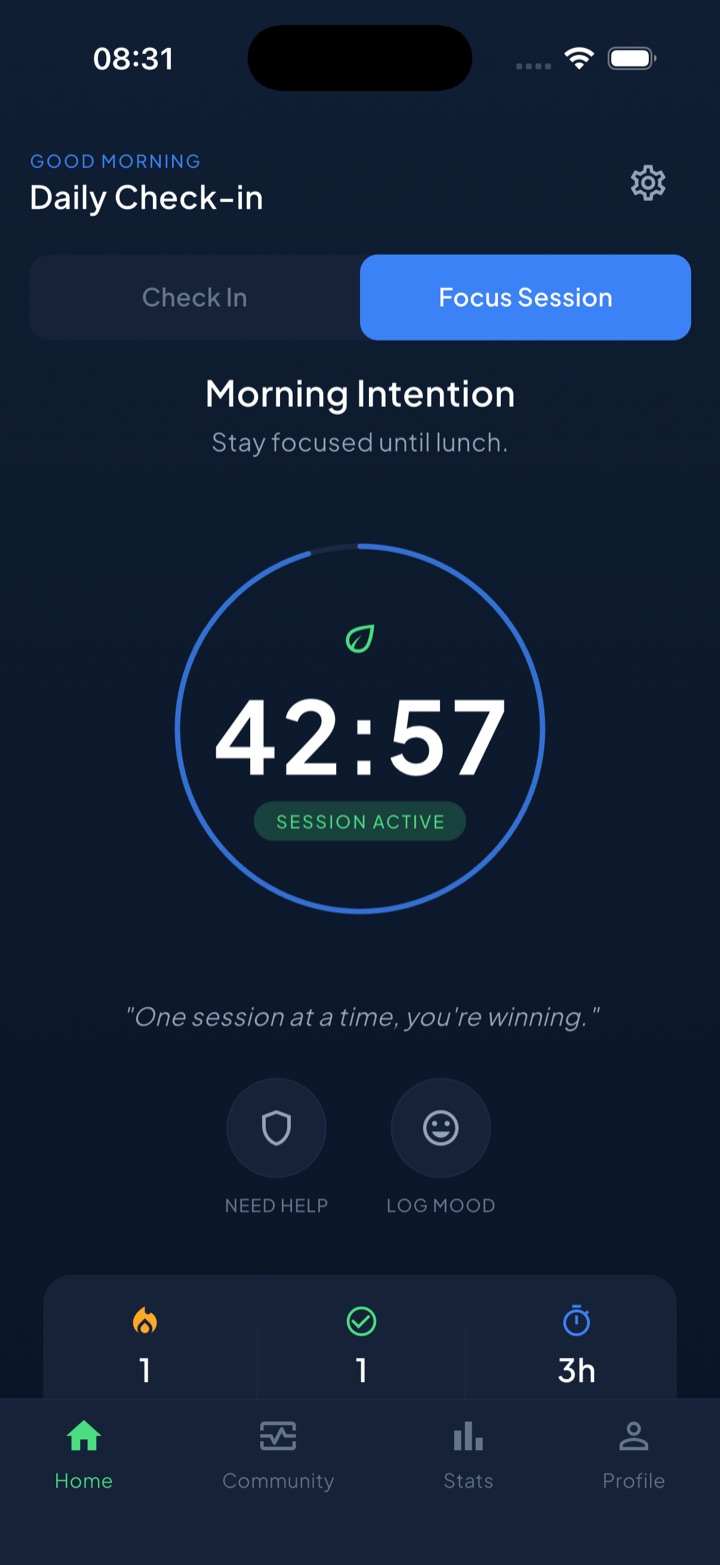
You can set the intention (“finish the draft”), let the timer run, and use the built-in break timer between rounds. None of it requires giving up privacy: your blocked apps and usage stay on-device with iOS. And you don’t strictly need an app, a phone in another room and a kitchen timer eat the frog just as well. Unscrol mainly removes the temptation to negotiate, so the hardest task actually gets your first and best hour.
Frequently asked questions
What does eat the frog mean in productivity?
It means doing your single most important and most dreaded task first thing in the day, before email, meetings, or your phone can pull you away. The phrase comes from a line often attributed to Mark Twain, though its real source is unverified: if the first thing you do each morning is eat a live frog, you can go through the day knowing the worst is behind you. Brian Tracy popularized it as a productivity method in his book Eat That Frog.
Why does doing the hardest task first actually work?
Two reasons. Your hardest task gets your freshest attention and fullest self-control early, before the day's small decisions wear you down. And finishing it removes the low-grade dread that otherwise drains focus while you avoid it, the mental tab that stays open all day. Completing the important thing first also guarantees the day counts even if everything after it falls apart.
Is eating the frog ever a bad idea?
Yes, for two groups. Strong night owls often peak in the late afternoon or evening, so forcing hard cognitive work at 8am fights their biology. And if your genuinely most important task requires other people, information, or energy you don't have yet, doing it first is just banging on a locked door. Eat the frog during your personal peak window, which for many but not all people is the morning.