Almost every parent tries the same three things in the same order: ask, nag, confiscate. All three produce a fight, and none produces a lasting change. The reason is not that your teenager is unusually stubborn. It is that adolescence involves a strong, normal drive toward autonomy, so a rule imposed on a teenager becomes something to defeat, while a rule they helped write becomes something they own. That single distinction explains most of the difference between families where this works and families where it does not.

Why confiscation backfires
It genuinely works for one evening. Then four things happen.
They route around it. An old phone, a school laptop, a friend’s device, a tablet nobody remembered. Teenagers are more resourceful about this than adults expect, and every successful workaround teaches them that the rule is a puzzle rather than a boundary.
It goes underground. Use does not stop; it stops being visible. That is worse, because the conversations you most want to be able to have — about something upsetting they saw, someone messaging them, a group chat that turned cruel — require them to be willing to tell you.
It costs the relationship. Confiscation in anger is the most expensive intervention available. You spend trust to buy a few hours of compliance, and trust is the thing you will need for every harder conversation coming.
It targets the wrong thing. Adults think of a phone as a device. For a fourteen-year-old it is where the friendships are. Removing it is not “less screen time”; it is being taken out of the room where everyone else is. The reaction makes complete sense once you see it that way.
Confiscation still has a place — as a pre-agreed consequence for a specific broken agreement, applied calmly, for a defined period. That is a boundary. Grabbing the phone mid-argument is a punishment, and punishments get defeated.
Protect the non-negotiables, negotiate the rest
The single most useful reframe: stop arguing about hours. Hours are abstract and endlessly debatable. Argue about what the hours displace, which is concrete.
There are five things that genuinely matter, and screen time only matters to the extent it eats them:
- Sleep — eight to ten hours, phone charging outside the bedroom
- School — homework happens, attendance holds
- Movement — the body goes outside and does something
- In-person friendship — not only through a screen
- Family contact — some meals, some conversation
If all five are intact, the total number is genuinely not worth a war. If sleep is collapsing, that is one specific thing to fix, and it is much easier to get agreement on “the phone charges in the kitchen” than on “you’re on it too much”.
Sleep is the one to spend your capital on. Adolescents need more sleep than adults and get less, the effect on mood and school performance is large and quick, and the fix is a single physical rule rather than a continuous judgement call. If you win one thing, win this. There is more on the mechanism in screen time and sleep.
The conversation that works
Timing and framing do most of the work.
Not during a session. Interrupting mid-scroll guarantees defensiveness. Pick a neutral moment — in the car, on a walk, doing the washing up. Side-by-side beats face-to-face for difficult conversations with teenagers, reliably.
Lead with curiosity, not statistics. “What do you actually use it for most?” gets a real answer. “Do you know how many hours you did this week?” gets a wall. You want information first.
Name your own. “I check mine at dinner and I don’t like it either” changes the entire register. It makes this a household problem rather than a verdict on them. It also has to be true — teenagers detect the mismatch between a rule for them and a phone in your hand at the table instantly, and it discredits everything else you say.
Hand them the pen. “What would a fair rule look like?” Their proposal will be more lenient than yours and stricter than you feared, and it will have something in it you can accept. A rule they wrote gets kept far more often than a better rule you imposed.
Agree the consequence in advance, together. Then applying it later is administration rather than betrayal.
“We spent a year fighting about hours. Then we dropped it entirely and agreed on exactly one rule — phones charge in the kitchen overnight, mine included. That was it. His sleep fixed itself, his mood improved, and the arguments just stopped.” — Deniz, father of two, 47
What about parental controls?
They have a real but narrow role, and the honest framing matters.
Announce them. Covert monitoring, if discovered — and it is usually discovered — costs more trust than it ever bought in safety. “I’ve set the router to drop wifi at midnight, we agreed that” is a boundary. Secret surveillance is something else.
Match the tool to the age. Tight, non-negotiable controls make sense for a nine-year-old. For a sixteen-year-old, controls that they had no say in are mostly a challenge to be circumvented, and there are enough guides online that they will succeed. The developmental goal at sixteen is a young adult who can self-regulate in two years, and that skill is not built by an external system doing all the regulating.
Use them for structure, not surveillance. A downtime window that applies to the whole household is a shared rhythm. A dashboard where you read their app-by-app breakdown daily is a different relationship. For the mechanics, our iPhone parental controls guide covers the setup, and screen time recommendations by age covers where the guidance actually lands.
When it is more than a phase
Most heavy teenage phone use is normal, social, and self-correcting. Some of it is a symptom. Worth taking seriously if you see:
- Withdrawal from friendships they used to value, not just a shift online
- A drop in mood, appetite, or sleep that persists beyond a bad fortnight
- Distress or aggression that is out of proportion when the phone is unavailable
- School results falling sharply rather than drifting
- Signs of bullying, or content that is frightening them
In those cases the phone is often where the distress is visible rather than where it comes from. That is a conversation with your GP or the school, not a screen-time rule. Social media and anxiety covers what the evidence does and does not say.
How does Unscrol help?
Two honest caveats. First, iOS Screen Time with Family Sharing is free and does most of what a parent needs — downtime, app limits, communication limits. Start there. Second, Unscrol is not a parental surveillance tool. There is no parent dashboard reporting a child’s activity, and that is deliberate.
Where Unscrol fits is the household version of this problem — a teenager who has agreed they want to cut down, and a parent doing it alongside them rather than to them. It is an iPhone and Apple Watch app built on Apple’s Screen Time frameworks, so blocks are system-enforced by iOS rather than a cosmetic overlay.
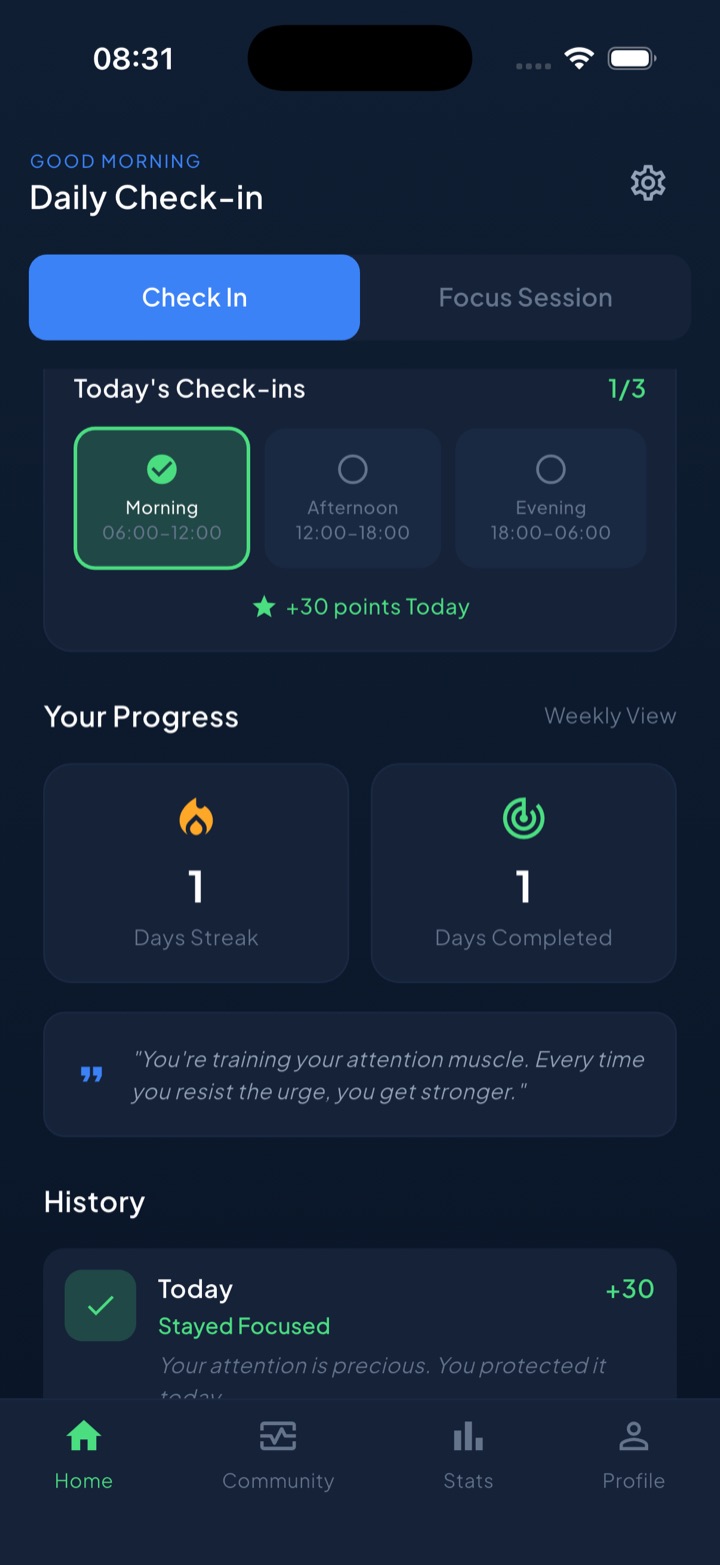
Scheduled blocks let each person set their own sleep and study windows, which turns “the phones go away at eleven” into something the phone enforces rather than something you have to police. A unified daily streak grows on any day someone does a quick check-in or finishes one of 45+ challenges, and a shared leaderboard makes it a household thing rather than a rule aimed at one person — which, for a teenager, is very often the difference between cooperation and a fight. Block lists and usage data are processed on-device by iOS and never reach Unscrol’s servers. Free to download; the optional Pro tier adds a Streak Saver that rescues a single missed day, twice a week.
Frequently asked questions
Should I take my teenager's phone away?
Confiscation works as an immediate circuit breaker and fails as a strategy. It reliably stops use tonight, and it reliably produces workarounds, secrecy, and a fight that costs more than the screen time did. Adolescents are developmentally driven to resist controls they had no part in setting, so an imposed rule invites evasion in a way a negotiated one does not. Removing the phone for a defined reason, for a defined period, agreed in advance, is very different from removing it in anger mid-argument. The first is a boundary; the second is a punishment they will spend their energy defeating.
How much screen time is appropriate for a teenager?
Most paediatric bodies have moved away from a single hour count for teenagers, because what the time displaces matters far more than the total. The practical questions are whether they are sleeping eight to ten hours, moving their body, seeing friends in person, keeping up at school, and able to be without the phone without distress. A teenager with four hours of screen time who has all five of those is doing better than one with two hours who is not sleeping. Protect the non-negotiables first and the total tends to sort itself out.
Why does my teenager get so angry when I mention their phone?
Three things are happening at once. The phone is where their social life lives, so a limit reads as social exclusion rather than a scheduling matter. Adolescence involves a strong developmental push toward autonomy, so any imposed control is resisted almost automatically. And the request usually arrives as criticism, which triggers defensiveness before the content is even heard. The disproportionate reaction is a signal about how much is at stake for them socially, not evidence that they are unreasonable.