Second screening feels like relaxing twice at once. It is actually doing neither properly. You put on an episode, the phone comes out within four minutes, and two hours later you have watched a show you cannot summarise and scrolled a feed you cannot remember. The evening got used up and none of it landed. This is the most common and least discussed screen habit there is, largely because it does not look like a problem — you were only watching television.

Why the phone comes out four minutes in
Three forces, and they compound.
Television has slow parts. Feeds do not. A well-made episode has setup, quiet dialogue, and pacing that pays off later. A feed has been optimised so that every three seconds justifies the next three. If your baseline for stimulation has been set by short-form video, ordinary drama registers as a lull, and your attention goes looking for something denser to fill it. This is the same recalibration described in TikTok brain and short-form video.
The sofa is one of the strongest cues you own. Sit down, phone appears. That is not boredom, it is a trained association — the same mechanism that puts a phone in your hand within twenty seconds of getting into bed. The reach happens before any conscious decision, which is why “I’ll just watch properly tonight” fails so consistently.
You are avoiding stillness. For a lot of people, an evening with nothing in their hands is the first genuinely quiet moment of the day, and quiet moments are when everything you have been outrunning arrives — the unanswered email, the awkward conversation, the thing you are worried about. A second screen is very effective at preventing that. Worth noticing without judgement, because it changes what the fix needs to be.
What it actually costs
Not your health. Your attention has a specific limit, and second screening runs straight into it.
You cannot genuinely process two language-based streams at once. Dialogue and captions and comments all compete for the same machinery, so what feels like doing two things is really rapid alternation with a switching cost at every crossover. The result is measurable in the most ordinary way: you follow the plot worse, you remember the feed less, and you finish a series with no memory of it.
There is a second cost, harder to see. Watching something properly — actually following it, noticing how it was made, being moved by it — is genuinely restorative. Half-watching it is not. So an evening of second screening produces the specific and familiar sensation of having relaxed for three hours and not feeling rested at all. You were not resting. You were consuming two things at half attention.
“I watched an entire prestige drama over three weeks and when a friend asked what happened in it I could not tell her. I had been on my phone for most of every episode. That was the moment I actually felt bad about it — not the hours, the fact that nothing had gone in.” — Berk, sound engineer, 30
The three fixes
In order of how much they help relative to effort.
1. Move the phone, do not resist it
The sofa cue is strong and resisting a cue while sitting inside it is the hardest possible version of this. Put the phone somewhere requiring you to stand: a shelf across the room, the kitchen counter, charging in the hall.
That is the 20-second rule applied to the exact moment it works best, because second screening is almost purely automatic. The reach is not motivated by anything. Add ten steps and most of it simply stops, with no willpower spent at all.
2. Raise the bar on what you watch
Underrated and slightly uncomfortable: if you are on your phone through most of an episode, the episode is probably not good enough to hold you. That is information.
Watch fewer, better things — something you actively chose rather than what autoplayed next. Genuinely engaging television does not need to be defended against a phone; the urge simply does not arrive. If it does arrive constantly, the honest move is to stop watching that programme rather than to keep half-watching it out of momentum.
3. Take the phone time deliberately, between episodes
You are allowed to want the feed. Second screening is bad at giving it to you — it delivers fragmented scrolling you do not even enjoy, spread thinly across two hours.
So take it properly. Watch the episode with the phone across the room, then take ten deliberate minutes at the end. You will get more from both, and the total phone time usually falls anyway because a chosen ten minutes is shorter than two hours of unconscious drift. This is temptation bundling reversed: separate the two rewards instead of blending them into a worse third thing.
| Approach | What happens |
|---|---|
| Phone in hand, resist it | Fails within ten minutes; the cue wins |
| Phone face down on the sofa | Slightly better; still one reach away |
| Phone across the room | Works for most people, most nights |
| Phone in another room | Works reliably; occasionally feels excessive for TV |
| Scheduled block during evening hours | Works when the reach is motivated rather than automatic |
What about watching with other people?
Worth separating, because this is where the cost is not just your own attention.
Watching something together while both of you are on phones is one of the more corrosive small habits in a household. It has the shape of shared time and none of the substance, and it is the same dynamic as phubbing — being physically present and attentionally elsewhere. Nobody objects to it out loud, because nobody has grounds to when they are doing it too, so it quietly becomes what evenings are.
The fix is a rule rather than a preference, and it works better as a household one than an individual one: phones on the shelf while something is on. Not forever, not a moral stance — just for the ninety minutes you decided to spend together.
How does Unscrol help?
Most of this article is free and physical. Move the phone across the room. That single change resolves the automatic version of the habit, which is the majority of it, and no app is needed.
Unscrol is for the version where the reach is motivated rather than automatic — the evenings where you will cross the room. It is an iPhone and Apple Watch app built on Apple’s Screen Time frameworks, so blocks are enforced by iOS rather than by a cosmetic overlay.
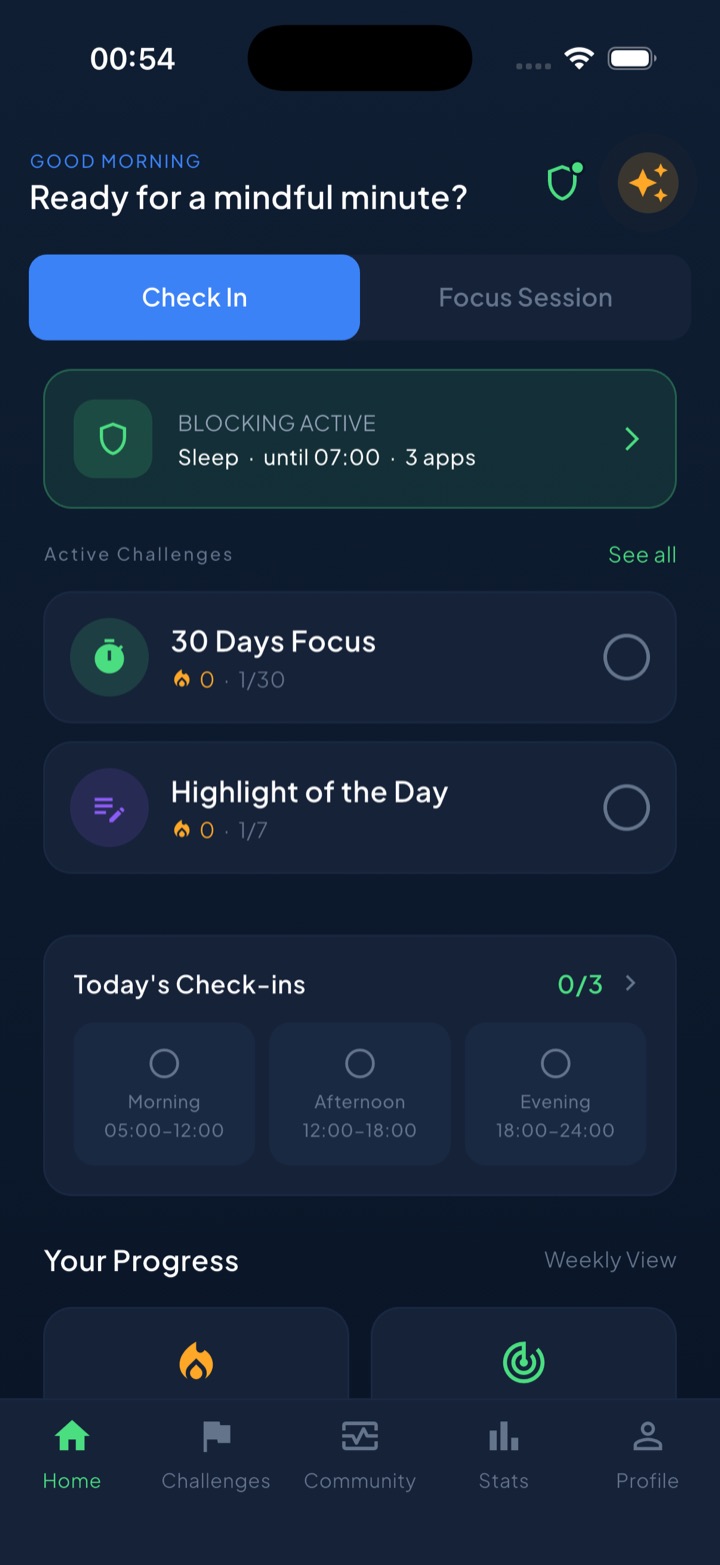
Scheduled blocks let you shield social and video categories across a chosen evening window, so the phone on the shelf stays uninteresting even if you do walk over to it. A short deliberate take-a-break bypass handles the genuine exceptions rather than making the block absolute. The guess-versus-real check is unusually revealing for this habit specifically, because second-screen time is the kind almost nobody estimates correctly — it never felt like a session. And a unified daily streak grows on any day you complete a quick check-in or one of 45+ challenges, so evenings you actually watched something properly count for something. Block lists and usage data are processed on-device by iOS and never reach Unscrol’s servers. Free to download; the optional Pro tier adds a Streak Saver that rescues a single missed day, twice a week.
Frequently asked questions
Why do I scroll on my phone while watching TV?
Because modern television is often not stimulating enough to hold attention on its own once you are used to short-form video. A streaming episode has slow stretches by design — setup, dialogue, pacing — and a feed has removed every slow stretch from your day. Your attention notices the dip and reaches for something denser. There is also a habit component: the sofa is one of the most reliable phone cues most people have, so the reach happens automatically the moment you sit down, before boredom has even arrived.
Is second screening actually bad for you?
It is not harmful in the way losing sleep is, but it does mean you get less from both activities. Attention cannot genuinely run two streams that both compete for language and comprehension, so you are alternating rapidly rather than doing both, and paying a small switching cost each time. In practice that means you follow the plot less well, remember less of what you scrolled, and end the evening feeling like you did not really rest. The clearest sign is finishing a series and being unable to describe what happened in it.
How do I stop using my phone while watching TV?
Change the location of the phone rather than trying to resist it, because the sofa is a strong automatic cue and resisting a cue in place rarely works. Put it on a shelf across the room or charging in the hall while you watch. It also helps to raise the quality bar on what you watch, since second screening is often a signal that the programme is not holding you; something genuinely engaging removes the urge without any effort. If you want the phone time, take it deliberately between episodes instead of during them.