Temptation bundling is a habit trick where you only let yourself do something you love while doing something you tend to avoid. You can only listen to your favorite podcast at the gym, only watch your show while folding laundry, only enjoy guilt-free scroll time after a focus session. The behavioral scientist Katy Milkman coined the term after finding that bundling page-turner audiobooks with the gym meaningfully increased how often people worked out. The mechanism is simple: the thing you want drags the thing you should do along with it, and the reward arrives now instead of some vague later.
What is temptation bundling, exactly?
Most self-control problems are really a fight between two versions of you. Your present self wants the immediate pleasure — the feed, the snack, the show. Your future self wants the outcome — the fitness, the finished work, the reclaimed attention. Willpower is the exhausting attempt to make the present self lose. Temptation bundling does something smarter: it makes them win together.
Milkman frames this as the tension between “want” activities (instantly gratifying, easy to overdo) and “should” activities (good for you, easy to postpone). A bundle chains them so the want is only available during the should. You’re not resisting the guilty pleasure — you’re rationing it, and the price of admission is doing the thing you’d otherwise put off.
This isn’t brand new. Psychologist David Premack described the underlying principle decades ago: a behavior you do often and eagerly can reinforce a behavior you do rarely. Parents use the folk version constantly — “vegetables first, then dessert.” Temptation bundling is grandma’s rule, applied on purpose to your own life.
Does temptation bundling actually work?
The headline evidence comes from a study Katy Milkman ran with Julia Minson and Kevin Volpp at the University of Pennsylvania. They gave gym-goers access to addictive audiobooks — the kind you can’t stop listening to — but with a catch for one group: the audiobooks were locked to an iPod they could only use at the gym. People in that restricted-access condition worked out roughly half again as often as the control group in the early weeks.
Two honest caveats keep this from being hype:
- The effect decayed. As weeks passed and a holiday break hit, the gap narrowed. Bundling is a nudge, not a permanent rewiring — you’ll periodically need to renew the deal with yourself.
- Exclusivity did the work. When people could listen to the audiobooks anywhere, the leverage disappeared. The magic isn’t the pairing alone; it’s that the treat is only available during the task.
So treat bundling as a reliable way to lower the activation energy of a habit you already want, especially in the fragile early stretch before it runs on autopilot. It pairs naturally with the longer-game tactics in how to build better habits.
12 temptation bundles you can steal
Pick behaviors from your own life, but here are working templates:
- Earned scroll time — you only open your feed after a completed focus session, never before.
- Podcast or audiobook you love, only while at the gym or on a run.
- Your favorite show, only while doing chores, meal prep, or folding laundry.
- A fancy coffee or specific playlist, only during your hardest deep-work block.
- Calling a friend you love catching up with, only while walking outside.
- A specific candle or tea reserved only for study sessions.
- Your comfort playlist, only while doing admin, email, or expense reports.
- A YouTube channel you enjoy, only while stretching or cooling down.
- Trashy magazine or manga, only while on the exercise bike.
- A gaming session, only after the day’s most important task is done.
- Your weekly “cheat” bakery visit, only right after a long walk to get there.
- Watching sports highlights, only while doing physical therapy or mobility work.
Notice how many of these turn the phone from villain into reward. That reframe — “the feed is what I unlock, not what I fight” — is the core of a sustainable approach to reducing screen time.
What makes a bundle work, and what breaks it?
A bundle fails silently when you get one of these wrong:
- The want isn’t tempting enough. If the audiobook is fine but not gripping, it won’t pull you to the gym. Choose something you genuinely crave, even something a little indulgent. The guiltier the pleasure, the stronger the pull.
- The want isn’t exclusive. If you’ll happily listen to the podcast on the couch too, the gym loses its monopoly. Guard the exclusivity, or the leverage leaks away.
- The should needs full attention the want steals. Bundling a page-turner audiobook with deep analytical work backfires — you’ll follow the story and drop the task. Bundle absorbing treats with low-focus chores (dishes, walking, the treadmill), and save quiet or instrumental pairings for cognitively heavy work.
- The want quietly sabotages the should. Watching a show while “studying” isn’t a bundle; it’s multitasking, which reliably degrades both. A real bundle enhances a task that doesn’t compete for the same mental channel.
Write your rule as a fixed if-then sentence — “I only listen to this podcast at the gym” — so there’s no negotiating in the moment. That’s an if-then implementation intention, which research shows dramatically improves follow-through.
Temptation bundling vs. rewards: which should you use?
They’re cousins, but the timing matters more than it looks.
| Temptation bundle | Reward | |
|---|---|---|
| When the pleasure happens | During the task | After the task |
| Gap where you can quit | None — they’re fused | Yes — you must finish first |
| Best for | Boring, low-focus, repetitive tasks | Discrete tasks with a clear finish line |
| Main failure mode | The want distracts from the should | You skip the task and take the reward anyway |
| Feels like | ”This is actually pleasant" | "Get through it, then relax” |
Use a bundle when the task is dull but doesn’t demand deep concentration — cardio, chores, commuting. Use a reward when the task needs your whole brain and a treat mid-task would wreck it; then the payoff is the guilt-free break afterward. Many people run both: a bundle to start, a reward to finish.
How Unscrol turns “earn your scroll” into a daily bundle
The most useful bundle for phone habits flips the roles: your feed stops being the temptation you resist and becomes the reward you unlock. Unscrol is built around that trade. You run a focus session with distracting apps shielded by Apple’s Screen Time frameworks, and the guilt-free scroll is what waits on the other side of the timer — the want, bundled to the should.
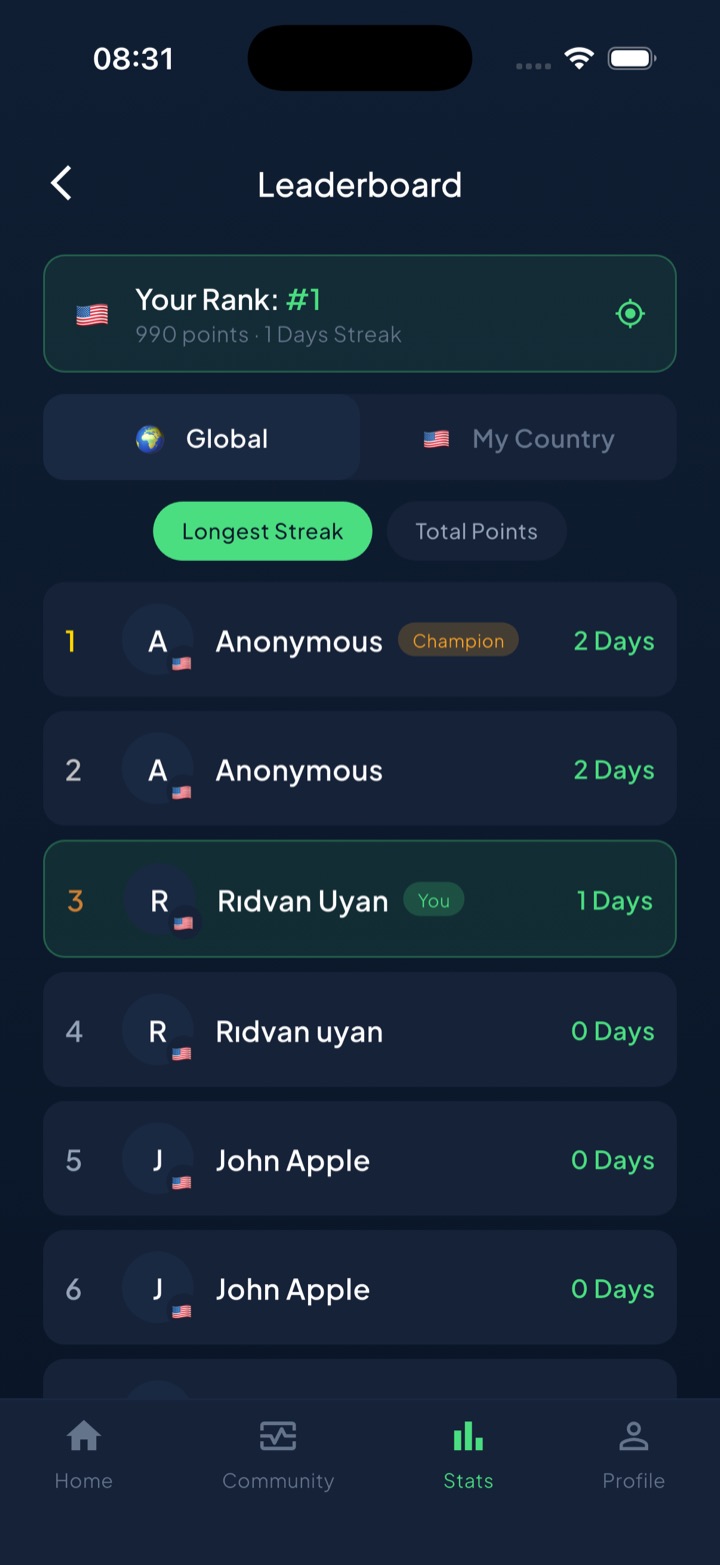
It also bundles a second want most people underrate: mild competition. Every check-in and completed challenge earns points and moves you up a leaderboard, ranked globally or by country, by longest streak or total points. Climbing a ranking is genuinely fun, and here it’s fused to the behavior you actually want more of.
You don’t need any app to do this. Lock your favorite podcast to your gym bag, keep a specific playlist for deep work, or make “one episode” the reward after your top task — a paper rule works fine. Unscrol just makes the “earn your scroll” version automatic, so the deal enforces itself instead of relying on you to remember it.
The whole point of bundling is to stop fighting your wants and start aiming them. Pair the pleasure with the work, guard the exclusivity, and let what you love do the pulling.
Frequently asked questions
What is temptation bundling?
Temptation bundling is a habit strategy where you only let yourself do something you love while doing something you tend to avoid. You can only listen to your favorite podcast while at the gym, or only get guilt-free scroll time after a focus session. The pleasurable activity acts as an instant reward that pulls the harder behavior along, aligning what you want now with what your future self wants.
Does temptation bundling actually work?
Yes, modestly. Behavioral scientist Katy Milkman ran a study where people could only listen to gripping audiobooks at the gym, and gym visits rose meaningfully compared to a control group. The effect faded somewhat over weeks and around holidays, so bundling is a real nudge, not a permanent fix. It works best when the temptation is genuinely fun and truly exclusive to the task.
What is the difference between temptation bundling and a reward?
A reward comes after you finish the task, so there is a gap where you can quit. A bundle happens at the same time as the task, so the enjoyable part is only available while you are doing the hard thing. Bundling removes the waiting and makes the boring behavior pleasant in the moment, which is why it often beats promising yourself a treat later.
Can temptation bundling help me reduce screen time?
It can, if you flip the phone from the temptation into the earned reward. Instead of banning your feed, make it the thing you unlock only after a focused block of work or study. Pairing 'earned scroll time' with a completed focus session turns the phone from a distraction you fight into a payoff you schedule, which is far easier to sustain than pure restriction.