A phone-free family dinner means exactly what it sounds like: for the length of one shared meal, no one at the table has a phone — including the parents. The rule works when three things are true: it applies to everyone equally (kids instantly detect a double standard), it’s backed by a physical routine like a phone basket rather than willpower, and the meal itself is interesting enough to compete with a feed. You don’t need punishments or a lecture about screen time. You need a basket, one consistent sentence, and about two weeks of holding the line.

Why do shared meals matter so much for kids?
Because dinner is often the only time in the day the whole family talks face to face. Everything else — school, work, homework, activities — happens in parallel. Dinner happens together.
Researchers who study family meals have found consistent associations worth taking seriously, even with the usual caveat that correlation isn’t causation:
- Language. Dinner-table conversation exposes younger kids to rare words and back-and-forth talk they don’t get from screens. Studies suggest mealtime conversation is one of the richest everyday sources of vocabulary a child hears.
- Eating habits. Kids who regularly eat with their families tend to eat more vegetables and less junk, and they learn to read their own fullness instead of eating on autopilot in front of a screen.
- Connection and wellbeing. Regular family dinners are associated with lower rates of anxiety and risky behavior in teens. Not because the food is magic — because it’s a reliable, low-pressure window where a kid can mention the thing that’s bothering them.
A phone at the table doesn’t cancel dinner. It cancels the conversation, which is the part doing the work. If you’re calibrating the bigger picture of limits by age, our screen time recommendations by age guide pairs well with this one — but the dinner table is the highest-leverage thirty minutes to start with.
Why does “do as I say, not as I do” fail?
Because kids copy what you do, not what you announce. If your phone sits next to your plate — even face down, even silent — the rule your child actually learns is: phones belong at the table, and important people get to check theirs.
Two things make the parental phone especially corrosive at dinner:
- A visible phone changes the conversation. Researchers have found that the mere presence of a phone during face-to-face conversation tends to lower how connected and empathic the exchange feels — before anyone even touches it. Face-down on the table is not neutral; it’s a message that something else might matter more.
- “Just checking” is invisible to you and glaring to them. You experience it as three seconds of triage. Your kid experiences it as you leaving the table mid-sentence. Ask any eight-year-old whose parent “wasn’t really on their phone at dinner” — they keep score with astonishing accuracy.
This is why the single biggest predictor of whether the rule sticks is not how you enforce it on the kids. It’s whether your phone is in the basket first.
How do you actually install the rule?
Skip the lecture. Install a system:
- Announce it at a calm moment. Not mid-argument, not while confiscating a phone. Sunday afternoon works: “Starting tonight, dinner is phone-free for all of us. Mine goes in first.”
- Create a phone basket. A bowl, basket, or shelf in another room or across the kitchen — not on the table’s edge. Out of reach beats face-down. This is classic environment design beating willpower: you’re not asking anyone to resist a phone; you’re making the phone not part of the room.
- Make it a pre-meal ritual. Phones go in when plates go down, in a fixed order: parents first, then kids. The order matters more than it looks — it’s the rule proving it’s fair.
- Agree on one script. One calm sentence for slip-ups, used identically on adults and kids: “Phone in the basket — you can have it back after dinner.” No debate, no lecture, no sarcasm. The script is boring on purpose; boring doesn’t escalate.
- Give kids enforcement rights. If your child catches you reaching for your phone, they get to say the script to you — and you comply cheerfully. Nothing sells a rule to a ten-year-old faster than the power to enforce it on a parent.
- Start with dinner only. Don’t launch “no screens ever” — you’ll lose the whole war to win no battles. One meal, every day, held consistently, beats ambitious rules that collapse by Thursday.
Expect roughly two weeks of friction. The first dinners will have silences and complaints. That’s not the rule failing; that’s a family relearning how to fill airtime that screens used to fill.
What do you say when they push back?
Pushback is predictable, so script it in advance:
| The pushback | Who says it | What to say |
|---|---|---|
| ”I’m expecting an important message” | Usually a parent | ”Calls still ring from the basket. Messages wait thirty minutes." |
| "My friends will think I’m ignoring them” | Teens | ”Tell them your family does phone-free dinners. You’ll be back online by 7:30." |
| "Can I just finish this video?” | Younger kids | ”Pause it — it’ll be there after dinner. Phone in the basket." |
| "Dinner is boring” | Everyone, eventually | ”Fair. Help me make it less boring — you pick tomorrow’s question." |
| "You checked yours yesterday!” | Kids, correctly | ”You’re right, and you get to call that out. Basket, same as everyone.” |
That last row is the whole game. The rule survives on fairness, not authority. The one response to avoid: negotiating exceptions in the moment. Every “okay, just tonight” teaches everyone that the rule is a suggestion with a whine-based override.
How do you make dinner interesting enough to compete?
A feed is engineered entertainment; a quiet table full of tired people is not. You don’t need to out-entertain TikTok, but you do need to give the attention somewhere to land:
- Run one ritual question. “Rose and thorn” (best and worst moment of the day) or a rotating “question of the day” that a different family member picks each night. Rituals beat improvisation — nobody has to think of something to say from scratch.
- Give kids jobs. Setting the table, choosing the music, announcing the menu like a waiter. Participation converts dinner from something done to kids into something they run.
- Let boredom breathe. Some silences are fine. Boredom at the table is often the runway for the real conversation — the school thing, the friend thing — that never surfaces while thumbs are busy.
- Extend the win, don’t just defend the meal. Families that enjoy phone-free dinners often stretch them into a phone-free hour with a game or a walk. If you need ammunition, here’s a full list of things to do instead of scrolling.
“The basket felt gimmicky until the night my twelve-year-old put my phone in it and grinned at me. Two weeks in, dinner got longer on its own — nobody was rushing to get back to a screen. The surprise wasn’t the kids’ behavior. It was how twitchy I felt the first three nights.” — Elena, mother of two, 43
How does Unscrol help you keep dinner phone-free?
Start with the free route, honestly: a basket plus Apple’s built-in Screen Time covers most of it. Set Downtime or App Limits on your own iPhone for your dinner window, and the apps that actually pull at you are shielded while calls still ring. For many families, that plus the ritual above is enough.
The weak point is always the same person: the parent who sets the limits can also dismiss them with one tap, and “I’ll just quickly check” creeps back within a month. Unscrol is an iPhone app (iOS 16+) built to close that gap — for your phone first, because that’s where the rule is won or lost.
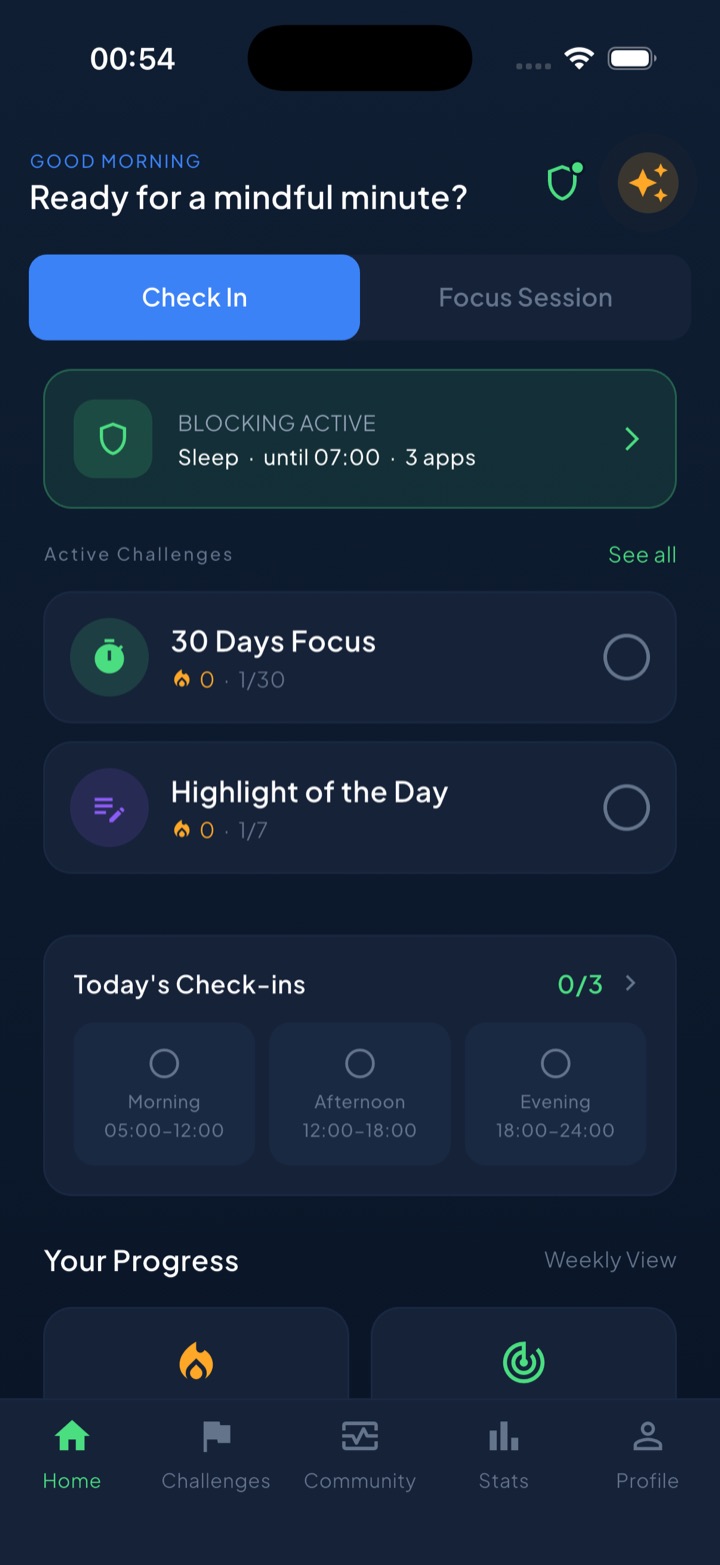
- A recurring dinner routine. Create a scheduled block window — say 18:30–19:30 every evening — and Unscrol shields your chosen apps with Apple’s own Screen Time frameworks, system-enforced rather than a polite reminder. Phone calls aren’t blocked, so you stay reachable.
- A deliberate exception, not a loophole. The short “take a break” bypass exists for the genuine need — looking up a recipe mid-cooking — without silently disabling the whole rule the way “ignore limit” does.
- A streak your kids can see. Daily check-ins and a unified streak turn “we do phone-free dinners” into a number on your home-screen widget. Teens with their own iPhone can run Unscrol too and compare streaks on the leaderboard — shared accountability beats one-way policing.
- Private by design. Your block lists and usage are processed on-device and never touch our servers — worth knowing when the phone in question is yours.
The honest version: the basket and the script are the actual intervention, and they’re free. Unscrol’s job is to make sure the adult who invented the rule doesn’t quietly become its first exception.
Frequently asked questions
How do I start a no-phones-at-the-table rule?
Announce it at a calm moment, not mid-conflict, and frame it as a rule for everyone — parents included. Put a basket or shelf away from the table where all phones land before anyone sits down, agree on one short script for slip-ups, and let kids call out adults who break it. Start with dinner only, expect about two weeks of pushback, and don't negotiate exceptions in the moment. Consistency, not enforcement intensity, is what makes it stick.
Why do phone-free family dinners matter for kids?
Shared meals are one of the most reliable daily windows for connection. Researchers have found that regular family dinners are associated with richer vocabulary in younger kids, healthier eating patterns, and better emotional wellbeing in teens. These are correlations, not magic guarantees — but the mechanism is simple: dinner is often the only time everyone talks face to face. A phone at the table quietly removes exactly the ingredient that makes those benefits possible.
What is a phone basket and does it actually work?
A phone basket is a container placed away from the dining table where every family member's phone goes before the meal — parents' phones first. It works because it replaces a vague rule ('don't use your phone') with a physical routine that happens once, before temptation starts. Out of reach beats face-down on the table: even a visible, silent phone splits attention. The basket also makes the rule fair and checkable — anyone can see whose phone isn't in it.
What if I need to be reachable during dinner?
You almost always still are. Putting your phone in a basket doesn't block calls — it just stops the reflexive scrolling and 'quick checks.' Leave the ringer on and keep the basket within earshot, or set emergency contacts to break through silent mode. Genuine emergencies ring; group chats, work threads, and notifications can wait thirty minutes. Naming this rule out loud helps: 'calls still come through, everything else waits until we're done.'