If you’ve become a new parent who can’t stop scrolling, nothing is wrong with you. Postpartum doomscrolling is one of the most predictable habits in modern parenthood: you’re suddenly isolated with a tiny human who can’t hold a conversation, more exhausted than you’ve ever been, quietly anxious about every squeak and rash — and pinned in place for hours with exactly one free hand. The phone is the only object on earth designed for that situation. The catch is that the same scrolling that gets you through a 3 a.m. feed also steals the fragmented sleep you desperately need and feeds the anxiety it promises to calm. The way out isn’t guilt, and it isn’t a hardcore detox. It’s a compassionate reset: protect your sleep windows, close the anxiety-googling loop, and keep the connection without the feed.

Why do new parents scroll more than ever?
Because every force that drives phone use gets turned up to maximum at the same time:
- Trapped time. Contact naps, long feeds, endless rocking — early parenthood is full of stretches where you must stay still and quiet with one hand free. The phone is the only activity that fits that posture.
- Isolation. Adult conversation falls off a cliff, especially for whoever is home on leave. The feed can feel like the last open window to the world of grown-ups.
- Exhaustion. Deep tiredness makes active leisure — reading, hobbies, even choosing a show — feel impossible. Scrolling asks nothing of you, which is precisely why it wins every tiebreak.
- Anxiety. A new baby generates a hundred questions a day, and the phone claims to have every answer, instantly, at any hour.
None of this is a moral failure; it’s a rational response to an extreme situation. (The feeding scroll — that specific moment when the baby latches and your thumb starts moving on its own — is a phenomenon that deserves its own conversation; here we’re zooming out to the whole postpartum picture.) If you’re wondering whether coping has quietly tipped into compulsion, our phone addiction test takes two minutes and doesn’t judge.
Where does scrolling collide with the sleep you desperately need?
At night — exactly where you can least afford it. With a newborn, sleep arrives in fragments, and fragments only add up if you fall back asleep fast after each waking. The 3 a.m. problem is that scrolling is arousing by design: novelty, outrage, and bright light all tell your brain it’s daytime, so a ten-minute feed quietly becomes a fifty-minute wake window. Repeat that across two or three night feeds and you’ve deleted a large slice of the only sleep on offer — everything about how screens sabotage sleep applies double when sleep is already rationed.
There’s a second, sneakier collision: the late-evening scroll. After a day in which nothing belonged to you, staying up to scroll feels like reclaiming a scrap of freedom — classic revenge bedtime procrastination, with the twist that a baby, not an alarm clock, decides when your night ends. Sleep researchers consistently find that a short, protected wind-down beats late-night “me time” for how you feel the next day — brutal news when that scroll is the only me time you have. That’s why the reset plan below replaces it instead of just deleting it.
Why does anxiety-googling at 3 a.m. make everything worse?
“Is this rash normal.” “Green poop 6 weeks.” “Baby breathing fast while sleeping.” Anxiety-googling feels responsible — you’re just checking. But it runs on a loop that never closes: every search returns both “completely normal” and one terrifying rare exception, your tired brain locks onto the exception, relief lasts a few minutes, and the next squeak restarts the cycle. Reassurance-seeking is the engine of health anxiety, and the algorithm compounds it — search and watch worried-parent content, and your feeds learn to serve you more of it. The fix isn’t “worry less.” It’s closing the loop: one or two trusted sources, a running list of questions for the pediatrician, and hard limits on when the search bar is even available. (More on how feeds amplify worry in social media and anxiety.)
Why do picture-perfect parent accounts hurt so much right now?
Because you’re comparing your 4 a.m. against someone else’s highlight reel — at the exact moment your identity, body, and sleep are all under renovation. The aesthetic-nursery, back-in-jeans, “soaking up every moment” account isn’t lying, exactly; it’s curating. But postpartum you is uniquely defenseless against it: sleep deprivation flattens mood, and new parenthood comes pre-loaded with the question “am I doing this right?” A feed full of apparent naturals answers that question wrongly, over and over.
“I’d feed my daughter at 3 a.m. watching moms with clean kitchens and glowing skin, and I’d end every feed feeling worse than when it started. Muting about thirty accounts did more for my postpartum mood than anything except sleep. My feed is boring now. Boring turned out to be the goal.” — Megan, first-time mom, 29
Muting is not weakness and unfollowing is not drama. It’s curating your input while you recover, the same way you’d eat differently while healing from anything else.
What does a compassionate reset plan look like?
Start by matching the moment to the need, because most postpartum scrolling is a reasonable need wearing an unhelpful solution:
| The moment | What you actually need | What the phone serves | A gentler swap |
|---|---|---|---|
| 3 a.m. feed | To stay awake enough, then back to sleep fast | A feed that fully wakes your brain | Quiet podcast or playlist, screen dark |
| Pinned under a contact nap | Rest, or something that feels like yours | Doomscrolling that leaves you wired and flat | E-book, a show you chose on purpose, dozing |
| A worrying symptom | Reassurance from someone qualified | Forty tabs and one horror story | Add it to the question list, or call the pediatric line |
| 2 p.m. loneliness | Adult contact | Strangers’ highlight reels | Voice-message a friend, stroller walk |
Then work through these steps — small on purpose, because you’re running on fumes:
- Drop the guilt first. You’re not scrolling because you’re weak; you’re coping with the hardest job you’ve ever had. Change sticks better when it starts from compassion, not shame.
- Protect the sleep windows only. In the early months, one rule matters more than all the others combined: after a night feed, the screen stays dark. Audio is allowed.
- Make the night phone boring. Grayscale after sunset, feed apps off the home screen, brightness at minimum. Keep the camera, calls, and white-noise app — this is a trim, not a punishment.
- Close the googling loop. Bookmark one or two trusted medical sources, keep a running note of non-urgent questions, and let real worries go to a professional instead of a search bar.
- Mute ruthlessly, follow gently. Mute every account that tightens your chest. Keep the ones that make parenting look like the mixed, messy thing it actually is.
- Replace, don’t just restrict. Keep one-handed alternatives within reach — audiobook, e-reader, a friend who’s also awake at odd hours. Our list of things to do instead of scrolling has a whole low-energy tier.
- Get backup. Tell your partner what you’re doing and make it a team rule. Then use system-level blocks for the hours that matter most, so 3 a.m. you never negotiates alone.
How does Unscrol help new parents scroll less?
Start free and simple: Apple’s built-in Screen Time can do the heavy lifting. Set Downtime across your night hours, add App Limits to your two or three stickiest apps, and leave calls and messages always allowed. Pair that with a paper question list for the pediatrician and you’ve covered most of this plan without installing anything.
Unscrol is the iPhone app for when willpower-at-3-a.m. isn’t a plan — it uses the same Apple Screen Time frameworks to make the reset stick, with everything processed on-device, so your block lists and usage never touch our servers.
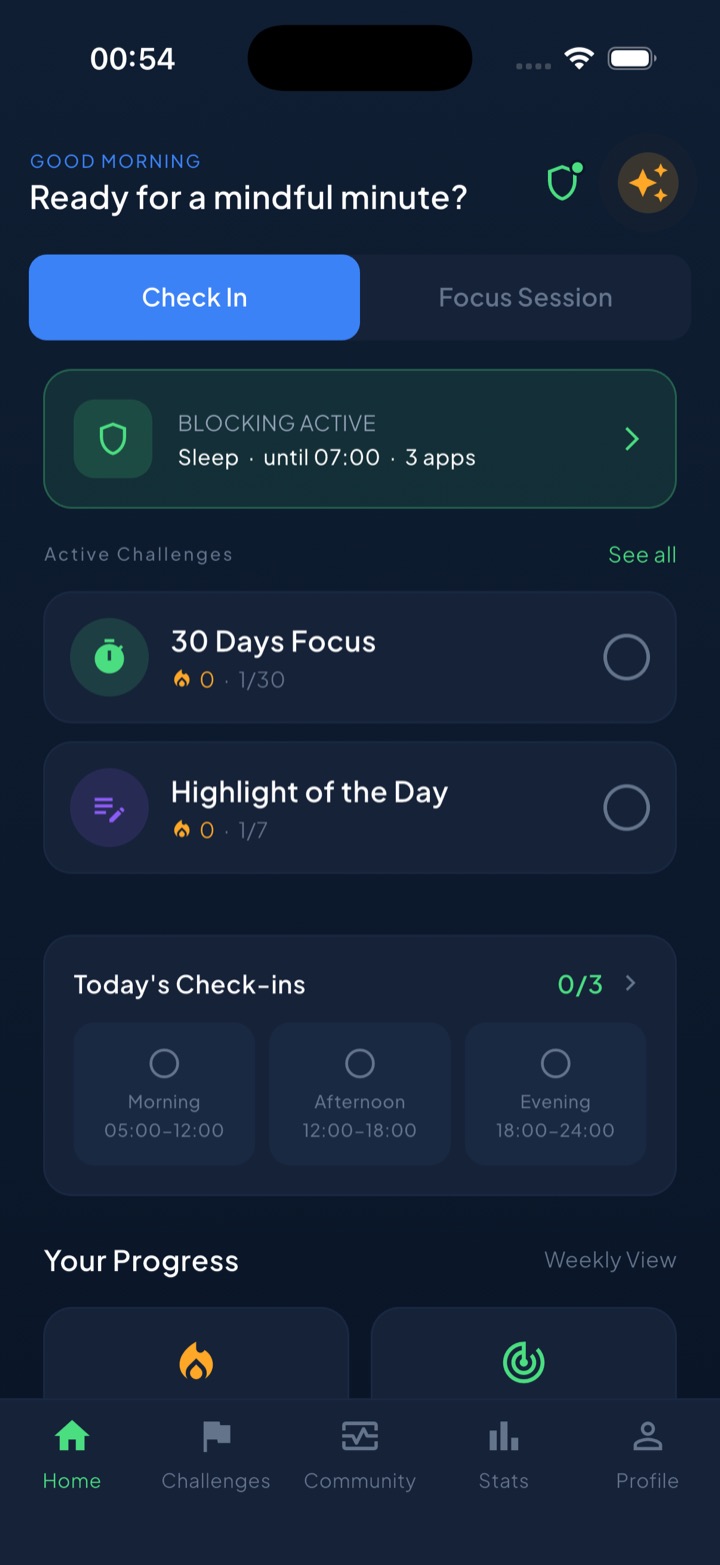
- A Sleep routine that covers night feeds. Schedule a block from, say, 22:00 to 07:00 that shields social and video apps — while the camera, calls, messages, and your white-noise app keep working. The 3 a.m. scroll simply can’t start.
- A “take a break” bypass for real life. Genuinely need a blocked app mid-block? A short, deliberate bypass lets you through without tearing the whole system down — a gentle gate, not a wall, which matters when you’re touched-out and running on four hours.
- Check-ins that fit a baby’s day. Morning, afternoon, and evening check-in slots take seconds each and rebuild the noticing-how-you-feel muscle that doomscrolling erodes.
- A streak that forgives bad nights. Any check-in or completed challenge keeps your daily streak alive, and Streak Saver can rescue a day that newborn chaos swallowed whole — because any plan for new parents has to assume bad nights.
The honest version: Screen Time plus self-compassion may be all you need. Unscrol is there to hold the line during the hours you can’t — so the scraps of night you win back go to sleep, not the feed.
Frequently asked questions
Why do new parents scroll so much?
Because new parenthood creates the perfect storm for scrolling: hours of one-handed 'trapped' time under a feeding or napping baby, sudden isolation from adult conversation, deep exhaustion that makes passive content the only thing that feels doable, and a constant hum of anxiety the phone promises to answer. Scrolling is a coping tool, not a character flaw — the problem is only that it also drains the sleep and calm you need most.
Is my phone use harming my baby?
Almost certainly less than the guilt is telling you. Babies thrive on responsive care most of the time, not on a parent who never glances at a screen. Researchers who study parent-infant interaction focus on overall patterns of responsiveness, not occasional scrolling. The more immediate costs are usually to you: lost sleep windows, amplified anxiety, and comparison spirals. Fix it for your own recovery first — your baby benefits automatically.
How do I stop anxiety-googling every baby symptom?
Replace open-ended searching with a closed loop: pick one or two trusted sources — your pediatrician's guidance plus one reputable medical site — and bookmark them; keep a running note of non-urgent questions for your next appointment; and give any search a time limit. At night, block browsers and social apps during sleep hours so the 3 a.m. spiral physically can't start. Genuine red-flag symptoms deserve a call to a professional, not a search.
How can I cut screen time as a new parent without feeling more isolated?
Keep the connection, cut the feed. Real contact — voice messages to a friend, a group chat with other parents, a call with your mom — genuinely relieves the isolation of new parenthood. Algorithmic feeds mostly simulate connection while making you feel worse. So keep messaging and calls always available, and put limits or scheduled blocks only on social and video apps. You end up more connected, not less, with hours back for sleep.