A study goal works when it is specific, personally meaningful, and paired with a daily process — not just a grade you hope for. Vague targets like “do better” give your brain nothing to act on, while a concrete, vivid goal (“get into that specific school, and to do it, solve a set of problems every evening”) creates a pull strong enough to survive boring Tuesdays. Decades of goal-setting research point the same way: specific, challenging goals beat “do your best,” and an outcome goal only produces results when a process goal underneath it tells you exactly what to do today. Start with why the goal matters, then design the reps that reach it.
Why does a vague goal fail before you start?
“Study more.” “Get better grades.” “Try harder next term.” These feel like goals, but your brain can’t act on them because they name a direction without a destination or a step. When the research psychologists Edwin Locke and Gary Latham reviewed hundreds of studies on goal-setting, one pattern held up across almost all of them: specific and appropriately hard goals produce better performance than vague “do your best” goals — largely because a clear target tells you when you’re on track and when you’re not.
A vague goal also can’t be scheduled. You can put “solve twenty geometry questions” in tonight’s plan; you cannot schedule “do better.” The fix is to force specificity on three axes:
- What exactly — the subject, the topic, the number (“twenty questions,” not “some math”).
- How you’ll know — a measurable signal (a mock-exam score band, a finished chapter, an error log shrinking).
- By when — a real date, working backward from the exam.
One Turkish 8th-grader who reportedly topped the 2026 LGS (Turkey’s national high-school entrance exam) put it plainly in interviews: “First the goal matters. After the goal, regular and determined work brings success.” Notice the order. The goal comes first because it is what makes the determined work feel worth doing.
Outcome goals vs process goals: which one gets you to the desk?
Here is the trap almost every student falls into: they set an outcome goal — a rank, a score, an acceptance letter — and then wonder why it doesn’t get them studying on a tired Wednesday. It doesn’t, because an outcome is a result you cannot directly perform. You can’t “do” a rank. You can only do the behaviors that, over months, tend to produce it.
That’s the job of a process goal: a behavior fully under your control, repeated on a schedule.
| Outcome goal | Process goal | |
|---|---|---|
| Example | ”Reach the top score band" | "Solve 10 problems + 1 reading passage daily” |
| You control it | Only indirectly | Completely |
| Can you do it today? | No | Yes |
| Emotional effect | Motivating but anxious | Calming, actionable |
| Best used as | Compass / direction | Daily engine |
Habit writers like James Clear make the same point in plainer language: you do not rise to the level of your goals, you fall to the level of your systems. The student aiming for a top score and the student who fell short may have wanted the exact same outcome; the difference was the daily process each one actually ran. Keep your outcome goal as the compass that points and motivates — then hand your calendar to your process goals.
How do you turn a goal into a plan for today?
A goal you have to decide to act on each day will lose, often, to a phone that requires no decision at all. The bridge from goal to action is an implementation intention — a pre-set “when-then” plan that decides in advance where, when, and how you’ll act. Instead of “I’ll study more,” you write: “When I finish dinner, then I sit at my desk and start the first problem set.” Research on these if-then plans consistently finds they roughly double the odds a good intention actually turns into behavior, because the decision is already made before willpower is asked to weigh in.
The same LGS topper’s routine reads like a stack of process goals wired to cues: solve paragraph (reading) questions every day, read books daily, take mock exams, do a little Sudoku to catch careless mistakes — and, crucially, he reportedly ramped the pace gradually, pushing hardest only in the final months. That gradual ramp is the honest version of discipline: you don’t leap to six hours a day, you attach one small, specific rep to a daily cue and let it grow. If sitting down at all is the hard part, that’s a discipline-design problem, and it’s worth reading how to build study discipline by changing your environment rather than white-knuckling it.
Does a study goal have to be emotional to work?
Somewhat, yes — and this is the part dry “SMART goal” templates miss. A goal that is merely correct on paper rarely survives contact with a boring textbook. A goal that is vivid and personal does. The LGS topper named specific high schools he wanted and a field he wanted to study; that concreteness gives the daily grind a face. When your target is a real place you can picture yourself walking into, the brain treats today’s reading as a down payment on something it already half-believes in.
This connects to identity. Every kept process goal is a small piece of evidence for a sentence about yourself — “I’m someone who does the reps.” Over weeks that sentence, not raw willpower, is what gets you to the desk. It’s also why chasing motivation as a feeling is a losing game: motivation follows action far more reliably than it precedes it, which is the core of getting past having no motivation to study. A word of honesty on the popular idea of “grit”: persistence clearly matters, but the research on grit as a distinct, trainable trait is genuinely contested, so treat it as a description of consistent behavior rather than a magic quality you either have or lack.
A five-line goal-setting worksheet
You don’t need an app for this part. A single index card does the job. Fill in these five lines and keep the card where you study:
- My outcome goal (with a date): the specific result and when — e.g., “Reach [score band] on the [month] mock.”
- Why it matters to me: one honest sentence you actually believe.
- My daily process goal: the smallest rep that moves the needle — e.g., “10 problems + 1 reading passage.”
- My if-then trigger: “When [existing daily cue], then I start [the rep].”
- My slip rule: “If I miss a day, I do the minimum the next day. Never twice.”
Review it once a week, adjust the process goal if it’s too easy or too brutal, and leave the outcome goal alone. This is the whole system. Everything else is decoration.
How Unscrol turns a goal into a daily streak
The weakness of any study goal is that the payoff is months away while your phone pays out in seconds. Unscrol, the screen-time app we build, is designed to give your process goals a fast, visible reward the goal itself can’t. Its unified daily streak counts a day as kept whenever you complete a check-in or a challenge, so showing up produces an immediate signal that you’re on track — the number goes up today, not next term. A Streak Saver can rescue a single missed day so one slip never becomes a spiral.
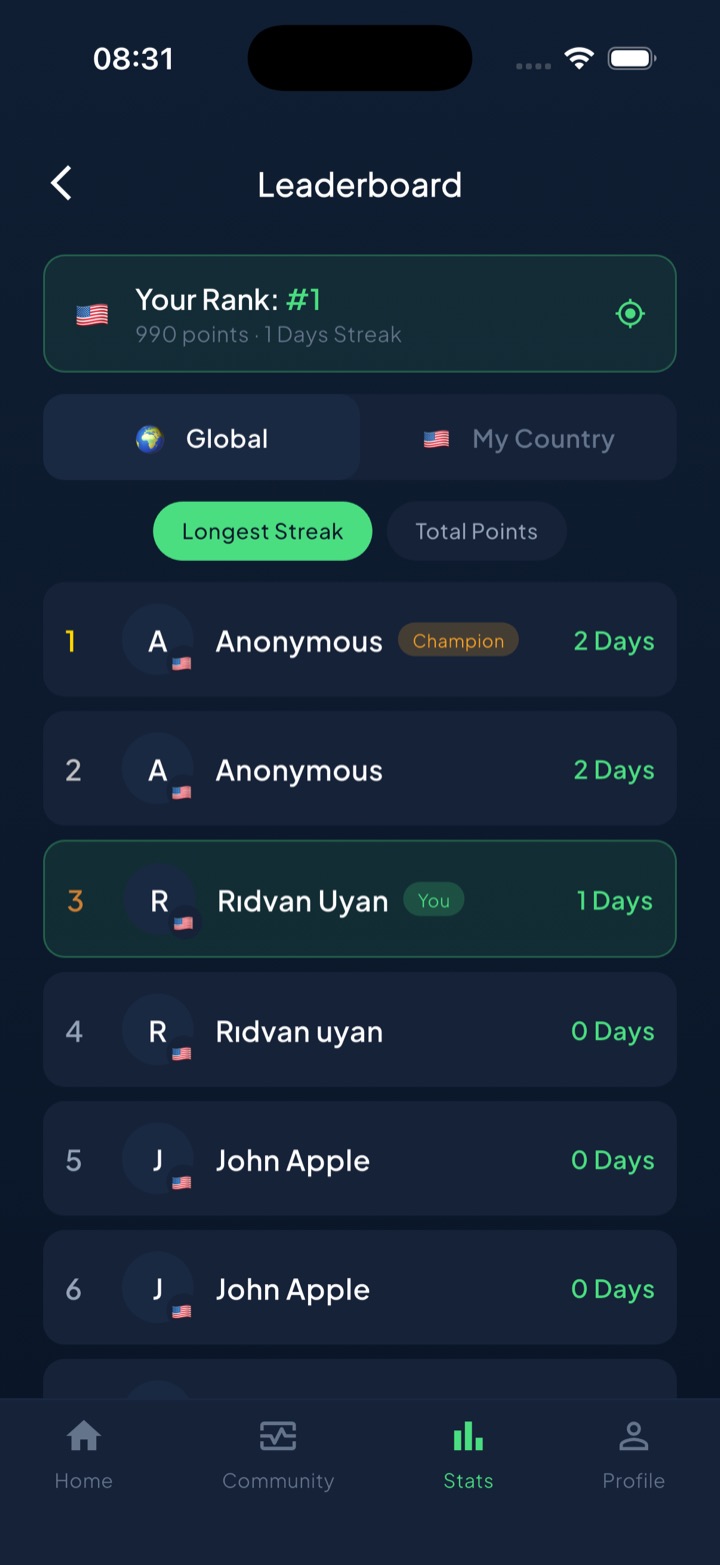
The leaderboard, global and by country, adds mild, opt-in accountability — your consistency is visible, ranked by longest streak or points — which turns a private goal into something you’re a little less willing to drop. When you sit down for the rep, a focus session blocks the apps competing for your attention using Apple’s Screen Time frameworks, and your usage data stays on-device. You can absolutely build this by hand — an index card goal and an X on a wall calendar for every day you did the rep is the same loop for free. The app just makes the daily reward harder to ignore than a distant grade.
Frequently asked questions
How do I set a study goal that actually motivates me?
Make it specific, personally meaningful, and tied to a daily action. 'Do better in math' gives your brain nothing to act on; 'raise my math score enough to reach that school, by solving ten problems every evening' does. Start with why the goal matters to you, then define the smallest daily rep that moves toward it. The vivid why sustains the boring reps.
What's the difference between a process goal and an outcome goal?
An outcome goal is the result you want (a rank, a score, an acceptance). A process goal is the behavior you control (solve ten problems, read twenty minutes, do one mock exam a week). Outcome goals set direction but can't be performed; process goals are what you actually do each day. Keep the outcome as your compass and let process goals run your calendar.
Should a study goal be big or small?
Both, at different layers. Keep one big, vivid outcome goal to supply motivation and meaning, then break it into daily process goals small enough that skipping feels silly. A large goal with no daily version stays a wish; a daily version with no larger meaning feels pointless. You need the mountain and the next step at the same time.
Why do I keep setting study goals and giving up?
Usually because the goal was an outcome with no daily process attached, so nothing told you what to do today, or because one missed day felt like failure and you quit. Fix both: attach a specific daily action, keep the minimum tiny, and treat a slip as one missed rep, not a verdict. Never miss twice is the whole rule.