Exercise beats scrolling on everything except the first thirty seconds — and that is exactly why the couch and phone keep winning. Scrolling is zero-cost, instant, and engineered to hook you; a workout is high-cost up front with a payoff that arrives twenty minutes in and lasts for hours. The popular “cheap dopamine vs earned dopamine” framing is not real neuroscience — dopamine is dopamine — but it points at a real trade: what you pay to start, when the reward lands, and what you’re left with afterward. This guide covers what exercise honestly does for your brain, why the feed outcompetes the gym in the moment, and the swap tactics that make the workout your default instead of the scroll.

What does exercise actually do for your brain?
Skip the supplement-ad version. Here is the hedged, boring, true one — which is still a great deal:
- Dopamine, honestly. Exercise triggers the release of catecholamines, including dopamine, and animal studies show meaningful changes in dopamine signaling with regular training. Direct human evidence is thinner — most of what we know comes from indirect measures — but the downstream effect is not in dispute: movement reliably shifts motivation and mood in a way that lasts well beyond the session.
- The “runner’s high,” updated. It was credited to endorphins for decades; more recent research points to endocannabinoids doing much of the work, since endorphins struggle to cross the blood–brain barrier. Either way, the post-run calm-but-lifted state is a real, repeatable phenomenon — you just should not expect euphoria from every jog.
- BDNF. Aerobic exercise reliably raises brain-derived neurotrophic factor, a protein that supports neuroplasticity and that researchers have linked to learning and mood. This is one of the better-replicated findings in exercise neuroscience — though the “exercise grows your brain” headlines oversell what a modest, useful signal it is.
- Mood, the big one. Meta-analyses suggest exercise has a meaningful effect on mild-to-moderate depression and anxiety symptoms — for some people comparable to first-line treatments, though it is a complement to professional care, not a replacement. And a single session improves mood and energy for hours. That last one you can verify this afternoon.
None of this makes exercise a dopamine faucet. It makes it something better: a reliable input you control, with compounding returns.
Is “cheap dopamine vs earned dopamine” real science?
No — and this article works better if we’re honest about that. Your brain does not stamp molecules as cheap or earned, and scrolling does not “drain” dopamine that squats then “refill.” That entire folk model is the same myth behind dopamine fasting, and what the science actually says about dopamine detoxes is worth reading before you build habits on it.
But the metaphor survives because it points at three differences that are absolutely real:
- Cost. The feed asks nothing of you. The workout asks shoes, sweat, and twenty minutes of discomfort. Brains systematically discount rewards that cost effort — psychologists call it effort discounting — so in any head-to-head moment, the free option starts ahead.
- Timing. The feed pays now, on an unpredictable slot-machine schedule that is the most habit-forming reward pattern known — that machinery is covered in dopamine and social media. The workout pays twenty to forty minutes in.
- Aftermath. An hour of scrolling typically leaves people flat, restless, and mildly annoyed with themselves. An hour after a workout, most people feel better than before they started — and that lift persists.
So keep the phrase, but use it as accounting, not neuroscience: one option is a payday loan, the other is a paycheck.
Why does the couch and phone beat the gym in the moment?
Because the moment is rigged. At 7 p.m. on the couch, you are not choosing between “scrolling” and “the gym.” You are choosing between a reward that is two seconds away at zero cost and one that is forty minutes away behind a wall of effort — getting changed, getting out the door, the first ten ugly minutes. And one side of the contest employs some of the best-paid engineers on earth to shave its cost to zero, while your side is just… you, tired, with your shoes in another room.
| The feed | The workout | |
|---|---|---|
| Cost to start | Zero — it’s already in your hand | Shoes, kit, leaving the house |
| First reward | ~2 seconds | ~20 minutes in |
| One hour later | Flat, restless, “where did the evening go” | Calm, energized, mildly smug |
| Next day | Nothing to show | Sleep, mood, and a rep closer to progress |
| What it trains | Reaching for the phone at every flicker of boredom | Tolerating the ramp-up before a reward |
Read the first two rows and the nightly loss stops being a character flaw. You are not weak; the contest is asymmetric. Which means the fix is not “want it more” — it is changing the asymmetry.
How do you swap scrolling for the workout?
Every tactic below does one of two things: shrinks the workout’s entry cost or raises the feed’s. That is the whole game.
- Build a gateway workout. Define a ten-minute minimum version — one round of push-ups, squats, and a plank, or a walk around the block. The rule is you only owe the gateway; anything more is bonus. Most days, starting is the entire battle, and ten minutes routinely turns into forty once you’re moving.
- Gym bag by the door. Pack it the night before and put it where you trip over it — kit laid out, bottle filled, shoes on top. Every step you pre-complete is a step your tired evening self doesn’t have to argue about.
- Give the urge a route. Use an if-then plan: when I catch myself reaching for the phone, then I do the first two minutes of my gateway workout. You’re not suppressing the restlessness — you’re rerouting it into the exact thing you wanted to do anyway.
- Bundle a treat into training. Save your favorite podcast or playlist for workouts only. That’s temptation bundling — it borrows the feed’s trick (instant reward) and staples it to the thing that pays you back.
- Make the workout your “main.” If you keep a dopamine menu, the workout belongs in the mains column — the absorbing, genuinely satisfying option you order when the evening feels empty, instead of defaulting to dessert.
- Block the feed in your workout window. The tactics above shrink the workout’s cost; this one raises the scroll’s. If Instagram simply doesn’t open between 6 and 8 p.m., the contest changes shape entirely — more on that below.
“I used to lose the 6-to-8 window every single night — sit down for one scroll, look up and it’s 7:40 and the gym feels pointless. What worked was embarrassing in its smallness: bag packed by the door and my ten-minute rule. I told myself I only owed ten minutes. I have missed maybe four evenings in three months, and almost none of those workouts stayed at ten minutes.” — Dan, software engineer, 33
How does Unscrol help you trade the scroll for the workout?
Start with the free route, because it genuinely works: pack the bag, define the gateway workout, and use Apple’s own Screen Time to set App Limits or Downtime on your feeds during your training window. Leave the phone in a locker or another room while you train. For plenty of people, that plus a week of momentum is enough.
Unscrol is the iPhone app for when you keep negotiating with yourself anyway. It uses the same Apple Screen Time frameworks — real, system-enforced app blocking, processed entirely on-device, so your block lists and usage never touch our servers.
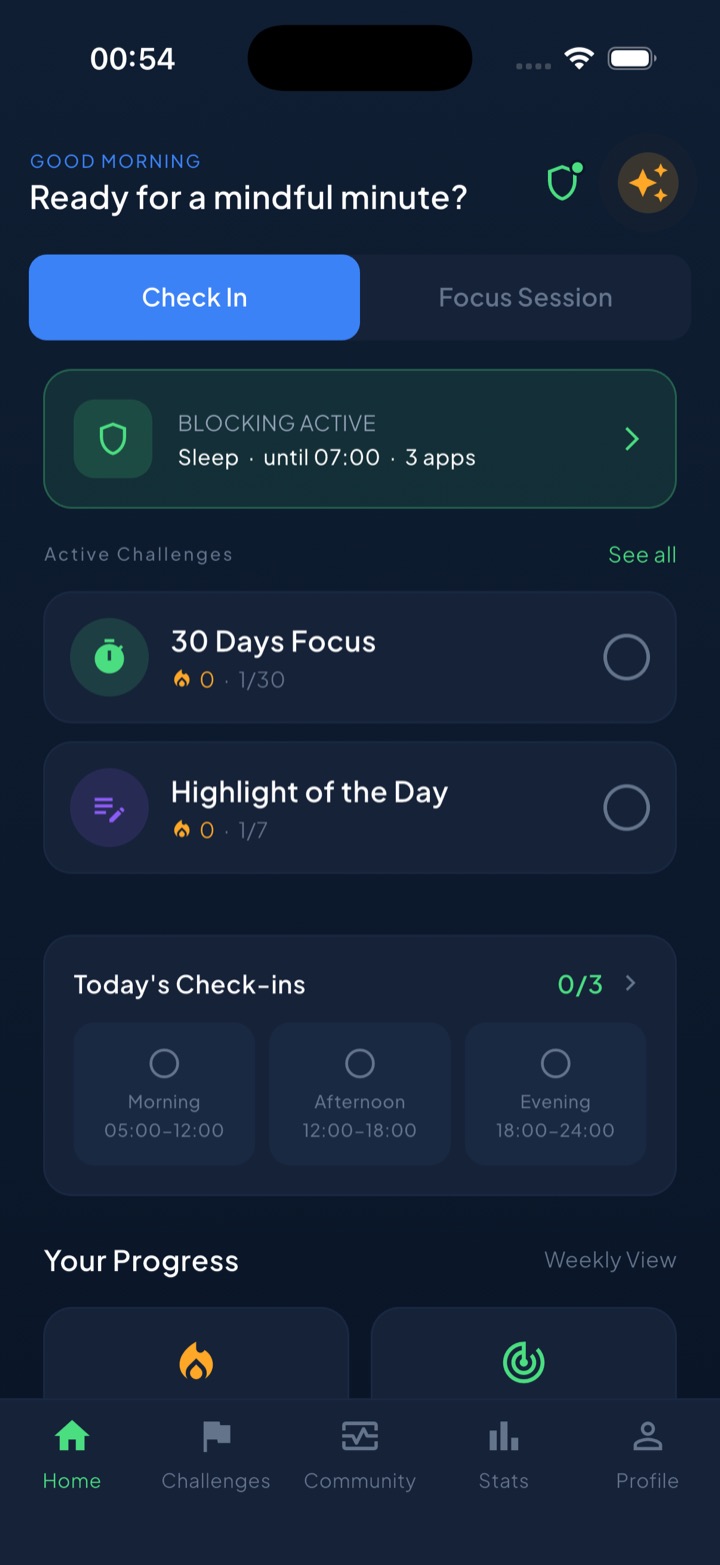
For the scroll-vs-squat contest specifically:
- A scheduled block routine for your training window. Set a recurring block — say 18:00–19:30 on lifting days — and your feeds simply don’t open at the exact moment they usually win. The short “take a break” bypass stays available for genuine exceptions, so it’s a speed bump with a purpose, not a wall.
- A focus session for the workout itself. Start a session when you start training and a Live Activity countdown sits on your Lock Screen — so checking the time doesn’t dump you into a feed between sets.
- Streaks and challenges for the payoff gap. Exercise’s rewards arrive late; a visible daily streak, 45+ challenges, and a home-screen widget give you a small, immediate win for showing up today — the same-day reward the gym can’t hand you on its own.
The honest version: the workout will never beat the feed on the first thirty seconds. So stop fighting there. Change the entry costs, block the window, and let the contest play out where exercise wins — everywhere after minute twenty.
Frequently asked questions
Does exercise actually release dopamine?
Yes, with caveats. Exercise triggers the release of catecholamines, including dopamine, and animal studies show clear changes in dopamine signaling with regular training. In humans the direct evidence is thinner, but the downstream effect is well documented: a single workout reliably improves mood, energy, and focus for hours afterward. Exercise is not a dopamine faucet you turn on — it is a reliable, repeatable mood and motivation input, which is more useful anyway.
Is 'cheap dopamine' a real scientific term?
No. Neuroscientists do not grade dopamine as cheap or earned — dopamine is dopamine. The metaphor still points at three real differences: cost (the feed asks nothing up front, the workout asks a lot), timing (the feed pays instantly and unpredictably, the workout pays after twenty minutes), and aftermath (scrolling often leaves you flat, exercise usually leaves you better for hours). Use it as accounting, not neuroscience.
How do I work out instead of scrolling?
Attack the entry cost, not the urge. Shrink the workout to a ten-minute gateway version so starting is trivial, pack your gym bag and leave it by the door the night before, and give the scroll urge a physical route: when you catch yourself reaching for the phone, do the first two minutes of movement instead. Then block your feeds during your workout window so the phone stops being the easier option at the exact moment it usually wins.
Why do I choose my phone over the gym when I know exercise feels better?
Because your brain discounts rewards that cost effort and arrive late. The feed pays out in two seconds for zero effort; the workout pays out in thirty minutes for a lot of it. In a head-to-head moment on the couch, that math beats your intentions almost every time. The fix is not more willpower — it is changing the math: make starting the workout smaller and make opening the feed harder.