You can game and still get good grades — but only if you flip the default order of your evening. The students who pull it off use earn-your-game scheduling: a defined study block comes first and unlocks the gaming session, so play becomes a bounded reward instead of a bottomless default. Add two honest rules — count sessions in matches, not minutes (because ranked games can’t be paused and “one hour” rarely is one hour), and taper during exam season instead of cold-quitting (bans rebound; tapers hold) — and gaming stops being the enemy of your GPA. The problem was never the game. It was the game starting before the work.

Why does gaming eat study time so easily?
Because a modern game is a professionally engineered “one more” machine, and homework is not. Ranked ladders, daily quests, battle passes, and duo queues with friends all reward starting and punish stopping — leave mid-match and you let your team down, log off before the daily resets and you “waste” progress. Homework offers the exact opposite: slow feedback, no teammates waiting, no XP bar.
So when both sit in front of you at 6 p.m., this is not a fair fight of willpower. If the game is available first, it wins first — and study gets whatever brain is left at 11 p.m., which is not much. That’s also why the guilt loop (“I’ll just play until I feel like studying”) never resolves: the feeling of wanting to study is not scheduled to arrive.
The fix is structural, not moral: change the order, and put a real barrier between you and the queue button until the work is done. If the deeper issue is that gaming has stopped feeling optional at all, read how to stop playing video games so much first — this article assumes you want balance, not quitting.
What is earn-your-game scheduling?
It’s the simplest contract that actually survives contact with a ranked queue: study blocks unlock gaming sessions. Not “study more, game less” — a precise if-then your evening runs on.
- Set the daily quota in blocks, not vibes. Two focused blocks of 45–50 minutes beats “study for two hours-ish.” Decide the blocks the night before — what subject, what task — so starting requires zero decisions (that’s most of how to focus on homework).
- Blocks come before the first launch. Always. The rule is order, not amount. A block done after “just one warm-up match” doesn’t count, because there is no such thing as one warm-up match.
- Phone out of reach during blocks. Discord, YouTube builds, TikTok clips of your main — the second screen is where study blocks quietly die. Block or banish it for the 45 minutes.
- Define the session before you queue. “Three matches” or “two ranked, one unranked” — a match count, agreed with yourself (or your duo) in advance. Clock-time limits fail because matches don’t end on the hour; match counts have natural exits.
- Hard stop = last match ends, apps lock. The end of a session is the moment the result screen shows, not “one more to end on a win.” Ending on a loss is allowed. Your rank will survive it.
Notice what this doesn’t ask of you: less total gaming on a normal week. Most students find the same hours fit fine once they stop leaking. What it removes is the unbounded session that starts at 5 p.m. “for a bit” and ends at 1 a.m.
How do you use temptation bundling without wrecking your grades?
Temptation bundling — pairing a thing you crave with a thing you avoid — is one of the best-studied tricks in behavioral science, and student gamers routinely use it wrong: lectures on one monitor, ranked on the other. That’s not bundling, that’s losing twice.
Done right, gaming is a sequenced temptation, not a simultaneous one:
- Bundle during study only what doesn’t compete for the same attention. A lo-fi playlist, good tea, your comfiest setup — sensory pairings, yes. Anything with a screen, objectives, or teammates — no.
- Use the game as the “after,” strictly. “When the second block ends, I queue with the squad at 8:30” is a bundle your brain genuinely anticipates — researchers call this kind of anticipation a motivator in its own right. It also gives your duo a reliable time, which they’ll prefer to your current “maybe in a bit.”
- Bundle the boring subject with the better reward. Ranked night after the math blocks, casual-only after the easy reading. Your most-avoided subject should unlock your most-wanted session.
How much time does a ranked session really take?
Here’s the honest talk nobody puts in a study guide. When you plan “an hour of gaming,” check the real arithmetic — times are rough and vary, but the shape is what matters:
| Game | Typical match | Queue + lobby | ”Just 3 matches” really is |
|---|---|---|---|
| League of Legends (ranked) | ~25–40 min | ~5–10 min | ~1.5–2.5 hours |
| Valorant / CS2 (competitive) | ~30–45 min | ~5–10 min | ~2–2.5 hours |
| Fortnite / battle royale | ~15–25 min | ~2–5 min | ~1–1.5 hours |
| EA FC / Rocket League | ~10–20 min | ~2–5 min | ~45–75 min |
| Gacha / live-service dailies | ”just dailies” | — | 20–60 min, every day |
Three things follow from the table. First, ranked matches can’t be paused — a session is only plannable at its start, never mid-match, so all limits must be set before queueing. Second, a “quick League game” is structurally impossible; if your evening has 45 free minutes, that’s a Rocket League night, not a ranked LoL night — pick the game that fits the slot. Third, daily-quest systems are a tax on every single day; deciding “I don’t do dailies on school nights” is one decision that saves you thirty small ones.
“I told my duo I study 7 to 8:30 and queue at 8:35, every weekday. First week felt embarrassing, like I was a kid with a curfew. But my duo started doing the same because his grades were tanking too. My rank went up — turns out I was hardstuck because I’d been playing tired garbage games at midnight.” — Leo, high-school junior, 17
How should you game during exam season?
Taper, don’t cold-quit. Deleting your games two weeks before finals feels heroic and usually backfires: the game becomes forbidden fruit occupying more headspace than it did when allowed, you lose your main decompression valve exactly when stress peaks, and the first “five-minute exception” turns into a lost evening followed by a guilt spiral.
A taper keeps the habit’s shape while shrinking its size:
- Three weeks out: normal earn-your-game evenings, but cap at your baseline match count. Build your exam study schedule around fixed session times.
- Two weeks out: cut the count (three matches → two), and switch ranked to unranked. Ranked deserves your full brain and punishes distraction with lost LP and tilt you’ll carry into your notes.
- Exam week: one short match or 20 minutes of something pausable, after the day’s revision, as a deliberate decompression — not a reward you must earn twice.
- After the last exam: binge guilt-free. Seriously. A planned post-exam gaming day makes the taper vastly easier to keep, because the brain is waiting for something real.
The ranked-specific honesty: a taper also protects your rank. Comebacks after cold-quits are where tilted losing streaks live. A small maintenance dose keeps your mechanics warm and your MMR intact.
How does Unscrol help you balance gaming and studying?
Start with the free route, because it genuinely works: write tomorrow’s two study blocks on paper tonight, tell your duo your queue time, and use Apple’s built-in Screen Time to set App Limits or a Downtime window on your phone during study blocks. If your gaming is on PC or console, your phone is still the main leak — Discord pings, YouTube gameplay, TikTok — and that’s the part Screen Time can fence off.
Unscrol is an iPhone app that makes that fence actually hold, using the same Apple Screen Time frameworks — real, system-enforced blocking, processed entirely on-device, so your app list and usage never touch our servers.
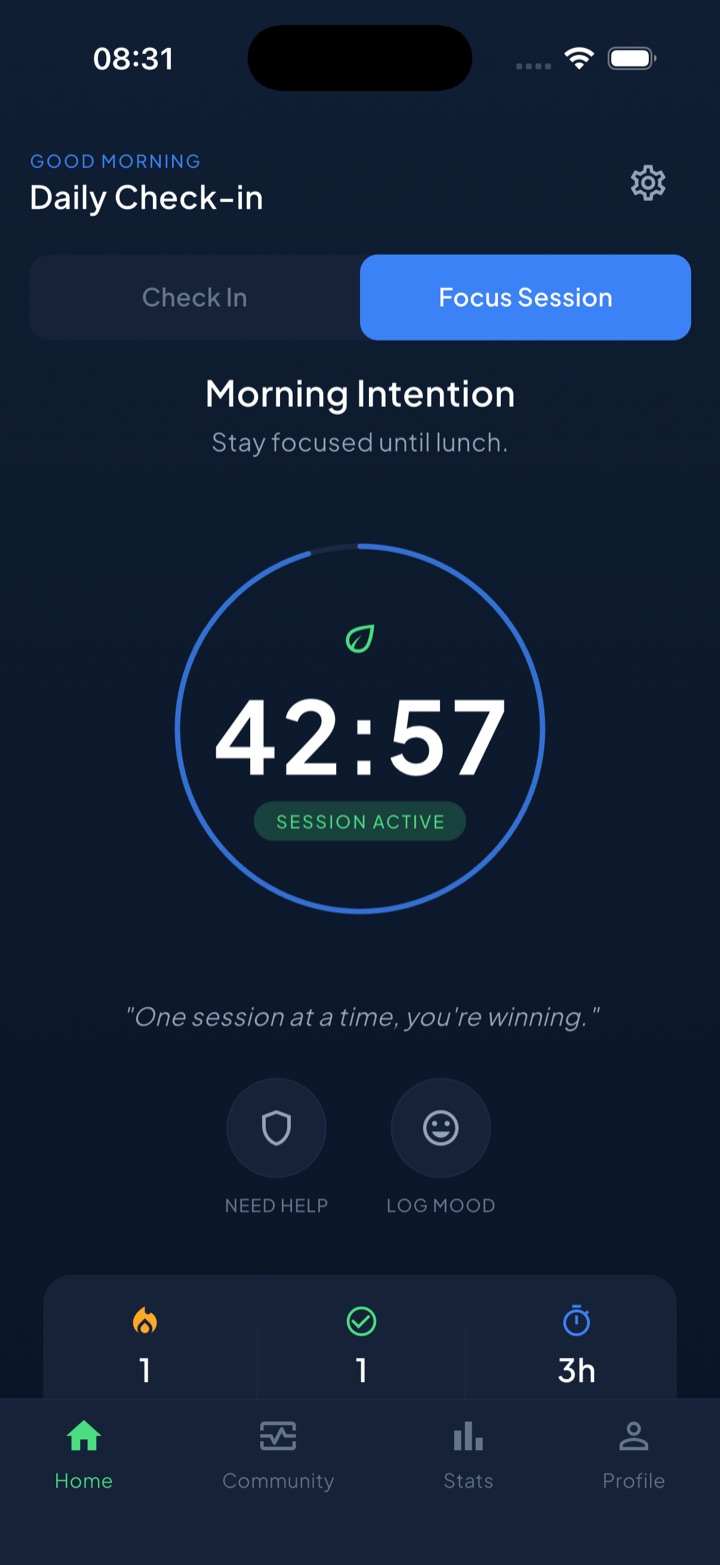
Here’s how it maps onto earn-your-game:
- Focus sessions = your study blocks. Start a 45-minute session and your chosen apps are shielded until it ends, with a Live Activity countdown on the lock screen — the block is real, not a promise.
- Scheduled routines = the order rule. A recurring School or Study window (say 17:00–20:00 on weekdays) blocks mobile games and feeds automatically; your session unlock happens when the window ends, no negotiation. A short “take a break” bypass exists for genuine exceptions, so it’s a speed bump you must consciously cross, not a wall you resent.
- Streaks make the taper visible. Daily check-ins and a unified streak turn “I kept my study-first rule today” into something you can see and won’t want to break — which is exactly the pull ranked ladders use, pointed at your grades for once.
The honest version: paper, a told-in-advance queue time, and Screen Time can do this. Unscrol is for the 6 p.m. moment when the queue button is glowing and your willpower isn’t — it makes the study block the thing that’s already running.
Frequently asked questions
Can you play video games and still get good grades?
Yes — the students who manage both don't game less than everyone thinks, they game in a different order. They put a defined study block first and treat the gaming session as the thing that block unlocks. That flips gaming from a default that swallows the evening into a bounded reward with a clear start and end. The grades problem usually isn't gaming itself; it's unbounded gaming that starts before the work and therefore never leaves room for it.
How do I balance gaming and studying?
Use earn-your-game scheduling: decide a daily study quota (say, two focused 45-minute blocks), do them phone-away and before you launch anything, and only then start a gaming session with a defined end — a number of matches, not a clock time you'll ignore. During exam season, taper your sessions down to a short daily maintenance dose instead of quitting cold, which tends to rebound. Blocking apps on your phone during study blocks removes the second screen that quietly doubles your gaming time.
Should I quit gaming completely during exams?
Usually no. Cold-quitting mid-semester often backfires: the game becomes forbidden fruit, you lose your main stress valve and your social circle overnight, and one 'exception' collapses into a binge. A taper works better — shrink sessions as the exam approaches (for example three matches a day, then one, then a short unranked game), keep it after your study quota, and pause ranked queues specifically, since ranked punishes both quitting mid-match and rusty comebacks.
How long should a student gamer play per day?
There's no magic number — what matters is that gaming fits after sleep, school, and your study quota, not instead of them. A useful honest test: count sessions in matches, not minutes, and multiply by real match length including queue and lobby time. If your 'one hour' of ranked is actually two and a half, the fix is a smaller match count with a hard stop, not a promise to watch the clock harder next time.