To focus on homework, remove the distraction before you start rather than trying to resist it while you work. The routine that works for almost everyone has four steps: clear your desk of everything except the one subject you’re doing, put your phone in another room (not face-down on the desk), pick one task and set a 25-minute timer, and take a short break when it rings. The phone step matters most. Research by Adrian Ward and colleagues found that just having your phone visible, even switched off, measurably reduces your available focus. Out of sight genuinely means more mental capacity, not less.
Why is homework so hard to focus on?
Because focus is mostly about your setup, not your willpower. If your phone is on the desk, ten tabs are open, notifications keep buzzing, and the task in your head is a vague “do my homework,” your attention has nowhere to settle. That’s an environment problem, and the good news is that environment problems are fixable in about two minutes, while willpower problems feel hopeless.
Gloria Mark’s research on attention found that people now hold focus on a single screen for under a minute on average before switching, and that after an interruption it can take a long time, often many minutes, to fully get back into what you were doing. Each buzz doesn’t cost you just the ten seconds you glance at it; it costs you the climb back to concentration afterward.
The most common homework distractions have simple, physical fixes:
| Distraction | The fix |
|---|---|
| Phone buzzing on the desk | Put it in another room, on silent |
| Too many browser tabs open | Close everything except the one you need |
| ”Do all my homework” (too vague) | Pick one subject, one task, right now |
| Music with lyrics pulling attention | Switch to instrumental or silence |
| Noisy or busy room | Move to a quiet spot, or use earplugs |
| No end in sight | Set a 25-minute timer with a clear finish |
Notice none of these require you to “try harder.” They just remove the thing pulling at you, which is the whole idea behind how to focus while studying.
What’s the four-step distraction-proof routine?
Do these in order every time, until it becomes automatic:
- Clear the desk. Take everything off it except what you need for one subject. A clean surface tells your brain there’s only one thing to do here. Put other books, snacks, and clutter out of reach.
- Phone in another room. Not in your pocket, not face-down, in a different room, on silent. This one step does more than the other three combined (more below).
- One task, one timer. Choose a single specific task (“math problems 1–10,” not “math”). Set a timer for 25 minutes. Work only on that until it rings.
- Short break, then repeat. When the timer goes, stand up, stretch, get water for about 5 minutes, then run another 25-minute block. After 3–4 blocks, take a longer break.
That’s the entire system. It’s not fancy on purpose: simple routines are the ones you’ll actually repeat, and repetition is what turns “sitting down to homework” from a daily fight into a habit. This is the Pomodoro method for students, and it works because a bounded 25 minutes feels doable even when a whole evening of homework feels crushing.
Where should your phone be while you work?
In another room. This is worth its own step because the research is so clear and so surprising.
Adrian Ward and colleagues ran an experiment in 2017 where people did attention and memory tasks with their phone in one of three places: on the desk, in their pocket or bag, or in another room. The people with their phone in another room performed best. The people with it on the desk performed worst, even though the phone was switched off and face-down and nobody touched it. Just knowing it was there used up a slice of their mental capacity, an effect the researchers called “brain drain.”
The lesson for homework: “I’ll just keep it face-down and ignore it” doesn’t work. Your brain spends effort not looking at it, and that effort is exactly the focus you need for algebra. The only reliable fix is distance, put it in another room so it isn’t quietly draining you. If you use your phone for music or a timer, use a separate device or a timer app you can’t easily leave, or hand the phone to a parent for the block. There’s a full breakdown in the brain drain effect.
How long should you work before a break?
For most people, focused blocks of 25 to 50 minutes with short breaks beat long unbroken slogs. Attention is a limited fuel tank, and pushing past empty just means slow, error-filled work you’ll have to redo.
Keep the break science simple:
- Work in blocks, not marathons. 25 minutes is a good default; older students who are warmed up can stretch to 45–50. The point is a clear finish line.
- Take real breaks. Stand up, move, look out a window, get water. A 5-minute break that’s actually restful beats one you spend scrolling, which drops you right back into the distraction loop you were avoiding.
- Don’t make the break a screen. If your “break” is TikTok, the 25 minutes of focus you just built get erased, and it’s much harder to start the next block. Move your body instead.
- Eat and drink. A little water and a light snack (not a sugar crash) keeps concentration steadier. Hunger and dehydration quietly wreck focus.
Building longer focus is trainable, too, if 25 minutes feels hard now, it gets easier with practice, the same way described in how to improve concentration.
A quick note for parents
If you’re helping a younger student, the highest-leverage things you can do are structural, not motivational:
- Own the phone during homework time. Hold it in another room for the study block. This removes the daily argument and delivers the brain-drain benefit at once.
- Set a consistent time and place. A fixed homework window and a dedicated (clutter-free) spot make starting a habit rather than a nightly negotiation.
- Praise showing up, not just grades. Reinforcing the routine (“you sat down and did your 25 minutes”) builds the behavior that produces the grades.
Consistency beats intensity. A predictable 45 focused minutes every evening does more than a chaotic three-hour session once a week.
“Homework used to be a two-hour battle with the phone winning most of it. We started leaving her phone in the kitchen and setting a scheduled block during homework time. The first week was rough, but now she sits down, does two timer rounds, and it’s over before dinner. The difference was taking the phone out of the room, not nagging.” — Daniel, parent of a 14-year-old
Making homework time automatic with Unscrol
The hardest part of a homework routine is the phone, and asking a distracted brain to keep ignoring it never lasts. Unscrol is built to take that fight off the table. Its scheduled blocking routines let you set a recurring homework window, say every weekday 16:00–18:00, that automatically shields games, social, and entertainment apps using Apple’s official Screen Time frameworks, so during homework time those apps simply won’t open. It’s the “phone in another room” benefit, enforced automatically, even on the days nobody feels like enforcing it.
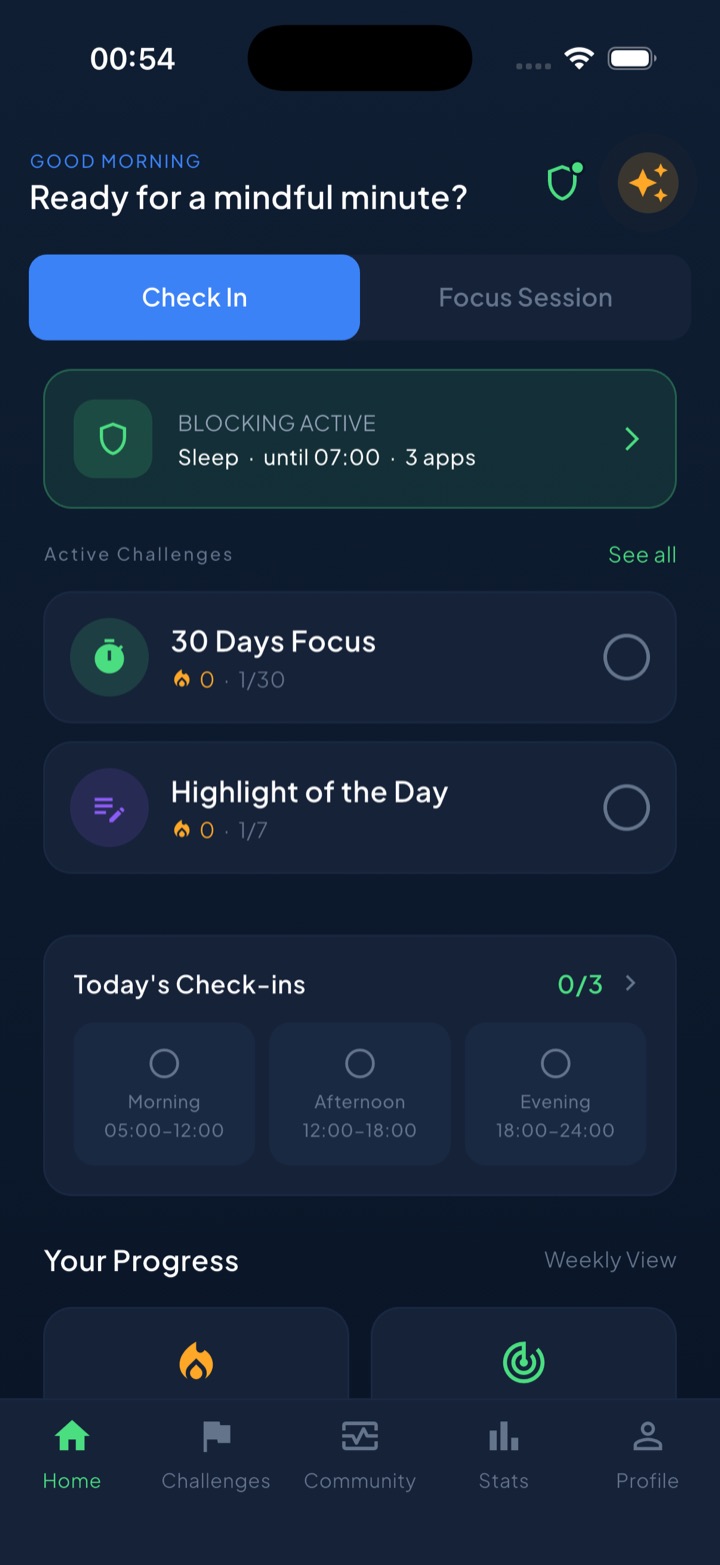
For a single homework session you can start a focus timer instead, a 25-minute block with a Lock Screen countdown and a break timer built in, which maps exactly onto the four-step routine above. Blocked apps and usage stay on-device with iOS, so a student’s data isn’t going anywhere. And none of it is strictly necessary: a phone left in the kitchen, a clear desk, and a $5 kitchen timer run the same routine for free. Unscrol just makes the block automatic, so the routine survives the evenings when willpower doesn’t. Set it up once, and homework time defends itself.
Frequently asked questions
How can I focus on homework without getting distracted?
Remove the distraction before you start instead of resisting it while you work. Clear your desk of everything except the one subject you're doing, put your phone in a different room, pick a single task, and set a 25-minute timer. Take a short break when it rings, then repeat. The phone step is the most important, because a visible phone drains focus even when it's switched off.
Why can't I focus on my homework?
Usually because the environment is working against you. A phone on the desk, several tabs open, notifications on, and a vague sense of 'do all the homework' all pull attention in different directions. Focus isn't mainly a willpower problem you can fix by trying harder; it's a setup problem. Change the setup, one task, phone in another room, timer running, and focus gets much easier without needing more discipline.
Should I have my phone near me while doing homework?
No. Research by Adrian Ward and colleagues found that simply having your phone visible on the desk, even face-down and switched off, measurably reduced people's available attention and working memory. The brain spends effort not-checking it. Putting the phone in another room, not just in your pocket or face-down, frees up mental capacity you didn't know the phone was quietly using.