An ADHD-friendly morning routine follows three design rules: fewer steps, not more discipline — three fixed “anchors” instead of a ten-step miracle morning; a checklist that lives outside your head — paper on the mirror, not an app; and a phone-later first hour — the phone charges outside the bedroom, a real alarm clock wakes you, and feeds stay shut until your anchors are done. Generic routines fail ADHD brains because they demand working memory, sequencing, and decision-making at the exact time of day those are weakest — and then hand your half-awake brain the most stimulating object in the house. One thing up front: this is a friction-engineering guide, not medical advice — nothing here replaces a clinician, medication, or therapy.

Why do generic “miracle morning” routines fail ADHD brains?
The classic productivity morning — wake at 5, meditate, journal, exercise, read, visualize, cold shower — is written for a brain that wakes up with its executive function already online. Researchers describe ADHD as, in part, a difference in executive function: working memory, task initiation, time perception, and the regulation of attention and effort. A ten-step routine attacks every one of those at once:
- Too many steps is a working-memory test before coffee. Every step you have to remember is a place the sequence can fall apart.
- Every step is a decision, and early-morning decision-making is exactly what a groggy ADHD brain does worst. “What was next? Do I still have time? Should I skip it today?” — that’s decision fatigue by 7 a.m.
- Time blindness eats the schedule. Ten minutes of journaling quietly becomes forty, the rest of the plan is now “ruined,” and the whole routine gets abandoned instead of trimmed.
- All-or-nothing thinking finishes it off. Miss one step on day four and the routine feels broken — and to a brain sensitive to failure, broken reads as proof it was never going to work.
- The phone gets there first. If your alarm is your phone, you wake up holding a slot machine. A just-woken, understimulated ADHD brain is dopamine-hungry, and infinite feeds are engineered for precisely that state — which is how one notification becomes forty lost minutes. Why ADHD brains and feeds are such a bad match gets a full deep dive in ADHD and phone addiction.
None of this is laziness or a character flaw. The routine failed because it was designed for a different brain. So design one for yours.
What is a 3-anchor morning?
A 3-anchor morning replaces the step list with three fixed anchors — small, non-negotiable actions that define a successful morning. Everything else (workout, journaling, reading) is a bonus, never a requirement. Why three? Because three fits in working memory without a list, and because a smaller “complete” is much harder to break.
| Anchor | Its job | Tiny versions that still count |
|---|---|---|
| Body anchor | Get the machine running | Glass of water waiting on the nightstand, meds if prescribed, something with protein |
| Light + movement anchor | Tell your brain it’s daytime | Open the curtains, step onto the balcony, ten slow stretches |
| Launch anchor | Start the day’s first real action | Get dressed, pack the bag, sit down at the desk, walk out the door |
Two rules make the anchors hold:
- Size each anchor for your worst morning, not your best. The workout version of the movement anchor is lovely; the “open the curtains” version is the one that survives a 6-hour night. If the tiny version happened, the anchor counts.
- Attach each anchor to something that already happens. Alarm off → drink the water. Kettle on → curtains open. That’s habit stacking: new behavior bolted onto existing behavior, so nothing depends on remembering.
Everything else went sideways but the three anchors happened? That morning was a success. This reframe is what protects the routine from perfectionist collapse.
How do you get the checklist out of your head?
ADHD working memory is not a safe place to store a routine. Externalize it — put the plan in the environment, where your eyes will trip over it:
- Paper, not pixels. Write the three anchors on an index card and tape it to the bathroom mirror or next to the kettle. A checklist stored inside the phone is guarded by the phone.
- Stage the environment the night before. Water glass on the nightstand, clothes on the chair, bag packed by the door. Morning-you should walk a path that evening-you already cleared.
- Pre-write the first move as an if-then. “When the alarm goes off, I drink the water on the nightstand.” Deciding in advance — an implementation intention — deletes the exact decision your groggy brain would fumble.
- Make ticking it off physical. A whiteboard with three checkboxes gives you a tiny, real hit of completion — visible progress that a mental list never provides.
How do you keep the phone from hijacking the first hour?
Bluntly: for an ADHD brain, willpower at 6:50 a.m. is not a plan. This is phone-later, not phone-never — a design problem, not a virtue test:
- Charge the phone outside the bedroom. Kitchen or hallway. The single highest-leverage change on this page.
- Buy a cheap alarm clock, so “but it’s my alarm” stops being the loophole that puts the phone back on the nightstand.
- Feeds open only after the three anchors. Not a vague “less phone in the morning” — a concrete rule with a finish line your brain can see.
- If the phone must be nearby (on-call, kids, eldercare): lock-screen notifications off, grayscale on, and the charger across the room so checking requires standing up.
We’ve written a full phone-free morning routine guide for the general case; this article is the ADHD adaptation — same idea, fewer steps, much less friction.
What does a dopamine-smart first hour look like?
Most routine advice prescribes calm: silence, stillness, meditation. For many ADHD adults that’s the hardest possible ask, because a just-woken ADHD brain is understimulated and hunting for input. Starve it and it will find the phone. Feed it clean stimulation instead:
- Sound as a side dish. A favorite playlist or podcast running during the boring anchors. Pairing a fun input with a dull task is most of the trick.
- Light and movement early. Bright light and a few minutes of movement are the boring, reliable, evidence-friendly way to actually feel awake.
- Protein before philosophy. Eat something. Deep reflection can wait; blood sugar can’t.
- Novelty inside structure. Keep the three anchors identical every day, and rotate everything around them — new music, a different breakfast, a new walking route. Structure holds the routine; novelty keeps your brain willing to show up.
“I’ve bought three planners and tried the 5 a.m. thing twice. What finally worked was embarrassingly small: water, curtains, get dressed — on a sticky note on the mirror — with my phone charging in the kitchen. Some mornings that’s all that happens. But it happens every day now, which no routine of mine has ever done.” — Dana, graphic designer, 36
How do you set this up tonight?
- Pick your three anchors and write the tiny, worst-day version of each one.
- Write them on a card and tape it where your morning already passes: mirror, kettle, coffee machine.
- Move the charger out of the bedroom and set a real alarm clock.
- Stage tomorrow: water glass out, clothes out, bag packed.
- Track “3/3 anchors” for two weeks with an X on a paper calendar. Anchors done = a win, no matter what else happened. A missed day is data, not a verdict.
How does Unscrol help ADHD mornings?
Start free. Apple’s built-in Screen Time can do the heavy lifting: schedule Downtime from bedtime until, say, 8:30 a.m., and add App Limits on your worst feeds. Combine that with the paper checklist, a $15 alarm clock, and a charger in the kitchen, and you’ve built most of this article without installing anything.
The catch, with ADHD, usually arrives around the fifth morning: Screen Time asks politely, and “Remind Me in 15 Minutes” is a button your dopamine-hungry thumb taps before you’re conscious of the decision. Unscrol is an iPhone app built on the same Apple Screen Time frameworks, but designed to hold when the polite version doesn’t:
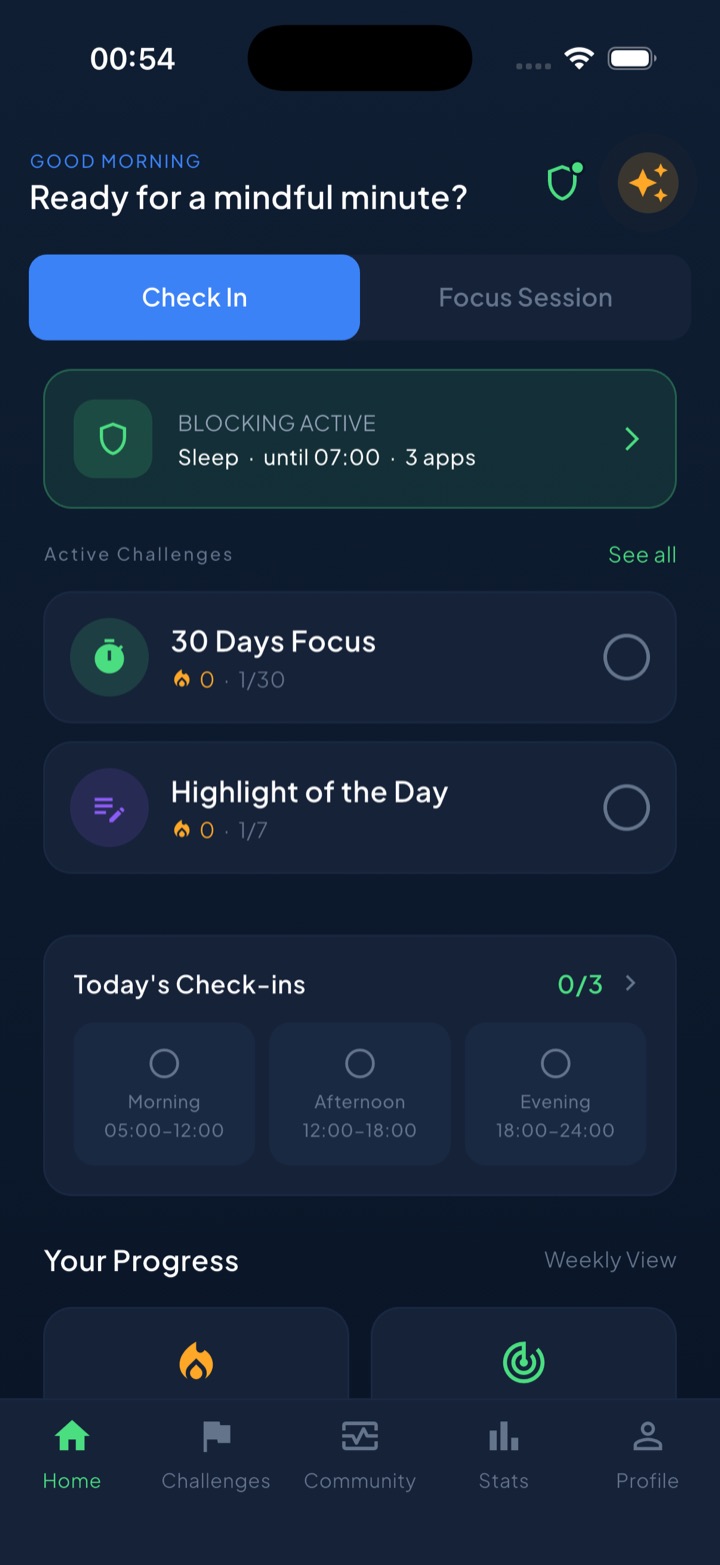
- A scheduled block that covers the morning. Set a Sleep routine from 22:30 to 08:30 and your feeds are simply not available when you wake up — system-enforced, no 6:50 a.m. negotiation with yourself.
- A short “take a break” bypass for genuine exceptions — deliberate and time-boxed, so checking one thing doesn’t become the trapdoor into an hour of scrolling.
- The morning check-in as a ready-made launch anchor. Unscrol’s day has morning, afternoon, and evening check-in slots; the morning one is a 30-second built-in third anchor.
- A streak that forgives. Check-ins and challenges feed one daily streak, and Streak Saver (premium) can rescue a single missed day — a rare piece of streak design that pushes against all-or-nothing thinking instead of feeding it.
The honest version: paper, an alarm clock, and Screen Time can build this entire routine. Unscrol is the enforcement layer that keeps the phone out of your first hour on the mornings your willpower isn’t awake yet — and everything it blocks or measures is processed on-device, never sent to our servers.
Frequently asked questions
What is a good morning routine for ADHD adults?
A good ADHD morning routine is deliberately small: three fixed anchors — something for your body (water, meds if prescribed, food), something for light and movement (open the curtains, stretch), and one launch action that starts your day (get dressed, sit at the desk). Everything else is optional bonus. The routine lives on paper where you can see it, not in your memory or your phone, and feeds stay closed until the three anchors are done.
Why do morning routines never stick when you have ADHD?
Generic routines demand exactly what a just-woken ADHD brain is worst at: remembering a sequence, making a decision at every step, and estimating time. Ten-step miracle mornings collapse under working-memory load and time blindness, and all-or-nothing thinking finishes them off — miss one step and the whole routine feels broken. It is not laziness; the routine was designed for a different brain. Fewer steps, externalized checklists, and pre-made decisions fix most of it.
Should I check my phone first thing in the morning if I have ADHD?
Ideally no — and not because of discipline. A just-woken ADHD brain is understimulated and dopamine-hungry, and infinite feeds are engineered for exactly that state, which is how one notification becomes forty lost minutes. The practical fix is phone-later, not phone-never: charge the phone outside the bedroom, wake up to a cheap alarm clock, and open feeds only after your morning anchors are done.
How many steps should an ADHD morning routine have?
Three. Three anchors fit in working memory without a list, are small enough to complete on your worst morning, and make the routine hard to 'break' — which protects it from the all-or-nothing collapse that kills most ADHD routines by day four. Anything beyond the three anchors (workout, journaling, reading) should be treated as a bonus, never a requirement. If the tiny version of each anchor happened, the morning counts as a success.