When you lose a streak, two things happen at once — one in the app, and one in your head. In the app, a number resets to zero. In your head, a much bigger story usually takes over: “I’ve ruined it, so why even bother?” That second reaction — not the missed day itself — is what actually breaks habits. Psychologists call it the what-the-hell effect: one slip triggers a cascade of giving up entirely. The calmer truth is more useful: a broken streak is a single missing data point, not a verdict on your character. The day after the break matters far more than the break, and the single healthiest rule in habit-building is never miss twice.

Why does losing a streak feel so much worse than it should?
Streaks are powerful because they hijack loss aversion — the well-documented finding that we feel a loss about twice as intensely as an equivalent gain. A 30-day streak quietly stops being “30 good days I built” and becomes “something I could lose.” That reframing is what gives streaks their pull, and it’s also what makes them turn on you. The motivation and the anxiety come from the exact same mechanism.
You can see this in Duolingo folklore: people report keeping streaks alive from hospital beds, doing a lesson at 11:58 PM in an airport, or begging a friend to log in during a flight. Those stories are widely shared and mostly affectionate — but they reveal the trap. At some point the streak isn’t serving the goal (learning Spanish); the goal is serving the streak. That’s streak anxiety: the number owns you, and protecting it feels more urgent than the thing it was meant to measure.
The fix isn’t to abandon streaks — they genuinely work. It’s to hold them loosely. We break down the mechanism in why streaks build habits; the short version is that a streak is a tool for consistency, and a tool that makes you miserable when it slips has stopped doing its job.
What is the “what-the-hell effect”?
The what-the-hell effect is the moment a small lapse flips into a full collapse. It was first described in dieting research: someone breaks their rule with one cookie, thinks “well, I’ve blown it now,” and eats the whole box — doing far more damage afterward than the original slip. Streaks create the identical trap. The miss costs you one day; the “what the hell, my streak’s gone anyway” thought costs you the next two weeks.
A few things reliably make it worse:
- All-or-nothing counting. If your only states are “perfect streak” or “back to zero,” every miss is catastrophic by design.
- Streaks tied to identity. When “I’m a person who never misses” is doing the emotional work, a single gap feels like proof you’re a fraud.
- Long streaks with no forgiveness. The more days you’ve banked, the more terrifying the reset — so the crash after a miss is bigger, not smaller.
The antidote is boring and effective: decouple the streak from your self-image, and give the streak a floor it can’t fall through in one bad day. That’s partly a mindset shift and partly a design choice — which is exactly why forgiveness mechanics exist.
How do you recover from a broken streak the healthy way?
Recovery is a skill, and it’s mostly about the next 24 hours, not the miss. Here’s the sequence:
- Name it as one day, out loud. “I missed Tuesday.” Not “I failed.” Specific and small.
- Show up the next day, even at 1%. A 30-second check-in or the tiniest version of the habit re-establishes the pattern. Momentum beats perfection.
- Never miss twice. This is the whole game. One gap is noise; two in a row is a new habit forming. Guard the day after the break like it’s the important one — because it is.
- Don’t chase the old number. Trying to “make up” lost days is how people burn out. Start again and let it compound.
- Ask what caused the miss. Travel, a fight, no sleep? Design around the cause. This is where a good habit tracker earns its keep — it shows you the pattern behind the gaps.
“I had a 112-day streak and lost it on a red-eye flight. I spent the next morning genuinely mourning a number. Then I just… started again. My new rule is that the streak measures the habit, not me — and honestly, restarting from one felt lighter than protecting 112 ever did.” — Maya, product designer, 29
Streak freeze vs. repair window vs. Streak Saver — how do forgiveness mechanics compare?
Most serious habit apps have realized that a brittle, zero-tolerance streak backfires, so they build in a way to survive a bad day. But the designs differ in how forgiving they are — and too much forgiveness makes the streak meaningless.
| Mechanic | How it works | The trade-off |
|---|---|---|
| Streak freeze (Duolingo) | A token auto-protects your streak on a missed day; you can stock up a couple. | Easy and reassuring, but a stockpile can let you coast for days without real practice. |
| Repair / grace window | A short window (hours to a day) to retroactively complete the missed day. | Gentle, but it can become a nightly game of “I’ll do it tomorrow.” |
| Unscrol Streak Saver | A Pro token, 2 per week, rescues one fully-missed day — two in a row can’t be saved. | Deliberately scarce. Prevents a spiral without letting you abandon the habit. |
The design principle underneath all three is forgiveness with teeth: enough slack to stop the what-the-hell spiral, not so much that missing stops costing anything. A streak that can never break isn’t a streak — it’s a participation trophy. This is really a commitment device in reverse: instead of adding friction to bad behavior, it adds a small, limited cushion under good behavior.
Does a lower bar for “counting the day” help?
Yes — one of the most underrated fixes is making the streak easier to keep honestly. If the only way to count a day is a heavy 45-minute session, you’ll miss often and spiral often. If a day counts when you do any meaningful version of the habit, you stay in the game on hard days without lying to yourself.
That’s the logic behind Unscrol’s unified streak: a day counts if you do a quick mood or urge check-in or complete a challenge. The bar is low enough to survive a chaotic Tuesday, but it still requires you to show up and be honest — which is the actual habit you’re building. Lowering the bar isn’t cheating; it’s the difference between a streak you protect out of fear and one you keep because it fits your life.
How does Unscrol help you keep — and rescue — a streak?
Let’s be honest about what you already have for free: Apple’s built-in Screen Time can set app limits and show your usage, and a paper calendar with X marks is a perfectly good streak tracker. If your only problem is remembering, you may not need anything else. What Unscrol adds is consistency and a soft landing — the parts of streak-keeping that willpower alone tends to fumble.
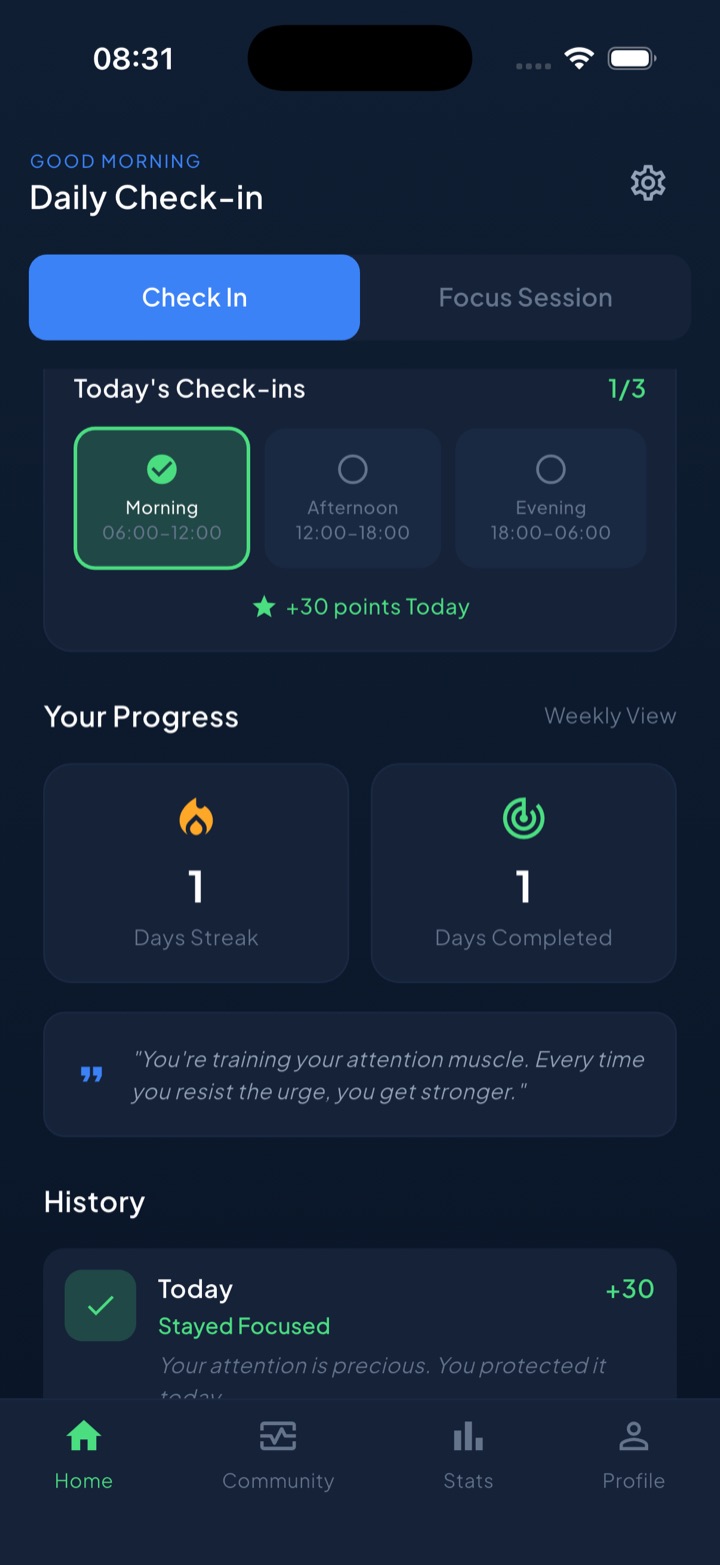
Unscrol runs a single unified daily streak across the whole app — check in about a mood or urge, or finish one of 45+ challenges, and the day counts. When life breaks your run, the Streak Saver (Unscrol Pro, twice a week) rescues a single fully-missed day, while two missed days in a row stay unrescuable by design — forgiveness with teeth, not a free pass. Alongside it, real system-enforced app blocking (Apple’s Screen Time frameworks), scheduled block routines, and focus sessions handle the behavior the streak is tracking, so the number reflects something true. Rebuilding after a rough patch? Pair it with our guide to breaking phone addiction — the streak keeps you consistent; the habits do the work.
Frequently asked questions
Why does breaking a streak feel so bad?
Breaking a streak triggers loss aversion — the tendency to feel a loss roughly twice as intensely as an equal gain. A long streak stops feeling like accumulated good days and starts feeling like something you could lose, so missing one day reads as losing everything. That emotional weight is exactly why streaks motivate us, and also why they sting. The healthier framing is that a streak is a scoreboard for a habit, not a measure of your worth. One missing day is a single data point, not a verdict.
Should I start over after breaking a habit streak?
Yes — restart immediately, and treat the very next day as the most important one. Research on habit formation shows a single missed day has almost no effect on long-term automaticity; what breaks habits is the spiral of giving up after the miss. The practical rule is never miss twice: one skipped day is an accident, two in a row is the start of a new (worse) pattern. Don't try to 'earn back' the old number. Just resume the behavior and let the count rebuild.
What is a streak freeze or streak saver?
A streak freeze (Duolingo) or streak saver (Unscrol) is a forgiveness mechanic: a limited token that protects your streak when you miss a day, so one slip doesn't reset you to zero. Good versions are deliberately scarce — Unscrol's Streak Saver is a Pro feature limited to twice a week and rescues only a single fully-missed day, so two missed days in a row still can't be saved. That scarcity is the point: it's forgiveness with teeth, enough to prevent a spiral without letting the streak become meaningless.