Walking without your phone is one of the simplest, most underrated upgrades you can make to a fitness routine: a phone-free walk gives your attention a real rest, drops your mind into the wandering, idea-generating mode researchers associate with the brain’s default-mode network, doubles as the easiest mindfulness practice in existence, and quietly lowers the background stress of being permanently reachable. You don’t need an hour — even ten minutes with no screen, no podcast, and no feed changes the character of a walk completely. The catch: the first few minutes feel genuinely uncomfortable, which is exactly why most people never try it — and a big part of why it works.

What does your phone actually take from a walk?
On paper, a walk is a walk — the steps count either way. But a walk spent on a phone is really consumption in motion: your legs move while your attention sits in the same feed it sits in on the couch. The scenery changes; the mental state doesn’t. What used to be the day’s built-in recovery slot becomes one more content slot.
And the phone doesn’t have to be in use to take its cut. The well-known 2017 “brain drain” study by Adrian Ward and colleagues found that the mere presence of a smartphone — silent, face down — measurably reduced people’s available cognitive capacity. Part of your mind stays on call, monitoring the pocket. We’ve covered what phone presence does to your thinking in depth, but the short version is blunt: a walk with a phone on you is not the same walk, even if you never touch it.
That’s the honest trade. You give up reachability and stimulation for forty minutes. What you get back is the only kind of attention that produces the next section.
Why do your best ideas arrive on a phone-free walk?
Everyone knows the shower-thought phenomenon: the solution appears the moment you stop looking for it. Walks used to be the main venue for this. When external input stops, the brain doesn’t idle — it switches to internally directed thought, a network of regions neuroscientists call the default-mode network. The science of exactly what this network does is still being mapped, so hold the details loosely — but mind-wandering has been consistently linked with memory consolidation, future planning, and creative incubation. Your brain files, connects, and rehearses precisely when you stop feeding it.
Movement seems to amplify the effect. A widely cited series of Stanford experiments found that people produced substantially more creative ideas while walking than while sitting — and the boost lingered briefly after they sat back down. Add the two together and a phone-free walk is arguably the cheapest creativity tool available to anyone.
But the mode only engages if there’s a vacuum for it to fill. A podcast, a voice memo, a quick scroll at the traffic light — any input collapses the wandering state back into consumption. That itchy, restless feeling in minute three of a silent walk isn’t a bug; it’s the doorway. Boredom is the on-ramp to your brain’s best work, and a walk is the gentlest place to practice tolerating it.
Is walking really the easiest form of mindfulness?
Formal meditation asks a lot: a cushion, a quiet room, twenty unscheduled minutes, and a tolerance for sitting still that most fitness-minded people find harder than a workout. Walking asks for none of it. The practice is embarrassingly simple: feel your feet hit the ground, notice your breath settle into a rhythm, register what you can see, hear, and smell. When you catch yourself composing an email in your head, come back to the footsteps. That noticing-and-returning is the rep — the same one meditation apps charge for, minus the app.
There’s a quiet irony here: most people’s mindfulness practice lives inside the exact device that fragments their attention the rest of the day. A phone-free walk is meditation with the temptation physically removed — and with a built-in metronome, because footsteps give drifting attention somewhere concrete to land.
Is it safe to walk without your phone? (Honest answer)
Mostly yes — with real caveats worth taking seriously rather than waving away:
- Tell someone. Route and rough return time, especially for longer or unfamiliar walks. A ten-second text before you leave removes most of the genuine risk.
- Carry ID and a card. Or a little cash. Old-school, still correct.
- Start on familiar routes in daylight. The first weeks are about the habit, not adventure. Save new trails for when phone-free feels normal.
- Consider a smartwatch as the middle ground. A cellular watch can make an emergency call, show the time, and count your steps — while offering essentially nothing to scroll. For many people this dissolves the safety objection entirely. If a full watch feels like overkill, the compromise tier is the phone on Do Not Disturb, in a zipped pocket: carried, not used.
- Know when to just bring it. Night walks, genuinely unfamiliar areas, a medical condition, waiting on an urgent call, or meeting someone mid-route — bring the phone without guilt. Phone-free is a tool, not a purity test.
How do you build the habit? The 4-week phone-free walking challenge
Cold turkey fails here the way it fails everywhere. Grade the exposure instead:
| Week | The walk | Phone rule | The goal |
|---|---|---|---|
| 1 | 10 min daily | On you, but on DND in a zipped pocket | Prove nothing breaks when you’re unreachable |
| 2 | 15–20 min daily | Left at home; loop near your house | First true phone-free walks |
| 3 | 20–30 min daily, one new route | Left at home; tell someone about the new route | Sit with boredom until it turns into thinking |
| 4 | Daily walk + one 45–60 min long walk | Left at home; smartwatch allowed | Make the long walk a weekly ritual |
Three rules that keep it honest: no audio for at least the first ten minutes of any walk; treat every urge to reach for the pocket as data, not failure; and if you miss a day, resume — don’t restart. And when you get home and the freed-up urge to scroll comes looking for you, have a plan ready: a short list of things to do instead of scrolling catches the rebound.
“I train clients all day, and I used to spend every walk between sessions catching up on Instagram. The first phone-free walk was honestly uncomfortable — I kept reaching for my pocket like a phantom limb. By week three it had become the part of my day where I plan sessions and cool off. My watch still tracks the steps; my head finally gets the recovery.” — Marcus, personal trainer, 34
How does Unscrol help you walk without your phone?
Start with the free, no-app route — it’s genuinely the best one here. The purest phone-free walk requires leaving the phone at home, which costs nothing. If it has to come along, Apple’s built-in Screen Time can shield the tempting part: set Downtime or App Limits over your usual walking window so the feeds are closed even if the phone is in your pocket. Pairing the walk with a phone-free morning routine stacks the two habits so each protects the other.
Unscrol is the iPhone app for the part willpower doesn’t cover: consistency. It uses the same Apple Screen Time frameworks — real, system-enforced app blocking, processed entirely on-device, so your block lists and usage never touch our servers.
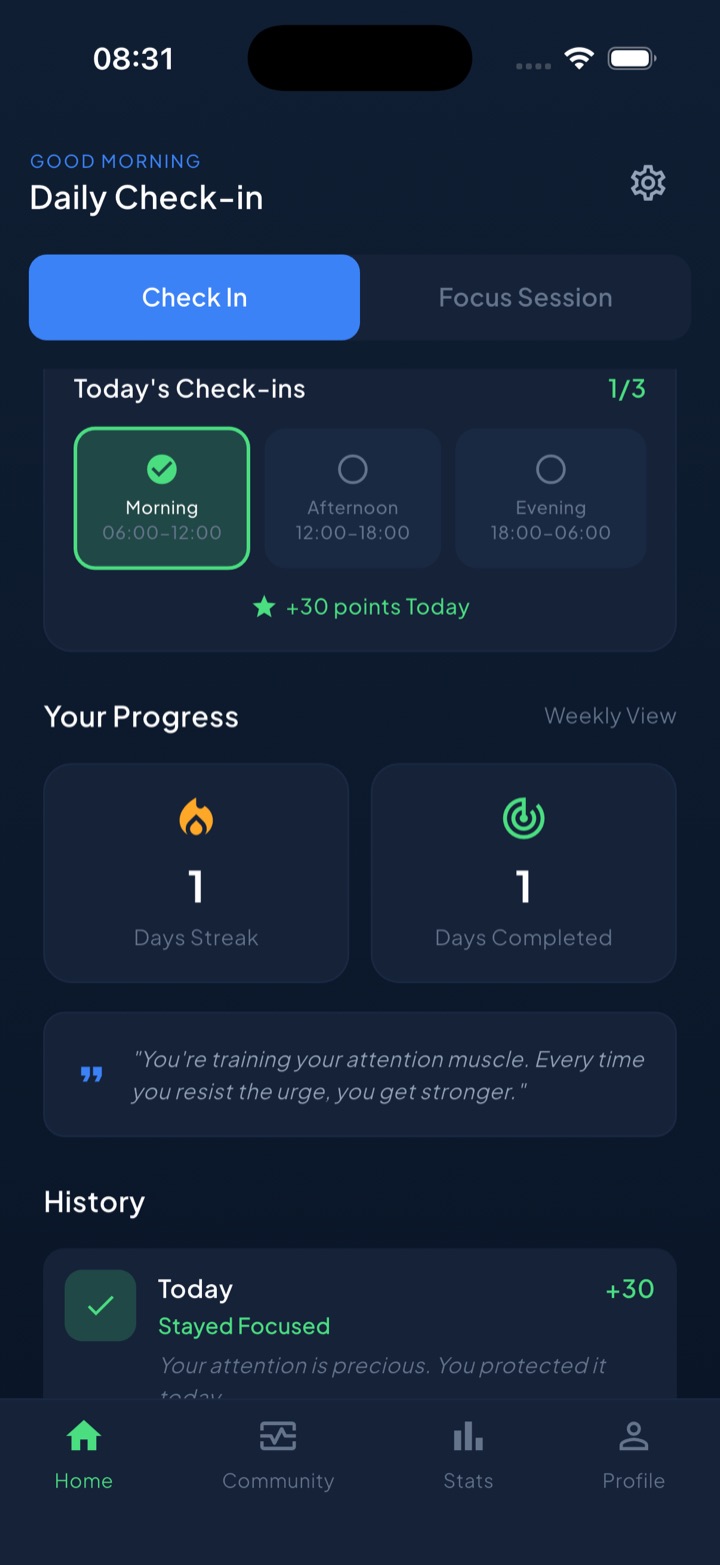
For a walking habit specifically:
- Scheduled block routines turn your walk window into protected time. A daily block at 7:00 means that even when the phone comes along for safety, it’s a tool in your pocket, not a feed — and the short “take a break” bypass exists for the genuine exception, like checking a map.
- Daily check-in slots (morning, afternoon, evening) give the walk a natural anchor: morning walk, morning check-in, done.
- The streak makes the habit visible. A check-in or a completed challenge keeps your daily streak alive, and the home and lock-screen widgets show it without opening a single app — which is rather the point.
The honest version: the walk itself needs nothing but shoes and a closed door. Unscrol’s job is the other 23 hours — keeping the feeds shut when you said they’d be shut, and turning “I walked today” into a streak you don’t want to break.
Frequently asked questions
Is it safe to walk without your phone?
For most people, on familiar routes in daylight, yes — humans walked phone-free for all of history until about fifteen years ago. Make it safer: tell someone your route and expected return time, carry ID and a card or a little cash, and start with short loops near home. A cellular smartwatch is a good middle ground — it can make an emergency call without offering a single feed to scroll. Bring the phone, on Do Not Disturb in a zipped pocket, for unfamiliar areas, night walks, or if a medical condition makes reachability non-negotiable.
What are the benefits of walking without your phone?
A phone-free walk gives your attention genuine rest, which constant input never allows. With nothing to consume, your mind slips into wandering mode — the state researchers link to idea generation and problem-solving, which is why solutions so often arrive mid-walk. It also works as the lowest-effort mindfulness practice there is: noticing steps, breath, and surroundings with no app required. Many people report lower stress and a clearly better mood after even ten phone-free minutes, and the habit compounds because walking is something you already do.
How do I start walking without my phone?
Start graded, not cold turkey. Week one, take a daily ten-minute walk with the phone on Do Not Disturb in a zipped pocket — carried, not used. Week two, leave it at home for a short loop around your block. Week three, extend to twenty or thirty minutes and let yourself be bored. Week four, add one longer weekly walk of forty-five minutes or more, and tell someone before you go. Expect the first minutes to feel itchy; that discomfort fades within days and is part of the point.
Does listening to a podcast count as a phone-free walk?
Not really — it changes what the walk is for. Podcasts and music keep your attention occupied with input, so your mind never drops into the wandering, idea-generating state that makes phone-free walking special. That doesn't make audio walks bad; they're a fine way to learn or to make a long walk fly by. Just treat them as a different activity. If full silence feels like too big a jump, keep the first ten minutes audio-free, then decide whether you still want to press play.