Am I addicted to video games? If you’re asking the question, start with the distinction that matters most: loving games is not a disorder — losing control of them might be. The video game addiction test below is a 10-question self-check, scored 0–20, built around the signs researchers actually look for: impaired control, gaming crowding out everything else, and playing on despite real damage to sleep, school, work, or relationships. It takes two minutes, and the scoring bands tell you what your number does — and doesn’t — mean. One thing said plainly before you start: this is a self-reflection tool, not medical advice, and no online quiz can diagnose anyone.

Am I addicted to video games, or just really into them?
Hours alone don’t decide it. A competitive player or streamer can put in 25 hours a week and still sleep well, hold down their commitments, and take a week off for exams without falling apart. Someone else can play 12 hours and be in genuine trouble — because those 12 hours come out of sleep, homework, and every friendship they have.
What separates enthusiasm from a problem is function and control:
- Enthusiasm makes room for games around a life: play is planned, it ends when it needs to, and other things still happen.
- A problem rearranges life around games: sleep, meals, deadlines, and people keep losing the negotiation, and attempts to cut back keep failing.
It’s also worth saying, especially to worried parents: intense phases are normal. A teenager disappearing into a big new release for a launch weekend, or grinding a ranked season with friends, is ordinary fan behavior — not a symptom. The signals worth taking seriously are the ones that persist for months and cost something real. That’s exactly what the test below measures.
Take the 10-question video game addiction test
For each question, answer for the last few months — not your single worst week ever. Score each item:
0 = rarely or never · 1 = sometimes · 2 = often
| # | In the last few months… |
|---|---|
| 1 | When you’re not playing, do you spend a lot of time thinking about games — planning the next session, watching gameplay, itching to get back? |
| 2 | When you can’t play (busy day, trip, console unavailable), do you feel restless, irritable, or low? |
| 3 | Do you need to play longer — or chase bigger in-game rewards — to get the enjoyment that less used to give you? |
| 4 | Have you tried to cut back on gaming and failed? |
| 5 | Have hobbies or activities you used to enjoy faded away because gaming crowds them out? |
| 6 | Do you keep playing heavily even though you can see it causing problems — grades, work, health, arguments? |
| 7 | Do you downplay or hide how much you play from family, friends, or a partner? |
| 8 | Do you game mainly to escape bad feelings — stress, anxiety, loneliness, boredom? |
| 9 | Does gaming cost you significant sleep on school or work nights? |
| 10 | Has gaming put a relationship, your studies, or your job at genuine risk? |
Add up your ten answers for a total between 0 and 20. If your phone is a co-conspirator here — mobile games, Discord, endless gameplay videos — the companion phone addiction test is worth taking next; the two habits often feed each other.
What does your score mean?
| Score | Band | What it suggests |
|---|---|---|
| 0–5 | Healthy enthusiasm | Gaming fits inside your life. Nothing here needs fixing. |
| 6–11 | Warning zone | The habit is starting to negotiate with your sleep, work, or relationships — and sometimes winning. Worth changing course now, while it’s still easy. |
| 12–20 | High | The pattern resembles problem gaming. If it has looked like this for many months, a conversation with a professional is a reasonable next step, not an overreaction. |
Two honest caveats. First, a single “2” on questions 9 or 10 deserves attention regardless of your total — chronic sleep loss and endangered jobs or relationships are the costs that compound fastest. Second, this is a screening-style checklist, not a diagnostic instrument; it can tell you it’s worth looking closer, and nothing more.
“I took a test like this expecting to laugh it off and scored 14. The question that got me wasn’t the hours — it was ‘have you tried to cut back and failed?’ I’d deleted and reinstalled the same game four times that semester. Seeing it as a number made it impossible to keep calling it a joke.” — Daniel, computer science student, 21
What is “gaming disorder” according to the WHO?
The World Health Organization included gaming disorder in the ICD-11, its international classification of diseases, which came into effect in 2022. It’s a real diagnosis — and a deliberately strict one. The criteria require all three of:
- Impaired control over gaming — onset, frequency, intensity, duration, the ability to stop.
- Increasing priority given to gaming over other interests and daily activities.
- Continuation or escalation despite negative consequences.
And crucially, the pattern must be severe enough to cause significant impairment in personal, family, social, educational, or occupational functioning — normally evident for at least 12 months.
That last line is why you shouldn’t diagnose yourself, or your kid, off a bad month. Researchers who study this consistently find that only a small minority of people who game ever meet the full criteria. The WHO wasn’t declaring gaming dangerous; it was carving out a narrow category for the rare cases where play has genuinely taken over a life, so those people can get treatment. Playing a lot, loving games, even overdoing a season — none of that is gaming disorder.
Which signs mean it’s time to talk to a professional?
A high quiz score is a prompt to look closer. These patterns are prompts to actually book the conversation — with a family doctor, a school counselor, or a psychologist:
- The 12-month pattern: significant, visible impairment (failed courses, lost job, broken relationships) that has persisted most of a year or longer.
- Gaming is the only coping tool left. Every stress, sadness, or conflict routes straight into play, and mood crashes hard when play stops.
- Everything else has emptied out: offline friendships, exercise, hobbies, and family time have gone to near zero for months.
- Repeated failed self-rescues: uninstalls, sold accounts, promises — followed by relapse every time.
- Something underneath: depression, anxiety, ADHD, loneliness, or bullying often sits under heavy escape-gaming. Studies suggest treating the underlying issue matters more than fighting the game itself.
For parents, one addition: a dramatic response to limits — rage, despair, day-night reversal to play in secret — is a sign to seek guidance with your child, not to escalate the punishment war. Confiscating the console treats the symptom; a professional can help you find what the gaming was doing for them.
What are the first steps if your score is high?
If you landed in the warning zone or above, don’t aim for a dramatic quit-forever vow tonight. Do this instead:
- Tell one person. A friend, a partner, a parent. Secrecy is the habit’s home-field advantage, and question 7 stops being true the moment you say it out loud.
- Measure one normal week. Console dashboards, Steam, and your phone’s Screen Time already have the data. You can’t negotiate with a habit you haven’t measured.
- Fix sleep first. Late-night sessions are usually the most damaging hours and the easiest to isolate — a hard “screens end at 23:00” rule pays off faster than any other single change, because screen time wrecks sleep through more channels than just lost hours.
- Add friction. Log out after every session, disable auto-launch, move the console out of the bedroom, charge the phone outside the room. Every extra step between urge and game is a chance to choose differently.
- Replace, don’t just remove. An empty evening loses to a loaded game every time. Decide in advance what fills the freed hour — our full guide on how to stop playing video games so much walks through building that replacement plan.
- If you scored 12+, book the conversation. Not because you’re “an addict,” but because a professional can see what a checklist can’t — including whatever the gaming is medicating.
How does Unscrol help you rebalance gaming?
Start with the free tools — genuinely. Apple’s Screen Time can put App Limits on your mobile games and Downtime on your whole phone at night, and every console maker (PlayStation, Xbox, Nintendo) ships free playtime and family controls. If your score was in the warning zone, a week of honest limits with built-in tools is the right first experiment.
Unscrol is the iPhone layer that makes those limits actually hold. To be honest about scope: it can’t shield your PS5. But for most people the phone is where the loop lives between sessions — mobile games, Twitch, Discord, gameplay videos at 1 a.m. — and that’s exactly what Unscrol locks down, using Apple’s own Screen Time frameworks for real, system-enforced blocking, processed entirely on-device so your app list and usage never touch our servers.
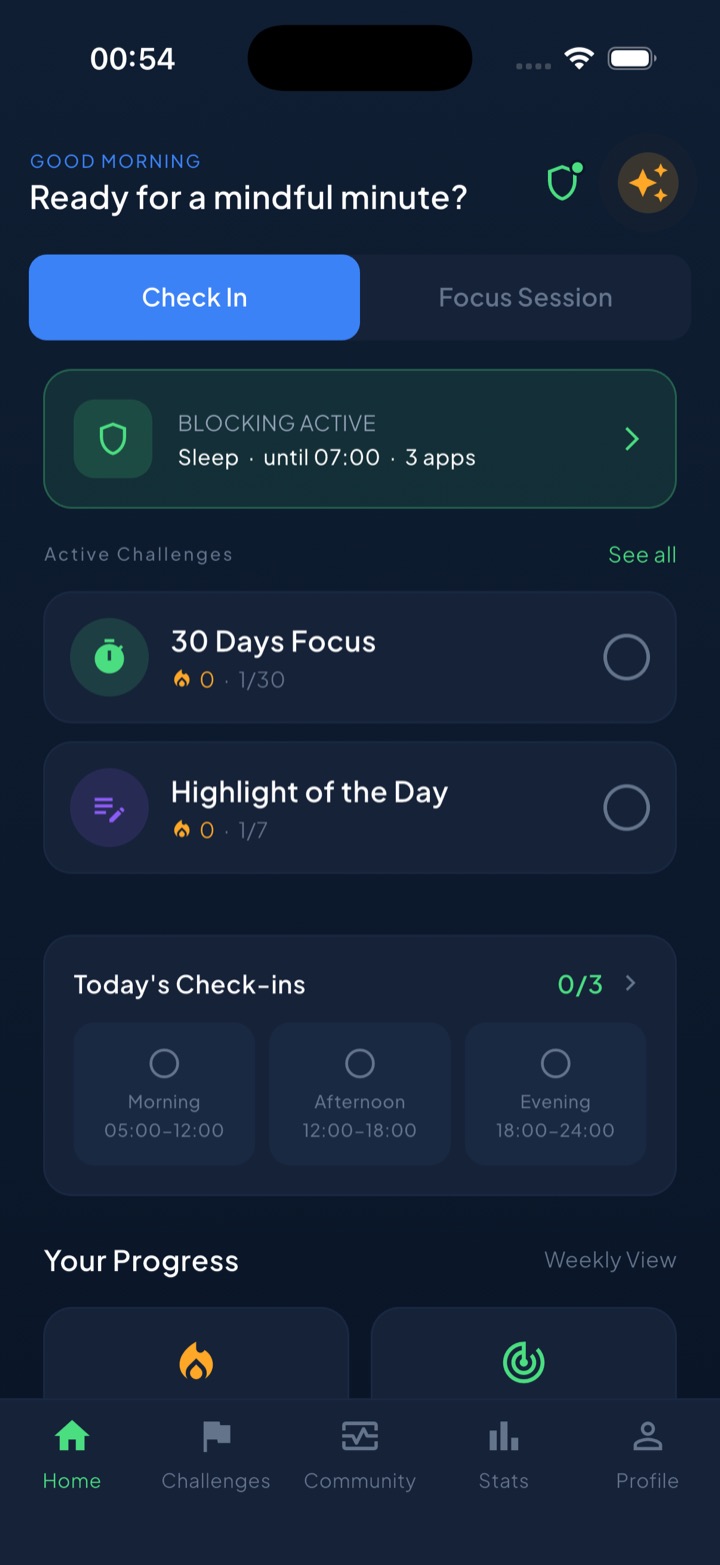
- Scheduled block routines put your gaming-adjacent apps behind a shield during the hours you named in step 3 — a Sleep routine at 23:00, a Work or School window during the day — so the “just five minutes” reinstall loop never starts.
- A short “take a break” bypass exists for genuine exceptions, which is precisely why the blocks survive: it’s a pressure valve, not a hole in the wall.
- Focus sessions, daily check-ins, and a streak flip the scoreboard. Gaming trained you to protect numbers that go up; Unscrol gives you one that measures the life you’re rebuilding — and its 45+ challenges are a ready-made menu for step 5’s empty hours.
The honest version: the checklist above works with paper, Screen Time, and console settings alone. Unscrol is for the part where willpower usually leaks — making the limit you set on a calm Sunday still be standing on a restless Tuesday night.
Frequently asked questions
How do I know if I'm addicted to video games?
Look at control and consequences, not hours. Warning signs include failing every attempt to cut back, gaming crowding out sleep, school, work, or people you care about, hiding how much you play, and playing on even when it's clearly causing damage. Someone who plays a lot but sleeps well, keeps commitments, and can stop for a busy week is probably an enthusiast. A structured self-check like a 10-question test can clarify the picture, but only a clinician can diagnose anything.
Is gaming disorder a real diagnosis?
Yes. The World Health Organization included gaming disorder in ICD-11, which came into effect in 2022. But the bar is deliberately high: impaired control over gaming, gaming taking priority over other interests and daily activities, and continued play despite negative consequences — severe enough to significantly impair personal, family, social, educational, or occupational functioning, normally evident for at least 12 months. Research suggests only a small minority of gamers ever meet these criteria.
How many hours of gaming is too much?
There is no magic number, and hours alone don't define addiction. A competitive player can log 25 hours a week and stay healthy; someone else can play 12 and be losing sleep, grades, and friendships. The better questions are functional ones: are you sleeping enough, meeting your commitments, keeping other interests alive, and able to stop when you decide to? When the answer to those slips for months at a time, the number of hours starts to matter.
What should I do if I think my child is addicted to gaming?
Start with a calm conversation about what they get from gaming — social life, achievement, escape — rather than an ambush about hours. Watch for months-long patterns: collapsing grades, reversed sleep, abandoning all offline activities, aggressive reactions to any limit. Use the free family tools on the console and phone to set consistent boundaries, and replace removed gaming time with something, not nothing. If real impairment has persisted for many months, talk to your family doctor or a psychologist.