Text neck (you’ll also see it called tech neck) is the neck and shoulder strain that comes from hours a day of looking down at a phone. Your head weighs roughly 4.5–5.5 kg (10–12 lb); tilt it forward and the effective load on your cervical spine multiplies — widely cited estimates put a deep, 60-degree scroll-slouch at roughly 27 kg (60 lb) of force. Held for the 3–5 hours a day many of us now spend on phones, that shows up as stiffness, aching shoulders, tension headaches, and a slowly rounding upper back. The fix has four parts: bring the phone up to eye level, take regular posture breaks, strengthen and stretch the right muscles — and the honest root fix, fewer scrolling hours in the first place. For pain that persists or radiates, see a professional; this article is general wellness information, not medical advice.

What is text neck, and is “tech neck” the same thing?
Text neck and tech neck are the same idea: a repetitive-strain pattern caused by holding your head forward and down at a screen, for a long time, very often. It is not a formal diagnosis you’ll find in a medical textbook — it’s a nickname physios and doctors use for a cluster of complaints they now see constantly: neck stiffness, tightness across the tops of the shoulders, aching between the shoulder blades, and headaches that start at the base of the skull.
Two things make phones uniquely good at producing it. First, the angle: unlike a monitor, a phone lives at chest or lap height, so your head tilts 30–60 degrees down toward it. Second, the hours: surveys consistently put average phone time at several hours a day (see our roundup of average screen time statistics). A bad posture held for thirty seconds is nothing. The same posture held for four hours a day, every day, is a training program — you are effectively strength-training your body into a forward-head, rounded-shoulder shape.
If your main complaint is tired, burning eyes rather than your neck, that’s a different (and often overlapping) problem — the 20-20-20 rule for digital eye strain covers that side. This article is about the muscles and joints holding your head up.
How heavy is your head when you look down at a phone?
The numbers most articles quote come from a biomechanical model published in 2014 by Kenneth Hansraj, a New York spine surgeon. He modeled the cervical spine and estimated the effective force it supports at different tilt angles. To be clear about what these are: model-based estimates, not direct measurements, and some researchers argue the true loads are lower. But the direction of the effect is not in dispute — more tilt, more work for your neck.
| Head tilt angle | Estimated load on the cervical spine* |
|---|---|
| 0° (neutral, ears over shoulders) | ~4.5–5.5 kg / 10–12 lb |
| 15° | ~12 kg / 27 lb |
| 30° | ~18 kg / 40 lb |
| 45° | ~22 kg / 49 lb |
| 60° (deep phone slouch) | ~27 kg / 60 lb |
*Estimates from Hansraj’s widely cited computer model; treat the exact figures as approximations.
The intuition is simple physics: your head is a bowling ball on a lever. Ears stacked over shoulders, the skeleton carries it almost for free. Tip it forward and the muscles along the back of your neck and upper back must hold it there — continuously, for as long as you scroll. Load matters, but time under load matters more. That’s why the same table is also an argument about hours, not just angles.
What are the warning signs of text neck?
Most people don’t notice text neck arriving; it accumulates. Common early signs:
- Neck stiffness or soreness at the end of the day, especially after heavy phone days
- Tightness across the upper traps — the “coat-hanger” ache along the tops of the shoulders
- A dull ache between the shoulder blades after long scrolling or laptop sessions
- Tension headaches that start at the base of the skull and creep upward
- The mirror test: from the side, your ear sits visibly forward of your shoulder, and your upper back rounds
- Cracking or grinding with neck movement that’s new for you
And the signs that mean stop self-treating and get assessed — pain that persists beyond a couple of weeks, pain that radiates down an arm, tingling or numbness in the hands, weakness, or pain that wakes you at night. Those can have causes that a stretch table won’t fix, and a doctor or physiotherapist is the right next step.
Which exercises and stretches actually help?
You don’t need a gym. The pattern you’re fighting is weak deep-neck and mid-back muscles plus short, tight chest and upper-trap muscles, so the routine strengthens one side and lengthens the other. Five to ten minutes a day, gentle and pain-free — if anything tingles or radiates, stop.
| Exercise | What it targets | How to do it |
|---|---|---|
| Chin tucks | Deep neck flexors; resets forward head | Sit tall, glide your chin straight back (make a “double chin”), hold 5 s. 10 reps, 2–3× a day |
| Doorway chest stretch | Tight pecs from rounded shoulders | Forearm on the door frame, elbow at shoulder height, step gently through. 30 s per side |
| Upper-trap stretch | The “phone shrug” tightness | Ear toward one shoulder, light hand assist, no yanking. 30 s per side |
| Wall angels | Mid-back strength and shoulder mobility | Back against a wall, slide arms overhead keeping wrists and elbows on the wall. 10 slow reps |
| Scapular squeezes | Postural endurance between the shoulder blades | Squeeze shoulder blades back and down, hold 5 s. 10–15 reps |
| Thoracic extension | Stiff upper back | Hands behind head, gently arch your upper back over the top of a chair back. 8–10 reps |
Consistency beats intensity here. One honest caveat: exercises treat the symptom pattern, not the cause. If the phone hours stay the same, you’re bailing water out of a boat with the tap still running.
How do you fix your phone ergonomics?
The goal is one sentence: bring the phone to your eyes, not your eyes to the phone. In practice:
- Raise the phone to eye level — or as close as your arms allow. Even chin height cuts the tilt angle dramatically.
- Support your elbows — on a desk, an armrest, a cushion, or a knee — so holding the phone up doesn’t exhaust your arms (arm fatigue is why the phone sinks to your lap in the first place).
- Take a posture break every 20–30 minutes. Stand, roll your shoulders, do one chin tuck, look at something far away. Pair it with the 20-20-20 rule and you cover eyes and neck in the same break.
- Move long sessions to a bigger screen at eye height — video, reading, and anything over 20 minutes belongs on a laptop or monitor you can position properly.
- Stop scrolling lying down. Side-lying and on-your-back scrolling produce some of the worst sustained neck angles of the day — scrolling in bed is the double offender, hurting both your neck and your sleep.
- Give sessions an ending. Posture collapses over time: minute one looks fine, minute forty is a full C-shape. Shorter sessions are an ergonomic intervention.
“I’m a trainer — I cue posture for a living — and my own neck was wrecked. Filming clients, editing reels, answering DMs: five hours a day, chin on chest. The stretches helped, but honestly the thing that fixed it was capping my social apps to 90 minutes. Same exercises, half the hours — the headaches were gone in three weeks.” — Marcus, personal trainer, 29
Isn’t the honest fix just scrolling less?
Yes — and most text-neck articles bury this. Angle × hours = strain. You can optimize the angle all you want, but nobody holds a phone at eye level for four hours, and no ten-minute stretch routine fully offsets a 25-hour scrolling week. The load table above is really a time table: the difference between a 30-minute phone day and a 4-hour phone day dwarfs the difference between good and bad posture within it.
Researchers who study neck pain tend to converge on the same unglamorous prescription: more variety of position, more movement breaks, less total time in any one posture. For phones, that translates directly into fewer, shorter sessions — which is a habit-change problem, not a posture problem. If that’s the part you keep failing at, our guide on how to reduce screen time covers the tactics that actually survive contact with a boring Tuesday evening.
How does Unscrol help you fix text neck at the source?
Start with the free, DIY route. Do the stretch routine above, prop your phone up at eye level, and use Apple’s built-in Screen Time: set App Limits on your heaviest scrolling apps and a Downtime window in the evening, when posture is at its worst. That alone attacks the hours side of the equation — and for many people it’s enough.
The catch is the “Ignore Limit” button. When the 15-minutes-left prompt appears, a tap makes it vanish, and your chin drops right back down. That’s where Unscrol comes in — an iPhone app (iOS 16+) built on the same Apple Screen Time frameworks, but with real, system-enforced blocking that doesn’t fold to a reflex tap. Everything is processed on-device: your block lists and usage never touch our servers.
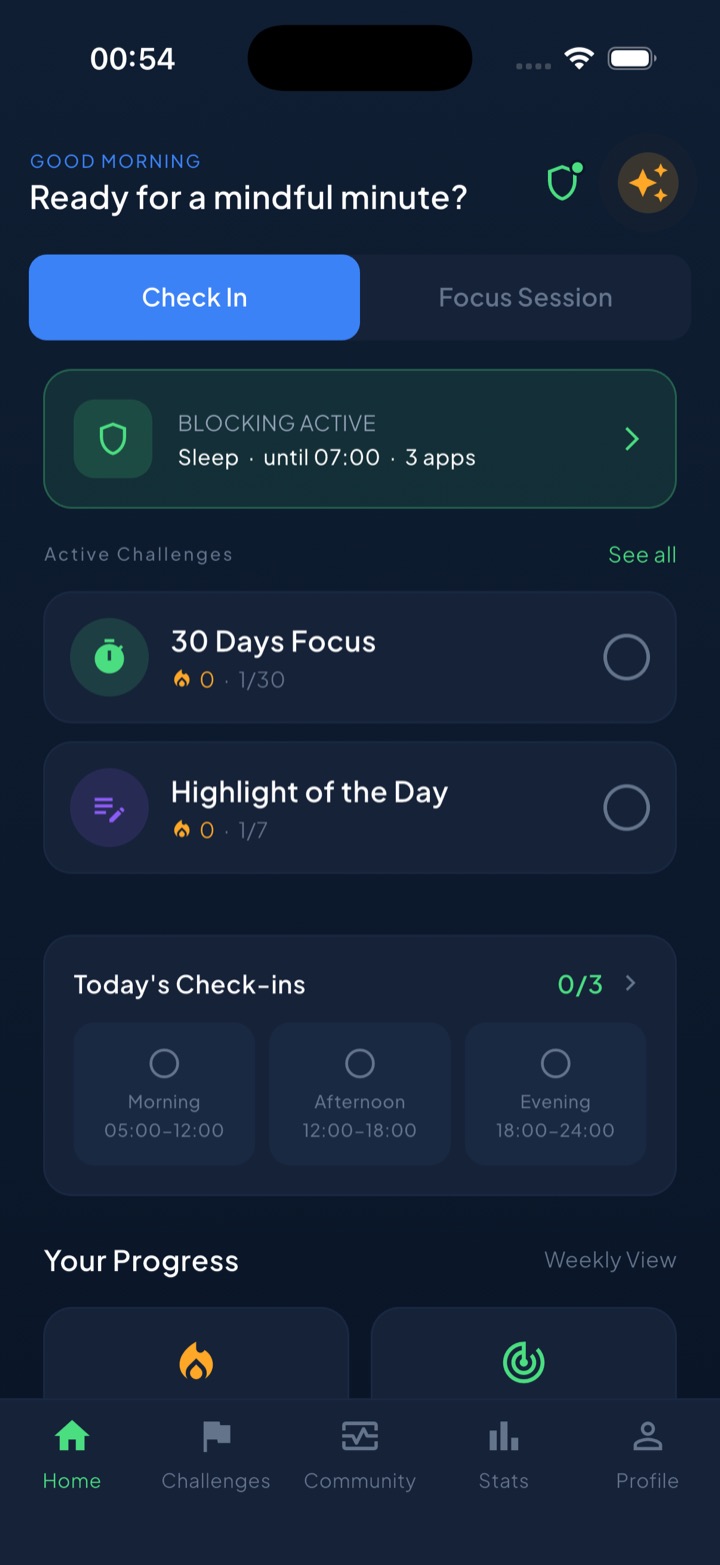
For text neck specifically, three features do the heavy lifting:
- Scheduled block routines. Shield your feeds during the postures that hurt most — a Sleep routine that blocks scrolling apps from 22:00 (no more side-lying scroll marathons), a Work routine for desk hours. The block enforces itself; your neck gets the hours back.
- A deliberate “take a break” bypass. Genuinely need an app mid-block? There’s a short, intentional bypass — a speed bump instead of a wall, which is exactly the pause a posture habit needs.
- Focus sessions, streaks, and check-ins. Run a focus session (with a Live Activity on your Lock Screen) for phone-free stretches, and let the daily streak make “less scrolling” a habit you can see — on the home screen widget, not by staring down at another feed.
The honest version: your neck doesn’t need an app — it needs your head upright for more hours a day. Apple’s free tools plus the exercise table above can get you there. Unscrol is for the moment your thumb disagrees with your spine, and wins.
Frequently asked questions
What is text neck?
Text neck — also called tech neck — is the neck and shoulder strain that builds up from spending hours a day with your head tilted down at a phone. The forward tilt makes your neck muscles work far harder to hold up your head, which over time can show up as stiffness, aching between the shoulder blades, tension headaches, and rounded, slumped shoulders. It isn't a formal medical diagnosis; it's a repetitive-strain pattern driven by posture plus sheer hours of screen time.
How much weight does looking down put on your neck?
An adult head weighs roughly 4.5 to 5.5 kg (10 to 12 lb) in a neutral position. Widely cited biomechanical estimates published by spine surgeon Kenneth Hansraj suggest the effective load on the cervical spine rises to about 12 kg at a 15-degree tilt, 18 kg at 30 degrees, and around 27 kg (60 lb) at 60 degrees — the classic phone-scrolling angle. These are computer-model estimates, not direct measurements, and researchers debate the exact numbers, but the direction is undisputed: the deeper the tilt and the longer you hold it, the harder your neck works.
What exercises help with text neck?
The staples are chin tucks to strengthen the deep neck flexors, doorway chest stretches to open shortened chest muscles, upper-trap and levator scapulae stretches for the sides of the neck, wall angels and scapular squeezes to wake up the mid-back, and gentle thoracic extensions over the back of a chair. Done for five to ten minutes a day in a pain-free range, they counteract the forward-head, rounded-shoulder pattern. If pain persists for weeks, radiates down an arm, or comes with numbness or weakness, see a doctor or physiotherapist rather than stretching through it.
Can text neck be fixed, or is the damage permanent?
For most people text neck is a muscular strain pattern, not permanent structural damage, and it responds well to change: raising the phone to eye level, taking regular posture breaks, doing simple strengthening and stretching, and — the biggest lever — cutting total scrolling hours. Discomfort often eases within weeks of consistent change. That said, this is general wellness information, not medical advice: persistent, worsening, or radiating pain deserves a proper assessment from a healthcare professional.