Yes, the 20-20-20 rule is worth doing — but keep your expectations honest. The rule says that for every 20 minutes of screen time, you look at something about 20 feet (6 metres) away for 20 seconds. It’s the standard advice optometrists give for digital eye strain (also called computer vision syndrome), and it targets a real problem: when you stare at a nearby screen, the tiny focusing muscle inside your eye stays contracted and your blink rate collapses, which is why your eyes end up dry, blurry, and aching. The catch is that rigorous trial evidence for the exact “20-20-20” formula is thin. It’s a cheap, sensible, low-risk habit — not a clinically proven cure. Below is what actually causes screen-strained eyes, what the science does and doesn’t support, and how to make the breaks happen.

Where did the 20-20-20 rule come from?
The rule is usually credited to optometrist Jeffrey Anshel, who popularised it as an easy-to-remember way to interrupt sustained near-work. It grew out of computer vision syndrome — the cluster of symptoms the American Optometric Association describes in people who spend hours at digital displays: dry or irritated eyes, blurred vision, headaches, and neck and shoulder pain.
The numbers were chosen for memorability more than laboratory precision. Twenty feet is roughly the distance at which your eyes can relax their focus to “infinity” — far enough that the focusing muscle lets go. Twenty seconds is long enough to give that muscle a genuine rest and to reset your blinking. Twenty minutes is a reasonable interval between breaks. None of it is magic; it’s a rule of thumb that’s easy to teach and easy to repeat, which is most of why it caught on.
Why do your eyes hurt from screens in the first place?
Two mechanisms do most of the damage, and both are well documented.
- Your blink rate crashes. At rest you blink roughly 15–20 times a minute. Staring at a screen — especially something absorbing like a spreadsheet or a video — can cut that by around half, and the blinks you do make are often incomplete. Fewer, shallower blinks mean the tear film evaporates and the eye surface dries out. That’s the burning, gritty feeling.
- Your focusing muscle never rests. Reading anything up close makes the ciliary muscle contract to keep the image sharp. Hold that for an hour and it fatigues, the same way any muscle would. That’s the blur when you finally look up, and part of the dull ache.
Add glare, small low-contrast text, and a screen positioned too close or at the wrong angle, and you have the full recipe for computer vision syndrome. Notice what’s not on the list: the screen “frying” your retinas. Everyday screen brightness doesn’t damage the eye — the discomfort is fatigue and dryness, which is exactly what a distant, blinking pause counteracts.
Does the science actually back the rule up?
Here’s the honest version. The symptoms are real and common, and the mechanism the rule targets is well established. What’s missing is strong trial evidence that this specific 20/20/20 protocol beats other break patterns. The studies that exist tend to be small, short, and mixed, and “take regular breaks” is hard to test cleanly because people don’t follow instructions perfectly.
So treat the rule as a reasonable default, not a proven treatment. Any pattern that gets you looking into the distance and blinking regularly is likely fine — 20-20-20 just happens to be the version that’s easy to remember.
| What you feel | Likely cause | What plausibly helps |
|---|---|---|
| Dry, gritty, burning eyes | Blink rate drops, tear film dries | Deliberate blinking, distant pauses, a humidified room |
| Blur when you look up | Focusing muscle fatigued from near-work | Looking ~20 ft away for 20 sec; longer breaks hourly |
| Headache, brow ache | Sustained near-focus + squinting at small text | Bigger text, more contrast, better lighting, breaks |
| Neck and shoulder ache | Screen too low, head craned forward | Raise the screen to eye level; sit back |
What actually helps more than the rule alone?
The break is one lever. A few others matter as much or more:
- Fix the text and the glare first. Increase font size and contrast, kill reflections, and get the screen an arm’s length away at or just below eye level. This removes the squint that causes headaches.
- Blink on purpose. During your 20-second break, blink slowly and fully a few times. It sounds trivial; it’s the part that fixes dryness.
- Mind the posture — the “text-neck” tax. Screen too low means you crane forward, and every centimetre of forward head posture loads your neck. Bring the device up to you, not you down to it. Most “eye strain” headaches are half neck strain.
- Watch the clock at night. Long, close, late sessions are the worst for both eyes and sleep — near-focus plus bright light close to bedtime suppresses the wind-down. Cutting the last-hour scroll helps your eyes and your rest at once; see our guide on screen time and sleep.
“I always blamed my afternoon headaches on coffee. Turns out it was six-hour editing sessions where I never once looked away from the timeline. I set an hourly break and moved my monitor up, and the headaches mostly went. The 20-second look-away feels stupid until you realise you’d forgotten your eyes could relax.”
— Marcus, video editor, 31
Do blue-light glasses help?
Short answer: probably not much for eye strain. A 2023 Cochrane review of blue-light-filtering lenses found little to no reliable evidence that they reduce digital eye strain in the short term. Most screen discomfort is about behaviour — sparse blinking, unbroken near-focus, glare, tiny text, bad posture — none of which a lens tint fixes.
Blue light does have a real role at night, where bright screens close to bedtime can nudge your body clock and delay sleep. But that’s a timing-and-brightness issue, better solved by dimming, Night Shift, and simply stopping earlier than by tinted glasses. If you want the sleep angle, the biggest win is a hard stop on evening screens — which conveniently is also when your eyes have taken the most strain.
How does Unscrol help you take screen breaks?
Start with the free tools. iPhone’s built-in Screen Time and a plain kitchen or phone timer will run a 20-20-20 rhythm at zero cost — set a repeating timer, look away when it chimes. That’s genuinely all the rule requires, and if a timer is enough for you, use it. The honest problem isn’t knowing the rule; it’s that a lone timer is easy to swipe away, and one skipped break becomes a skipped afternoon.
Unscrol is an iPhone and Apple Watch app that adds the structure a bare timer lacks.
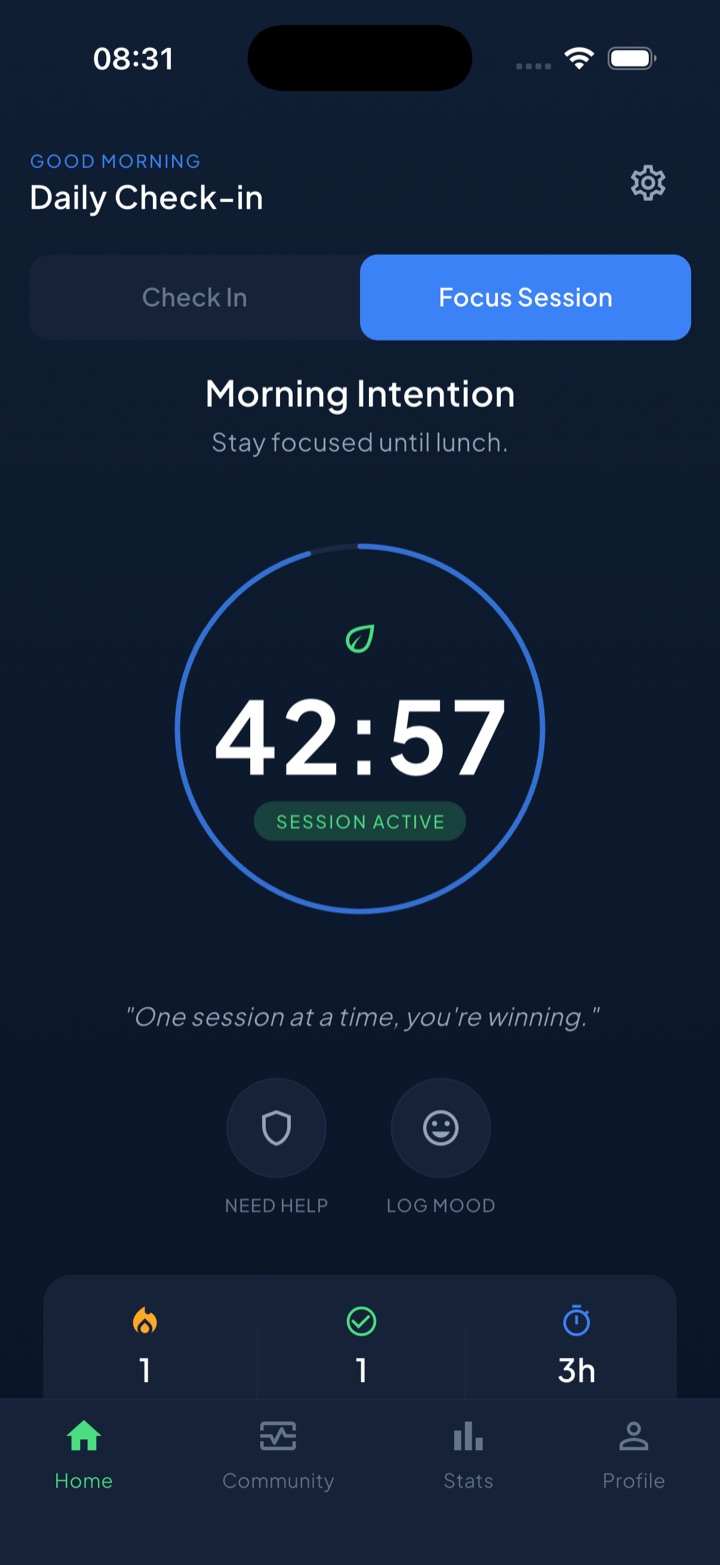
Its focus sessions are timed, Pomodoro-style work blocks (25, 45, or 60 minutes), and the end of each one is a built-in cue to pause — a natural trigger to look 20 feet away and blink before you start the next block. Because a focus session can shield distracting apps with Apple’s Screen Time frameworks, you’re less likely to “rest your eyes” by falling into a different feed. Evening block schedules (say, a Sleep window from 22:00) cut the longest, latest, most straining sessions — the ones that hurt your eyes and your sleep together. And the daily streak — a day counts when you do a quick mood or urge check-in, or finish a challenge — gives the whole thing momentum, so screen breaks become a habit instead of a one-day resolution.
None of this replaces good lighting, bigger text, or an optometrist if symptoms linger. It just makes the break happen on schedule instead of “when I remember.” If breaks are the part you keep skipping, see how to focus while studying and our take on notification overload — the same structure that protects your attention also protects your eyes.
Frequently asked questions
What is the 20-20-20 rule?
The 20-20-20 rule is a simple habit for reducing digital eye strain: every 20 minutes of screen time, look at something about 20 feet (6 metres) away for 20 seconds. The idea is that shifting your gaze to a distant object relaxes the focusing muscle inside your eye, which stays tensed when you stare at a nearby screen. The distant pause also nudges you to blink more, which re-wets the surface of the eye. It costs nothing, takes seconds, and is the standard first suggestion optometrists give for tired, dry, screen-strained eyes.
Does the 20-20-20 rule actually work?
Many people find that the 20-20-20 rule eases the dryness, blur, and heaviness they get from long screen sessions, and eye-care bodies widely recommend it. But rigorous trial evidence is genuinely thin, and studies that exist are small and mixed. What's better documented is the mechanism behind it: your blink rate drops sharply while you stare at a screen, and near-focus keeps the eye's focusing muscle contracted. Regular distant breaks counter both. So it's a low-cost, low-risk habit that plausibly helps, not a proven cure. If symptoms persist, see an optometrist.
Do blue-light glasses help with digital eye strain?
The evidence is weak. A 2023 Cochrane review of blue-light-filtering lenses found little to no reliable evidence that they reduce digital eye strain in the short term. Most screen discomfort comes from how you use the screen, not from blue light itself: infrequent blinking, non-stop near-focus, glare, small text, and poor posture. Blue light closer to bedtime is a real concern for sleep, but that's about timing and brightness, not lens tint. Fixing your habits, lighting, and break schedule will usually do more for tired eyes than a coated pair of glasses.