The fix for scrolling at the gym is not more discipline between sets — it’s changing what the phone is during your workout: equipment, not entertainment. Load your playlist or podcast before you walk in, run a rest timer so every break has an audible end, and keep the phone in your pocket, not your hand — or go further with an airplane-mode or phone-free session. The core problem is what you might call the rest-timer trap: a 90-second rest has a defined end, but a feed doesn’t, so “I’ll just check this while I rest” quietly turns 90 seconds into four, five, six minutes. Multiply that by 20 sets and half your gym time isn’t training at all. You don’t need to leave the phone at home; you need to make sure that between sets, nothing on it can outlast your rest period.

Why does a 90-second rest turn into 6 minutes of Reels?
Because a set and a feed are opposite kinds of activity. A set is hard and finite — it costs effort and ends on its own. A feed is effortless and infinite — it costs nothing and never ends. Every time you rack the bar, you sit down in the exact physiological state advertisers dream about: tired, seeking reward, with 90 “empty” seconds to fill. Your thumb does the rest.
The trap has a precise mechanism: your rest period has a clock, but the feed doesn’t. When rest is governed by feel — “I’ll go again when I’m ready” — and your attention is inside a video, “ready” gets redefined by the content, not your body. One more Reel is always 15 seconds. Four of them and a reply to a story later, you’ve tripled your rest without ever deciding to. Nobody chooses a six-minute rest between sets of curls; they just fail to choose an end.
There’s a second, sneakier cost: every scroll break is a context switch. You’re not resting between sets — you’re commuting between two mental worlds, the lift and the feed, and paying the re-focus toll each direction. That’s the opposite of the state where training feels best, the one lifters describe as being “locked in” — and what researchers call flow. We’ve written about how to enter a flow state; rule one is eliminating interruptions, and a feed is an interruption you administer to yourself 20 times a session.
What does scrolling between sets actually cost a workout?
Honest answer first: the research on phones specifically during resistance training is thinner than the headlines suggest, so hold the numbers loosely. But the studies that do exist, plus basic training logic, point in one consistent direction.
| What it costs | How it happens | How sure are we? |
|---|---|---|
| Session length | 20 sets × 2–4 extra minutes of scrolling = 40–80 minutes of dead time; sessions balloon or you cut exercises | Simple arithmetic — check your own screen time after a workout |
| Intensity | Studies suggest texting and browsing during exercise lower average intensity; long, unplanned rests also let your heart rate and muscle temperature drop | Reasonably supported for phone use during cardio; plausible for lifting |
| Focus / mind-muscle connection | Researchers have found an internal focus on the working muscle can improve muscle activation; arriving at the bar mid-thought about a video is the opposite of that | Attentional-focus research is solid; the phone link is inference |
| Program integrity | Your plan says 90s rest for a reason (hypertrophy, conditioning); 5-minute rests quietly turn one program into a different, easier one | Programming basics |
Notice what’s not on the list: some catastrophic dopamine effect on your gains. The damage is boring and structural — you train less, less hard, and less attentively inside the same hour. Which is good news, because structural problems have structural fixes.
Is all phone use at the gym bad, then?
No — and pretending otherwise is why most “leave your phone in the car” advice fails. For most lifters the phone is also the stereo, the stopwatch, and the logbook. The useful line isn’t phone vs. no phone; it’s equipment vs. entertainment:
- Equipment: a playlist, a podcast, a rest timer, your program in a notes app, logging your sets. These have a fixed job and no infinite tail. Music in particular is a genuine performance tool — we cover what actually helps in focus music and techniques.
- Entertainment: Reels, TikTok, YouTube Shorts, feeds, DMs. These have no end state and are engineered to make “one more” the default.
One trick worth stealing: make your gym audio a temptation bundle. Save a podcast or album you genuinely crave and allow yourself to listen to it only while training — the classic temptation bundling move. Now the phone’s most tempting content pulls you toward the workout instead of away from it, and it plays from your pocket with the screen dark.
What are the best phone setups for the gym?
Four setups, from lightest to strictest. Start where you honestly are; move down a row when the current one leaks.
- Pocket DJ (baseline). Queue the full playlist or podcast before you enter the gym — no mid-session DJ-ing, because “changing the song” is how feeds get opened. Phone goes in your pocket or on the bench face-down. Screen dark between sets.
- Timer takeover. Run a rest timer for every break — a watch, the phone’s timer, or your training app. The point is an audible end to rest: when it goes off, you lift, no negotiation. This alone kills most of the rest-timer trap, because rest is no longer governed by feel.
- Airplane-mode workout. Flip on airplane mode at the door. Downloaded music still plays, timers still run, your log still works — but feeds won’t load, and DMs can’t reach you. Everything a workout needs survives; everything that hijacks it doesn’t. Reply to the group chat in the locker room after.
- Blocked-apps hour. Airplane mode fails when you un-flip it between sets. The stricter version: block the feed apps themselves for your training window, so unlocking the phone shows you a shield instead of a slot machine. The phone stays fully useful as equipment; the entertainment layer is simply closed.
“I logged it once out of curiosity: a ‘one-hour’ push day was 34 minutes of actual training. The fix that stuck wasn’t leaving my phone in the car — I need it for music — it was a rest timer plus blocking Instagram from 6 to 8. Same phone, same pocket. My sessions are 45 minutes now and I’m lifting more than when they were 90.” — Marcus, software engineer and five-year lifter, 29
How do you run a phone-free gym experiment?
If you want the clean data, go all the way for one week. Five sessions is enough to feel the difference:
- Pick a normal training week — no PR attempts, no new program. You’re testing the phone, not your strength.
- Phone goes in the locker or car. If you need music, use a watch with offline playlists or accept silence for a week — it’s more interesting than it sounds.
- Time rests with a watch or the wall clock. Stick to your program’s prescribed rest, to the second.
- Write your log on paper — a note card in your pocket works fine.
- Compare the numbers afterward: total session time, sets completed, and how often you reached for a phone that wasn’t there. That last count is the honest measure of the habit.
Most people find two things: the workout gets dramatically shorter at the same volume, and the first two sessions feel genuinely twitchy — which tells you the scrolling was never really about resting. After the week, choose your permanent setup from the table above with real data instead of vibes.
How does Unscrol help you stop scrolling at the gym?
Start with the free route, because it genuinely works: queue your music before you walk in, use your phone’s built-in timer for rests, and set up Apple’s Screen Time — App Limits on your feed apps, or a Downtime window over your usual training hour. If that holds for you, you’re done; this article was free.
The catch most lifters hit is that iOS makes bypassing your own limits a one-tap affair (“Remind me in 15 minutes” — conveniently, one rest period). Unscrol is an iPhone app built on the same Apple Screen Time frameworks, but designed to make the block actually hold — and everything is processed on-device, so your block lists and usage never touch our servers.
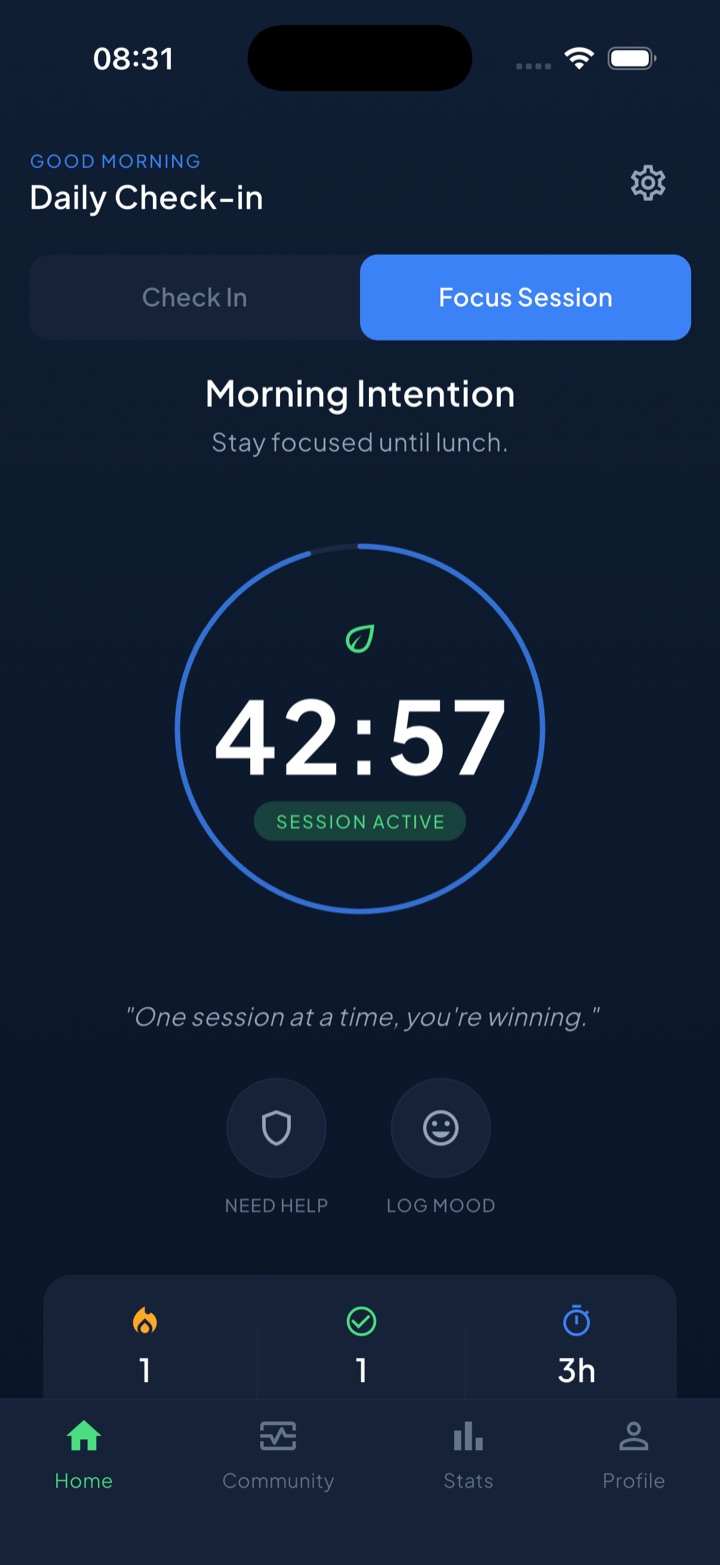
On the gym floor it looks like this:
- A scheduled block for your training window. Create a routine over your usual gym hours — say 06:30–08:00 — and your chosen feed apps are shielded by the system for exactly that window, every day, no morning decision required. Music, timers, and your training log keep working.
- A focus session for the workout itself. Start a session when you rack in; a Live Activity keeps the countdown on your Lock Screen, so checking the time never means unlocking into a feed.
- A “take a break” bypass for real exceptions — a short, deliberate escape hatch for the day you actually need to answer something, instead of an all-or-nothing wall you’ll eventually tear down.
- Streaks and challenges for the habit layer. Phone-free workouts make a natural daily challenge, and the streak gives your no-scroll week a scoreboard.
The honest version: a watch, a paper log, and Screen Time can do most of this. Unscrol’s job is to make it stick on the day your willpower is mid-set — so your 90-second rest is 90 seconds, and your hour in the gym is actually an hour of training.
Frequently asked questions
Is it bad to use your phone at the gym?
It depends entirely on what the phone is doing. Using it as equipment — a pre-loaded playlist, a rest timer, a workout log — is fine and often helps. Using it as entertainment between sets is where workouts fall apart: an open feed has no natural end, so a planned 90-second rest quietly stretches to four or six minutes. Researchers studying phone use during exercise have linked texting and browsing to lower workout intensity and worse focus, while music alone doesn't show the same cost.
How do I stop scrolling between sets?
Remove the decision, not the phone. Load your playlist or podcast before you enter the gym, start a running rest timer so every break has an audible end, and keep the phone in your pocket or gym bag between sets instead of your hand. If that isn't enough, block the feed apps for the hour you train — with Screen Time or an app blocker — so the phone still plays music and tracks sets, but the slot-machine apps are simply closed. Willpower mid-workout is unreliable; a locked feed is not.
Does scrolling between sets actually hurt muscle growth?
Not directly — dopamine doesn't shrink your muscles. The damage is indirect but real: scrolling stretches rest periods far past what your program intends, cools you down between sets, drags out the session until you cut exercises, and splits your attention so you lift with worse focus on the target muscle. Research on phone use during training is still limited, but studies consistently point to longer rests and reduced intensity. Fix the rest length and the focus, and you fix most of the cost.
Should I train completely phone-free?
Try it before you commit to it. A one-week phone-free experiment — phone in a locker, watch or wall clock for timing, workout on paper — tells you in five sessions what no article can: how much of your gym time was actually training. Many lifters find sessions get 15-20 minutes shorter at the same volume. If fully phone-free is impractical because your music and program live on the phone, airplane mode or a blocked-apps hour gives you most of the benefit with none of the sacrifice.