A flow state is total absorption in a task — attention narrows, self-consciousness disappears, and time seems to stretch or vanish. Psychologist Mihaly Csikszentmihalyi named it after studying artists, athletes, and workers who lost themselves in what they were doing, and the key discovery is that flow isn’t luck. It appears when specific conditions are met: a task that’s challenging but doable, one clear goal, immediate feedback on progress, and — critically — an uninterrupted ramp of about 15 to 20 minutes to get in. You can engineer all of those on purpose. The single thing that most reliably prevents flow is one glance at your phone, which resets the whole climb.
What is flow, and what does it feel like?
Csikszentmihalyi (pronounced “cheek-sent-me-high”) spent decades interviewing people about the moments they felt most alive and effective. Across chess players, surgeons, rock climbers, and factory workers, the same description kept surfacing: complete involvement in an activity for its own sake, where action and awareness merge and the rest of the world drops away. He called it flow.
The signature features are consistent:
- Intense, effortless concentration on the task at hand.
- A merging of action and awareness — you’re doing, not watching yourself do.
- Loss of self-consciousness — the inner critic goes quiet.
- Distorted time — hours pass like minutes, or a few minutes feel expanded.
- The activity feels intrinsically rewarding — you’d do it even without an external payoff.
Flow isn’t only a nice feeling. It’s also where a lot of people do their best, fastest, most creative work. That makes learning to trigger it a genuinely useful skill, not just a pleasant accident.
What conditions actually trigger flow?
Csikszentmihalyi identified a handful of prerequisites. Three are the load-bearing ones you can control directly.
1. Challenge-skill balance. This is the heart of it. Flow lives in the narrow band where the task’s difficulty roughly matches your skill. Too easy and you’re bored; too hard and you’re anxious. Both kill flow. The sweet spot is a task that stretches you slightly — hard enough to demand full attention, doable enough that you don’t stall.
2. Clear goals. You need to know exactly what you’re trying to do in this session. “Work on the report” is too vague to absorb you; “draft the results section” gives your attention a target. Ambiguity leaves a gap that distraction rushes to fill.
3. Immediate feedback. Flow needs a running sense of how you’re doing. A musician hears every note; a climber feels each hold. For knowledge work you often have to build the feedback — word counts, a checklist you tick, problems solved — so progress is visible in real time.
Two supporting conditions matter too: a sense of control over what you’re doing, and the removal of distractions so concentration can deepen without being yanked out. That last one is where most modern attempts at flow fall apart.
Why does it take 15 to 20 minutes to enter flow?
Flow doesn’t switch on the moment you sit down. There’s a ramp — commonly cited as roughly 15 to 20 minutes of unbroken focus — during which your attention gradually narrows and the surrounding world fades before the state locks in. Early in the ramp you’re still noticing the room, the itch to check your phone, the half-formed thought about lunch. Only after that settling period does deep absorption take over.
This is why interruptions are so devastating to flow specifically. It’s not just the seconds lost to a notification. Researcher Gloria Mark has found it takes on the order of 20 minutes to fully return to a task after an interruption, and psychologist Sophie Leroy described attention residue — after you switch, part of your mind stays stuck on the previous thing, so you’re not fully present on either. A single glance at your phone doesn’t cost you a glance; it can cost you the entire ramp, forcing you to climb back from the bottom. Do that a few times an hour and you never clear it once. The full price of that switching is broken down in the real cost of context switching.
Flow vs shallow focus: what’s the difference?
It helps to see what you’re actually aiming for, versus the fractured attention that passes for “working” most days.
| Shallow focus | Flow state | |
|---|---|---|
| Attention | Split, drifting, self-aware | Narrow, absorbed, effortless |
| Interruptions | Frequent, tolerated | None; protected block |
| Task difficulty | Random or mismatched | Tuned just past your skill |
| Goal clarity | Vague (“do some work”) | One specific target |
| Sense of time | Dragging, clock-watching | Distorted, vanished |
| Output | Busy but thin | Best and fastest work |
The gap between these two isn’t talent — it’s setup. Nearly every column on the right is something you can arrange before you start.
How do you set up to enter flow on purpose?
A repeatable pre-flight sequence, drawing the conditions together:
- Pick the right task. Choose something that sits just past comfortable. If it’s too easy, add a constraint (a deadline, a higher standard); if it’s too hard, break off a piece you can do.
- Name one clear goal for the block. Write it in a sentence: “Finish the first draft of section 2.” One target, not a to-do list.
- Build in feedback. Decide how you’ll see progress — a word count, problems checked off, pages turned — so momentum is visible.
- Kill every interruption before you start. Phone in another room or blocked, notifications off, tabs closed, door shut. This is non-negotiable; the ramp cannot survive a buzzing phone.
- Protect at least 30–45 unbroken minutes. You need to clear the 15-to-20-minute ramp and then have real time inside the state. Anything shorter rarely pays off.
- Start slightly before you feel ready. Waiting for motivation wastes the block. Begin the concrete first action and let engagement build during the ramp.
Do this consistently and flow stops feeling random. It becomes something you can mostly summon, the same discipline underneath the deep work guide and the broader tactics in how to improve concentration.
One honest note: flow isn’t guaranteed every session, and it isn’t the only valuable way to work. Tired days, dull-but-necessary admin, and genuinely stuck problems won’t always flow, and that’s fine. The aim is to make flow available far more often by removing the things that block it — chiefly the phone.
How Unscrol protects the flow ramp
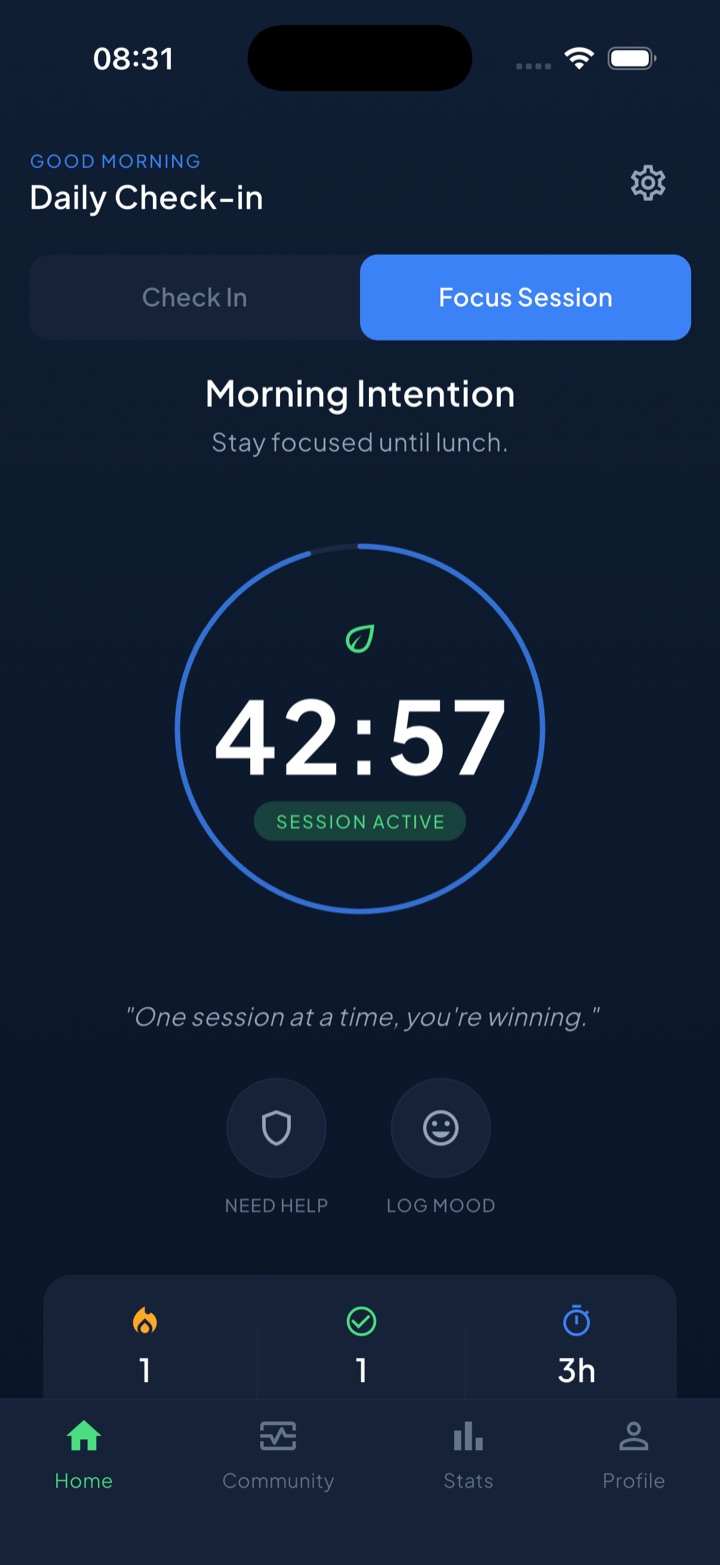
Flow’s fatal weakness is the entry ramp: 15 to 20 minutes of uninterrupted focus that a single phone check wipes out. Unscrol, the screen-time app we build, is designed to guard exactly that window. Start a focus session for the length of your block and it shields your most distracting apps with Apple’s official Screen Time frameworks — real system-level blocks, not reminders you can dismiss — so the reflexive mid-ramp check simply has nowhere to go. A Lock Screen and Dynamic Island countdown shows the time remaining, which quietly reinforces the “don’t break this block” intention and gives you the immediate feedback flow thrives on.
You can absolutely reach flow with no app — a phone in another room and a closed door do the essential job. What a blocker adds is insurance for the specific minutes when your resolve is thinnest, so the ramp survives long enough for the state to take hold.
The takeaway: flow isn’t a gift you wait for. Match the challenge to your skill, set one clear goal, and then defend an unbroken block long enough to climb the ramp — because the one glance at your phone is what keeps sending you back to the start.
Frequently asked questions
What is a flow state?
Flow is a state of complete absorption in a task, where your attention narrows, self-consciousness fades, and time seems to distort. Psychologist Mihaly Csikszentmihalyi named it after studying people who lost themselves in their work, sport, or art. In flow you're fully engaged and performing near your best without forcing it. It isn't magic or luck; it's a predictable state that appears when specific conditions are met, and you can set those conditions on purpose.
How do I get into a flow state?
Create its conditions. Pick a task that's challenging but within reach — hard enough to demand focus, not so hard you stall. Set one clear goal and a way to see progress. Then remove interruptions completely and give yourself an uninterrupted ramp of 15 to 20 minutes, because flow doesn't start instantly. The single biggest flow killer is the phone, so block distractions before you start rather than trusting yourself mid-task.
How long does it take to get into flow?
Most people need roughly 15 to 20 minutes of uninterrupted focus before flow begins, and it can take longer if you're tired or the task is unappealing. That ramp is why interruptions are so costly: a single notification can reset the clock and force you to climb back from the start. Protecting an unbroken block long enough to clear the ramp is the whole game.
Why can't I get into flow anymore?
Usually it's interruptions and a mismatched challenge level. If you check your phone every few minutes, you never clear the 15-to-20-minute entry ramp, so flow never starts. And if the task is too easy you get bored, while too hard makes you anxious — both block flow. Fix the environment first (kill notifications, phone in another room), then tune the task to sit just past your comfort zone.