If you train seriously, you already know the line: the workout is the stimulus, but recovery is where the gains happen — and recovery, above everything else, means sleep. That makes the pre-bed scroll the most underrated bad habit in fitness. A 45-minute feed session at midnight doesn’t feel like a training decision, but it is one: it pushes bedtime later, keeps your brain switched on, and trims the deep sleep your body uses to repair muscle, restore the nervous system, and consolidate skill. You would never voluntarily skip a rest day. Scrolling into the night quietly skips half of one — every night.

Why is sleep where the gains actually happen?
Lifting, sprinting, and conditioning don’t make you fitter in the moment — they make you temporarily worse and hand your body a to-do list. The rebuilding happens later, and sleep is when most of it gets done. During deep sleep, much of the day’s growth-hormone release is concentrated, tissue repair runs at full tilt, and the nervous system that fried itself on heavy triples gets restored. REM sleep, meanwhile, appears to help consolidate motor learning — the technique work you drilled today gets written in tonight.
Cut sleep and you cut all of it at once. Research on athletes has repeatedly associated short sleep with slower sprint times, worse accuracy, reduced time-to-exhaustion, and higher injury rates, and studies suggest sleep-deprived bodies also shift hormonally in the wrong direction — more stress hormone, less recovery signaling, stronger cravings for exactly the food you’re trying to limit. None of this requires an exotic mechanism. Less repair time, worse repair. (For the general science of what screens do to sleep, see screen time and sleep — this article is about what that costs you in the gym.)
How does late-night scrolling tax your training?
Be honest about the mechanism, because part of it is oversold. Blue light gets the headlines, but research on light alone is mixed — the better-supported problem is what the scroll does and what it displaces. Three levers:
| Lever | What the feed does | The training cost |
|---|---|---|
| Sleep length | ”One more scroll” has no natural endpoint — feeds are engineered to be bottomless | Bedtime drifts later; total repair time shrinks; sleep debt compounds across a training week |
| Sleep quality | Alerting, emotionally charged content keeps mental arousal high right up to lights-out | Longer to fall asleep; lighter, more fragmented sleep even once you’re under |
| Sleep timing | Bright light close to your face in the evening can nudge your body clock later | Groggy morning sessions, inconsistent wake times, worse readiness scores |
The first row is the big one. Most of the damage isn’t the glow of the screen — it’s that the scroll replaces sleep itself, minute for minute, during the exact window your body wanted for repairs.
Why is the pre-bed scroll the athlete’s hidden bad habit?
Because it hides in the one hour nobody audits. You periodize your training, hit your protein, maybe foam roll, cold plunge, and wear a recovery tracker — and then hand a chunk of the night back to an app in bed. There’s a real irony here: people spend serious money on massage guns and supplements while the cheapest, best-evidenced recovery intervention — a longer, protected night — goes unused.
The trap has a name: revenge bedtime procrastination. After a day of work plus training, the late-night scroll feels like the only time that’s truly yours, so you defend it — at the direct expense of tomorrow’s session. If that loop sounds familiar, we’ve written about why it happens and how to break it, and about how to stop scrolling in bed specifically. The short version: you don’t beat it with willpower at midnight. You beat it by making the decision earlier in the evening, while you still have some.
“I tracked everything — macros, volume, resting heart rate. My recovery scores were still trash and my squat hadn’t moved in months. The fix wasn’t another supplement. It was charging my phone in the kitchen and reading instead. Two weeks of genuine eight-hour nights and the bar started moving again. Most annoying cheap fix of my life.” — Dan, amateur powerlifter, 34
What does an athlete’s evening wind-down protocol look like?
Treat the last hour of the day like a training block: planned, repeatable, boring in the best way.
- Set a lights-out time that funds your training. Work backward from your wake-up to protect 8+ hours in bed — time in bed always exceeds time asleep, so build in margin.
- Call a screen curfew 45–60 minutes before lights-out. Think of it as the last set of the day. When the curfew hits, the phone’s workout is over.
- Charge the phone outside the bedroom. Kitchen, hallway, anywhere but the nightstand. A cheap alarm clock replaces the only legitimate excuse. Distance beats discipline.
- Replace the scroll — don’t just remove it. A vacuum gets filled by the phone. Fill it first: mobility work or stretching, a hot shower, packing your gym bag and writing tomorrow’s session, reading something on paper.
- Make the room dark, cool, and boring. The bed is for sleep. The more boring the bedroom, the better it does its one job.
- Anchor the morning: consistent wake time and daylight. Morning light is what sets your body clock, which is what makes the next night’s sleep come easily — a phone-free morning routine pairs perfectly with an evening curfew, and it means your first dopamine of the day comes from training, not a feed.
Does one late night ruin your progress?
No — and it’s worth saying plainly, because sleep anxiety helps nobody. A single short night mostly costs you next-day output and mood, not your long-term adaptations; research suggests the body defends muscle reasonably well against an occasional bad night. The damage comes from the chronic pattern: the 30–60 minutes surrendered to the feed most nights, compounding across months of training. Chase consistency, not perfection. One rough night before a race or a heavy session is survivable; a default bedtime of “whenever the scroll ends” is what quietly caps your progress.
How does Unscrol help athletes protect recovery?
Start free. iPhone’s built-in Screen Time can do the heavy lifting: schedule Downtime from your screen curfew until your alarm, put App Limits on your worst feeds, and flip on Sleep Focus so notifications die for the night. Add the analog layer — alarm clock, charger in the kitchen — and you’ve built a real curfew for exactly zero dollars.
The catch, as anyone who’s tapped “Remind Me in 15 Minutes” knows, is that stock limits are easy to talk your way past at 11:40 p.m. Unscrol (iOS 16+) is the layer that makes the curfew stick, built on the same Apple Screen Time frameworks — real, system-enforced app shields, with block lists and usage processed entirely on-device, never on our servers.
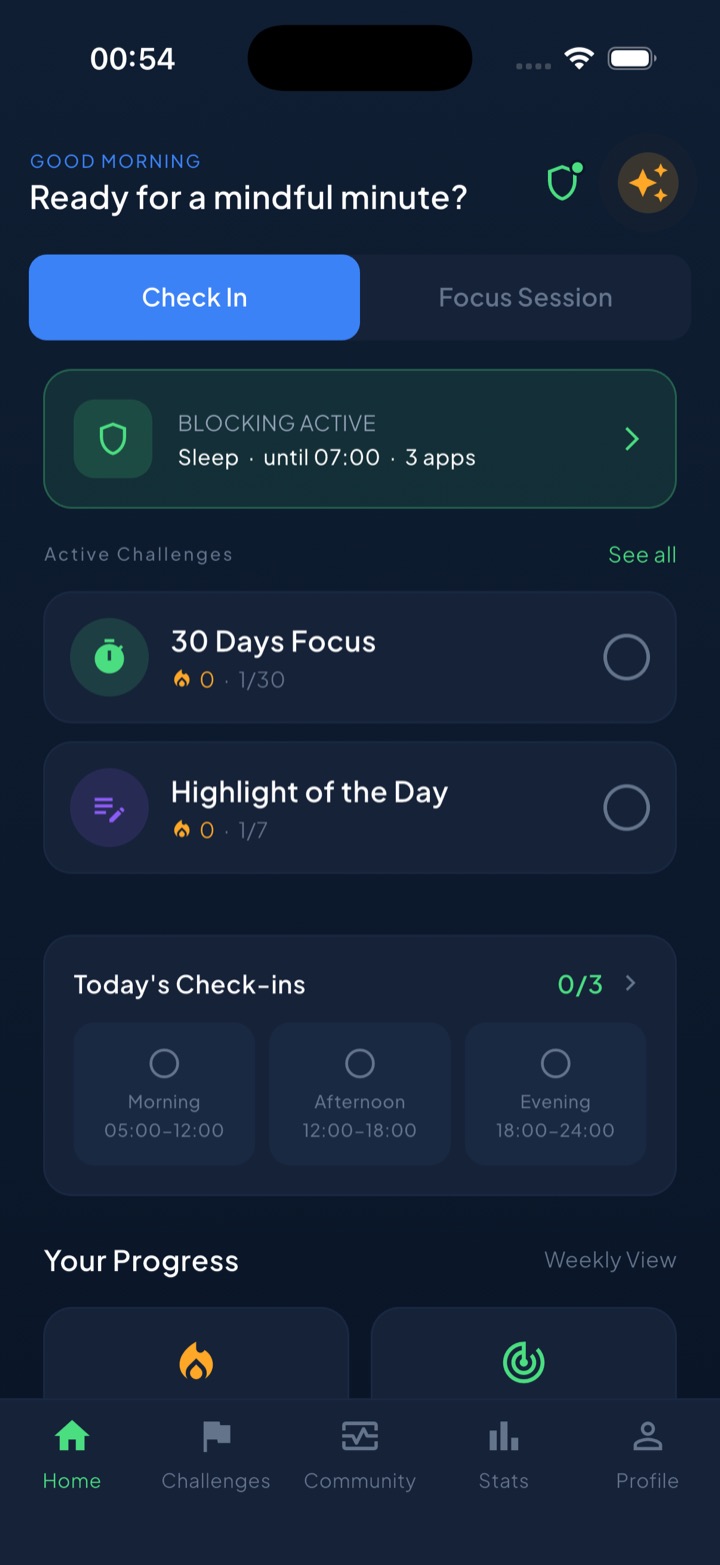
For an athlete’s evening it maps cleanly:
- A scheduled Sleep block shields your feeds automatically every night from curfew to wake-up — the decision is made once, in a calm moment, not renegotiated nightly at your most tired.
- A short “take a break” bypass exists for the genuine exception — coordinating a ride to tomorrow’s session — without unlocking the whole night.
- Evening check-ins and a daily streak turn the wind-down itself into something you train: protect the night, keep the streak, and let consistency compound the same way it does under the bar.
The honest version: sleep is the best legal performance enhancer you have, and Apple’s free tools plus an alarm clock get you most of the way. Unscrol is for making sure the plan survives contact with midnight.
Frequently asked questions
Does scrolling before bed really affect muscle recovery?
Indirectly, but meaningfully. Your body does most of its repair work during sleep — much of daily growth-hormone release is concentrated in deep sleep, and researchers consistently link evening screen use with later bedtimes and shorter, lower-quality sleep. The feed doesn't block muscle protein synthesis directly; it shrinks and degrades the recovery window where adaptation happens. For an athlete, an hour of midnight scrolling is functionally an hour subtracted from recovery, repeated across a training week.
How much sleep do athletes need for recovery?
Most adults need seven to nine hours, and sleep researchers and sports-science bodies generally suggest hard-training athletes should sit at the top of that range — many elite programs deliberately target nine or more. The heavier your training stress, the more recovery you need to fund it. Warning signs you're underfunded include stalled lifts, an elevated resting heart rate, nagging soreness that won't clear, low motivation, and stronger junk-food cravings than usual.
What is a screen curfew and how do I actually keep one?
A screen curfew is a fixed time each evening — commonly 45 to 60 minutes before lights-out — when screens go away for the night. The trick is to treat it like training, not a mood: schedule it, tie it to a wind-down you enjoy, and remove the renegotiation by charging your phone outside the bedroom and using a system-enforced app block during those hours. Decide once, while you're fresh, instead of arguing with yourself nightly at your most tired.
Should athletes keep the phone out of the bedroom?
It's probably the single highest-leverage change on this list. If the phone is on your nightstand, every wake-up is an invitation and the last scroll has no natural end. Charge it in the kitchen or hallway, buy a cheap alarm clock, and the bed goes back to being for sleep. Distance beats discipline: you don't need willpower at midnight if the temptation is physically in another room.