Revenge bedtime procrastination is staying up late on purpose — scrolling, streaming, or gaming — to reclaim personal time you never got during an over-scheduled day. It isn’t really about sleep; it’s a small act of rebellion against a day that belonged to everyone but you, and the late hours feel like the only ones that are truly yours. Two forces make it stick: self-control is weakest after a long day, and the phone offers instant, effortless reward at exactly that moment. The result is a predictable sleep-debt spiral, and the fix is structural — reclaim autonomy earlier and make the phone unavailable later.
Where does the term “revenge bedtime procrastination” come from?
The phrase traces to Chinese social media, where bàofùxìng áoyè (报复性熬夜), literally “retaliatory staying up late,” described overworked people refusing to end their day. It went viral in English around 2020, when lockdowns blurred the line between work and home and a lot of people recognized themselves in it instantly.
The underlying behavior was studied earlier and more soberly. Dutch psychologist Floor Kroese and colleagues coined “bedtime procrastination” to describe going to bed later than you intended, when nothing external is stopping you. Their research linked the habit to worse sleep, more daytime fatigue, and lower general self-regulation. The “revenge” layer adds a motive on top of Kroese’s mechanics — you’re not just drifting past bedtime, you’re taking the time back on purpose.
Both pieces matter. The procrastination explains how it happens; the revenge explains why it feels justified even as you watch the clock.
Why is your willpower lowest at exactly the wrong time?
Self-control behaves like a resource that runs down over a demanding day. Whether you frame that as depletion or simply as accumulated fatigue and dwindling motivation — psychologists still debate the exact mechanism — the practical pattern is reliable: after a full day of work, decisions, and holding yourself together, resisting an easy temptation at 11pm is far harder than resisting it at 11am.
Now add the phone. A feed is engineered to deliver variable, effortless reward with zero activation energy. When your capacity to choose the harder thing (closing your eyes) is at its floor, and the easier thing (one more video) is one tap away and endlessly refreshing, the outcome is close to a foregone conclusion. This isn’t weakness. It’s a predictable interaction between a tired brain and a system built to exploit exactly that state.
Why does scrolling feel like reclaiming your freedom?
The revenge part is the piece most advice ignores. Humans have a deep need for autonomy — the sense that our time and choices are our own. When a day is packed with obligations you didn’t choose (a job, a commute, childcare, chores), you can reach bedtime having spent almost no time on anything you actually wanted.
Late-night scrolling becomes the release valve. It’s the one stretch nobody is asking anything of you. Psychologically, staying up is a way of insisting this hour is mine. That’s why willpower-based advice (“just put the phone down”) fails so often here: it treats the phone as the problem, when the phone is the crude solution to a real problem — a day with no breathing room. Fix only the phone and the underlying hunger for autonomy pushes back somewhere else.
The trouble is the tab comes due. Skipped sleep isn’t free.
How does the sleep-debt spiral work?
Sleep scientist Matthew Walker has spent a career documenting what short sleep does: impaired attention and memory, worse mood and emotional regulation, weaker impulse control, and higher stress. Notice the cruel loop — every one of those makes the next day harder to control, which makes the next night’s revenge scrolling more tempting.
The spiral runs like this:
- A demanding day drains your self-regulation and leaves you starved for personal time.
- You reclaim it at night by scrolling, and go to bed late.
- You wake up under-slept, so your focus, mood, and willpower are already lower.
- The under-slept day feels even more depleting and less your own.
- Return to step 1, now with a bigger deficit.
Because sleep debt compounds, a few nights turn a one-off into a habit your brain starts to expect. Breaking it means interrupting the loop at more than one point, not just white-knuckling lights-out.
What actually breaks the cycle?
The reliable fixes target the two real drivers — the autonomy deficit and the late-night availability of the phone. Willpower-based rules tend to fail here because they fight you at your weakest hour; structural changes decide for you in advance.
| Willpower approach (usually fails) | Structural approach (usually works) |
|---|---|
| “I’ll just put the phone down at 11” | Phone charges in another room, out of reach |
| Rely on self-control when most depleted | Nightly app block set earlier, when rational |
| Treat scrolling as the whole problem | Reclaim real personal time earlier in the day |
| Aim for a hard lights-out time | Start a boring, screen-free wind-down buffer |
| Feel guilty and try harder tomorrow | Give the good night a small, visible reward |
Reclaim time earlier, on purpose. If the night is your only free time, the night will win. Deliberately schedule a genuinely-yours block earlier in the day or evening: 30 minutes of something you chose, before the wind-down window. When the autonomy need is partly met, the 11pm rebellion loses its fuel.
Set a wind-down alarm, not just a wake alarm. Most people alarm themselves awake and let bedtime float. Reverse it. An alarm 45–60 minutes before target sleep is the cue to start powering down.
Build a boring buffer. The transition matters more than the exact bedtime. Fill the last 30–45 minutes with low-stimulation, screen-free activity — reading, a shower, stretching, tidying. A phone-free morning routine gets most of the attention, but a phone-free evening routine is what protects the sleep in the first place.
Make the phone unavailable, not just discouraged. This is the decisive lever. Charging the phone in another room removes it entirely. If you use it as an alarm, a recurring nightly block on your feeds and video apps means the option to scroll simply isn’t there when your willpower is gone. The point is to decide once, in the afternoon when you’re rational, instead of a hundred times at midnight when you’re not.
Address the daytime pressure where you can. Some of this is a scheduling and boundaries problem, not a phone problem. If every day is so full it leaves nothing for you, that’s worth solving directly. Digital minimalism — clearing low-value screen time out of your day — can free up daytime slack so the night stops being your only escape.
“I always told myself the scrolling was ‘me time,’ which is why every alarm and app limit I tried felt like punishment. What worked was setting a nightly block that hides Instagram and YouTube after 10:30, plus actually taking 20 minutes for myself after dinner. The urge to stay up basically stopped fighting me.” — Priya, nurse, 29
Putting a wind-down on autopilot with Unscrol
Revenge bedtime procrastination is a willpower trap: it strikes exactly when your willpower is lowest, so the answer is to remove the decision from the moment. Unscrol, the screen-time app we build, is designed for this. You can set a scheduled blocking routine — Sleep 22:30–07:00, for example — that automatically shields your chosen feeds, video, and games using Apple’s official Screen Time frameworks. These are real system-level blocks, not overlay reminders, so at midnight the tempting apps genuinely aren’t available and there’s nothing to negotiate with.
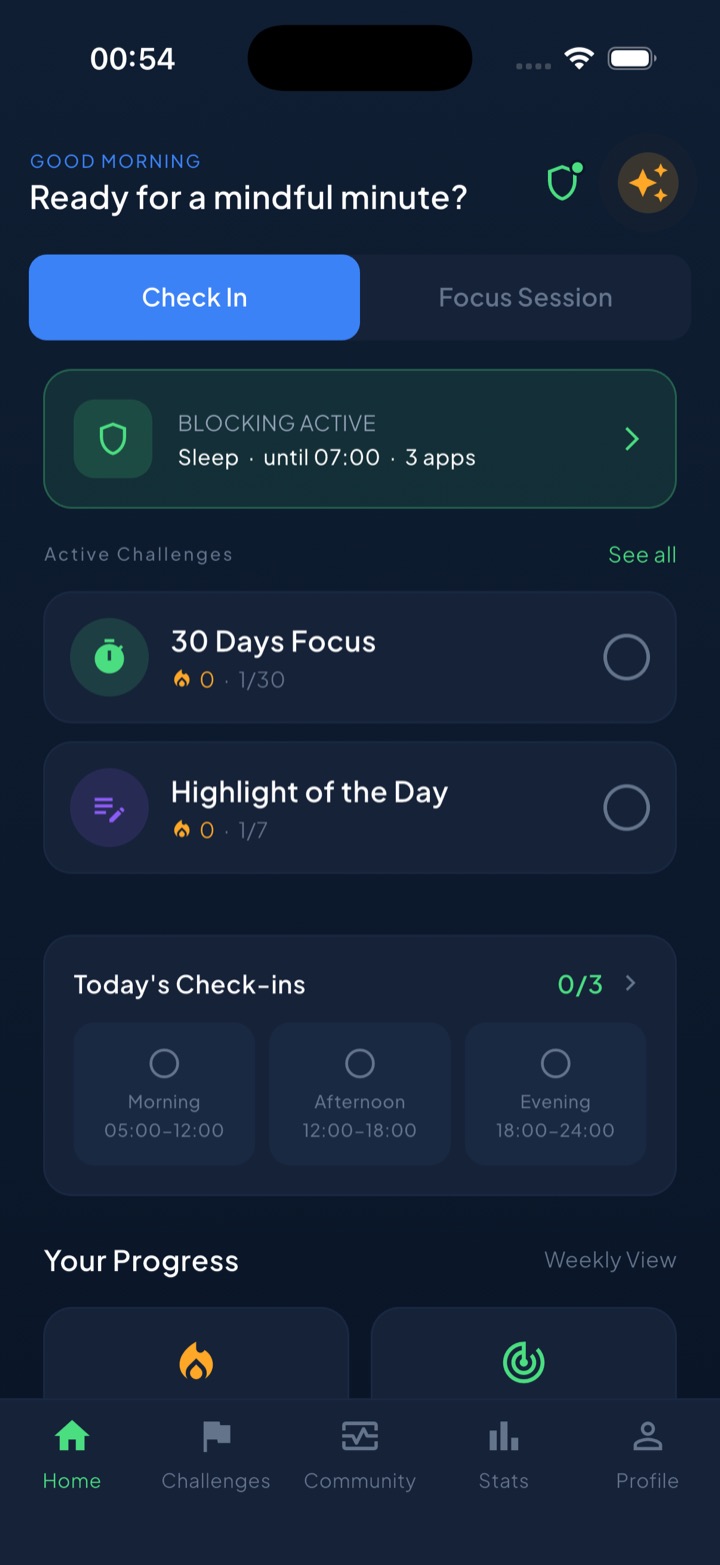
Because you set the schedule once, earlier in the day, you’re making the sane choice while you still have the capacity to make it. A morning check-in and an ongoing streak also give the good night a small, visible reward the next day. None of this is magic, and you can do the core of it for free: charge the phone in another room and set a wind-down alarm. Unscrol just makes the block hold when the phone stays on the nightstand.
The takeaway: you don’t scroll at night because you’re lazy — you scroll because the day left you no time and the phone is the easiest way to take some back. Give yourself that time earlier, then make the phone disappear before your willpower does.
Frequently asked questions
What is revenge bedtime procrastination?
Revenge bedtime procrastination is staying up late on purpose — usually scrolling, watching, or gaming — to claw back personal time you didn't get during a busy, over-controlled day. The 'revenge' is against a schedule that left no room for yourself. You know you'll be tired tomorrow and do it anyway, because the late-night hours feel like the only ones that are truly yours.
Why do I scroll on my phone instead of going to sleep?
Two forces stack up at night. First, self-control is at its weakest after a long day of decisions and effort, so resisting the feed is hardest exactly when you're most tired. Second, if your day gave you little freedom, late-night scrolling feels like reclaimed autonomy. The phone offers instant, effortless reward at the precise moment you have the least willpower to decline it.
Is revenge bedtime procrastination a real psychological thing?
It's a popular term rather than a clinical diagnosis, but it sits on solid research. Dutch psychologist Floor Kroese and colleagues studied 'bedtime procrastination' — going to bed later than intended without a good reason — and linked it to worse sleep and lower self-regulation. The 'revenge' framing came later from Chinese social media and adds the autonomy motive, but the core behavior is well documented.
How do I stop staying up late on my phone?
Attack it structurally, not with willpower. Give yourself real downtime earlier so the night doesn't feel like your only free time, set a fixed wind-down alarm, and make the phone genuinely unavailable after that — charge it in another room or block the tempting apps on a nightly schedule. A boring, screen-free buffer before bed does more than any single rule about lights-out.