Mobile game addiction is what happens when a game that costs nothing to download is engineered so that your daily return is the product. A console game you pay for once just needs to be good; a free-to-play mobile game only makes money if you come back every single day and eventually spend — so it is built around gacha pulls that work like slot machines, energy timers that summon you back on schedule, daily login streaks you’re afraid to break, and limited-time events that weaponize FOMO. The way out is not more willpower. It’s seeing the machinery, auditing what the game actually costs you in money and hours, and adding friction the design can’t route around.

Why are mobile games built differently from console games?
Follow the money. A $70 console game is paid for before you press start, so its designers mostly need you to finish it happy. A free-to-play mobile game earns nothing at download. Its revenue arrives two ways — you watching ads, or you buying things — and both depend on one behavior above all others: coming back every day. That’s why the industry lives on retention dashboards (how many players return after day 1, day 7, day 30) and why a small fraction of heavy spenders, internally called “whales” — a term the games industry borrowed straight from casinos — carries most of the revenue.
None of this makes individual developers villains; it’s the economics of “free.” But it does mean the standard advice — “just play in moderation” — misses the point entirely. Moderation is precisely the behavior the design is paid to erode. If your problem is four-hour console or PC sessions rather than monetized loops, read how to stop playing video games so much — this article is about the machinery that’s unique to mobile.
What tricks do mobile games use to keep you playing?
Almost every top-grossing mobile game runs some mix of the same seven mechanics:
| Mechanic | How it works | The psychology it exploits |
|---|---|---|
| Gacha / loot boxes | Spend currency on a randomized chance at rare characters or items | Variable-ratio rewards — the slot-machine schedule, the most compulsion-forming pattern known |
| Pity & near-miss systems | Guaranteed rare after N pulls; flashy “almost!” animations | Keeps you paying just below the threshold; near-misses excite reward circuitry much like wins |
| Energy / stamina timers | Play is metered and refills over hours — or instantly for money | Appointment mechanics: the interruption leaves an open loop that nags you to return |
| Daily login streaks | Escalating rewards for consecutive days; miss one and it resets | Loss aversion — protecting a 200-day streak outweighs the actual reward |
| Limited-time events | Exclusive banner or skin, available for ten days only | Scarcity + FOMO turns “someday” players into “today” spenders |
| Battle passes | A paid reward track that expires when the season ends | Sunk cost + a deadline: you paid, so now you must grind |
| First-purchase bundles | ”$0.99 starter pack — 500% value!” | Foot-in-the-door: the first payment is the hard one; prices ladder up from there |
If this loop feels familiar, it should — it’s the same variable-reward engine that powers infinite feeds, unpacked in dopamine and social media. The difference is that a mobile game attaches a price tag to every spin. Researchers have repeatedly found that loot-box spending correlates with problem-gambling scores; Belgium’s Gaming Commission went as far as declaring paid loot boxes illegal gambling in 2018, and several countries now force games to disclose pull odds. The industry disputes the legal label. The loop is the loop.
How much is your game actually costing you?
Gacha spending is engineered to hide in small numbers — a $1.99 refill here, a $4.99 bundle there, laundered through gems and crystals so nothing ever feels like money. The single most sobering thing you can do is a fifteen-minute cost audit:
- Pull your purchase history. On iPhone: Settings → your name → Media & Purchases, or sign in at reportaproblem.apple.com to see every charge. Add up the last 12 months for the game. Don’t estimate — count.
- Pull your hours. Settings → Screen Time → See All App & Website Activity → switch to weekly, find the game’s average, multiply by 52.
- Price the hours. Multiply your yearly hours by what an hour of your life is worth — your hourly wage is a reasonable floor.
- Add the streak tax. Estimate the minutes of daily chores — logins, dailies, energy-burn sessions — you do even when you don’t feel like playing. That’s the part that isn’t even fun.
- Write both totals on paper and put the note where you’ll see it: money on one line, hours on the other. Then decide whether next year should look the same.
“I had a 460-day login streak and couldn’t tell you the last day that was actually fun — I was clocking in, not playing. The audit broke the spell: two years of ‘cheap’ bundles added up to more than a month’s rent, and my dailies were eating 40 minutes I resented. Breaking the streak on purpose felt like quitting a job I didn’t remember applying for.” — Marcus, delivery driver, 26
When does heavy play become an actual addiction?
The World Health Organization added “gaming disorder” to its ICD-11 classification, defined by impaired control over gaming, gaming taking priority over other interests and daily activities, and continuing despite negative consequences — typically persisting for at least 12 months. Most players never come close to that bar; playing a lot is not, by itself, a disorder.
Honest warning signs that a hobby has tipped into compulsion: you play to escape rather than to enjoy; you hide or minimize your spending; a streak or a limited event can cause real anxiety; the game is the first thing you touch in the morning and the last at night; sleep, work, or study consistently loses to it. If your spending or play genuinely feels out of your control, talk to a professional — everything below is a toolkit for habit change, not a treatment.
How do you stop playing mobile games without going cold turkey?
The strategy is to dismantle the comeback triggers one by one, so the game has to survive on fun alone:
- Turn off every notification. Not “deliver quietly” — off. Each push is a purpose-built comeback trigger (“your energy is full!”).
- Break the streak on purpose. Skip one day, deliberately. This is the freeing move: once the streak is gone, the sunk cost evaporates and the daily obligation dies with it.
- Delete the app; keep the account. In nearly every live-service game your progress lives on the server, not the phone. Knowing you could return removes the “I’ll lose everything” panic — but now returning is a decision, not a tap on an icon.
- Disable in-app purchases at the system level. Settings → Screen Time → Content & Privacy Restrictions → iTunes & App Store Purchases → In-app Purchases → Don’t Allow. Future-you now has to undo a setting before spending — a small commitment device, which is exactly why it works.
- Cap whatever remains. An App Limit on the game (or the whole Games category) plus a proper blocker for the hours that matter — here’s how to block apps on iPhone step by step.
- Replace what the game was paying you. It met real needs: visible progress, a daily ritual, mastery, guildmates. Pick replacements that pay the same currencies — a gym program with levels, a language-learning streak, a standing weekly game night with friends — or the vacuum will refill itself.
How does Unscrol help you stop playing mobile games?
Start with the free route, honestly: Apple’s built-in Screen Time can put an App Limit on the game, schedule Downtime overnight, and switch off in-app purchases entirely. That costs nothing and it changes the defaults.
Its known weakness is the “Ignore Limit” button — one tap and the wall is gone, which is a poor match against software engineered to pull you back. Unscrol is an iPhone app (iOS 16+) built on the same Apple Screen Time frameworks that turns that soft wall into real, system-enforced shields — with your block lists and usage processed entirely on-device, never touching our servers.
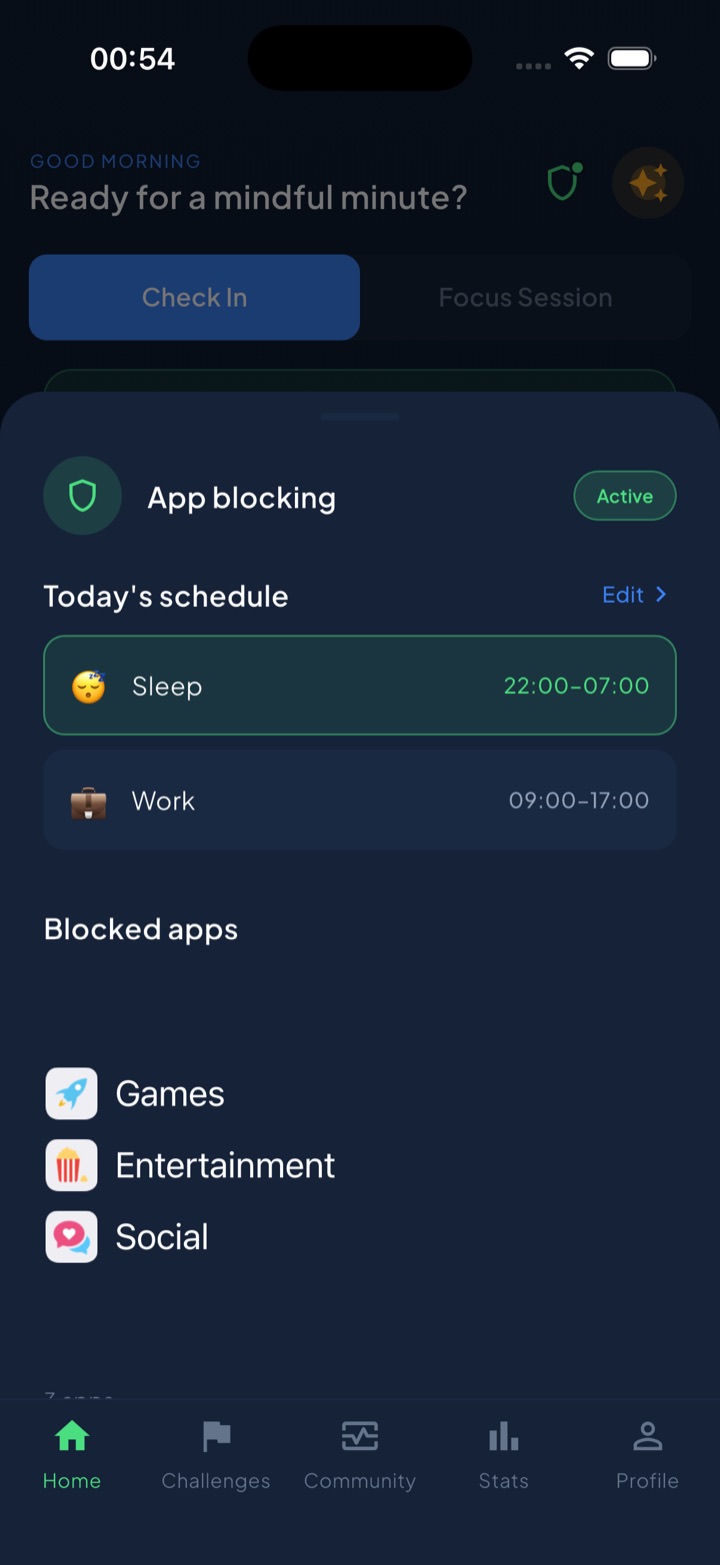
- Shield the game where your evenings actually go. Pick the games in the blocking hub and set scheduled routines — a Sleep block from 22:00, a Work or School window during the day — so the 11 p.m. energy-burn session simply isn’t an option. A short “take a break” bypass exists for genuine exceptions: friction, not a wall.
- Swap the streak. The login streak is the strongest chain a game has on you — so give the same psychology a healthier target. Unscrol’s daily check-ins, 45+ challenges, and unified streak (with a premium Streak Saver for the occasional missed day) put your loss aversion to work for you instead of for the game’s retention numbers.
- Keep the new habit visible. Home and lock-screen widgets show your streak and progress in the exact spot the game icon used to occupy — the leaderboard adds the competitive itch, minus the pull banner.
The honest version: the paper audit plus Screen Time is free and might be enough. Unscrol is for when it isn’t — when you need the block to hold at 11 p.m. and a streak on your side of the table.
Frequently asked questions
Why are mobile games so addictive?
Because the business model demands it. A free-to-play game earns nothing when you download it — it only earns when you come back daily and eventually spend. So designers optimize for compulsion: gacha and loot boxes run the same variable-reward schedule as slot machines, energy timers summon you back at set intervals, daily login streaks punish missing a single day, and limited-time events add fear of missing out. It isn't weak willpower; it's engineering aimed squarely at retention.
What is gacha addiction?
Gacha is a monetization system, named after Japanese gachapon capsule-toy machines, where you spend currency on randomized pulls for characters or items. Because rewards are unpredictable, it runs a variable-ratio reinforcement schedule — the most compulsion-forming reward pattern known, and the one slot machines use. Gacha addiction describes compulsive pulling: chasing a banner past your budget, spending to reach pity, and feeling genuine anxiety when you miss. Researchers have repeatedly found loot-box spending correlates with problem-gambling scores.
How do I stop playing mobile games?
Start by making the hidden costs visible: add up twelve months of in-app purchases and your weekly hours in Screen Time. Then dismantle the comeback triggers — turn off the game's notifications, deliberately break your login streak, and delete the app while keeping your account. Disable in-app purchases in Screen Time restrictions, set an App Limit, and give the freed hours a replacement that pays the same rewards: progress, ritual, and people. A blocker app makes the limits enforceable.
Are loot boxes gambling?
Legally it depends on the country; psychologically they run the same loop. You pay for an unpredictable chance at something valuable — a variable-ratio reward schedule identical to a slot machine's. Belgium's Gaming Commission declared paid loot boxes illegal gambling in 2018, several countries now require odds disclosure, and researchers consistently find links between loot-box spending and problem-gambling scores. Whatever the legal label, treat pull currency as real money and set hard limits before you open the shop.