Careless mistakes on exams are almost always attention lapses, not knowledge gaps, which is why studying more content rarely fixes them. You misread a sign, skip a step, or answer the question you expected instead of the one printed, not because you don’t know the material but because your attention flickered at the wrong second, usually under time pressure or fatigue. The fix is therefore about attention, not knowledge: slow down at the two riskiest moments (reading the question and recording the answer), build a deliberate checking routine, train sustained focus in practice, protect your sleep, and stop fragmenting your attention with constant phone-checking. You already know the answers. The goal is to stop losing points you’ve earned.
Why do careless mistakes actually happen?
Because your attention is not a steady spotlight; it flickers, and an exam is engineered to catch it flickering. When you rush, your brain switches to skimming mode, and a skimming brain fills in what it expects to see rather than what is there. That is how ”−” becomes ”+”, how “not” disappears from a question, how you solve for x when the question asked for 2x.
Three conditions make these lapses far more likely:
- Speed. Racing the clock trades accuracy for pace, and the first thing to go is the careful reading of the question.
- Fatigue. A tired brain has less attentional control, so lapses cluster in the last third of an exam and after poor sleep.
- Divided or fragmented attention. A mind trained to jump between things every few seconds is worse at holding steady on one problem for two full minutes, which is exactly what an exam demands.
The important reframe: a careless mistake is not proof you’re careless as a person. It is a predictable output of an under-trained, under-rested, or over-rushed attention system. All three are fixable.
Can you actually train attention, like solving Sudoku?
You can, and one concrete example is worth noting. In interviews after the 2026 LGS, Turkey’s national high-school entrance exam, one 14-year-old reported to be among the top scorers said he solved Sudoku specifically to reduce careless, attention-based errors. Whether or not Sudoku itself is special, the underlying logic is sound: he was deliberately practising sustained, error-intolerant attention, the exact skill an exam tests.
Attention behaves a bit like a trainable capacity. If most of your day is spent in rapid task-switching, your baseline drifts toward distractibility. If you regularly practise holding focus on one demanding thing, without checking anything, your capacity to do that in an exam improves. Practical training reps:
- Timed, phone-free problem sets where you don’t look up or check anything until done.
- Attention puzzles (Sudoku, logic grids, careful proofreading) that punish skimming.
- Full-length practice under real conditions, so two hours of unbroken concentration stops feeling foreign, which is also the point of how to increase your attention span.
How does your phone quietly make you more careless?
This is where a screen-time habit meets an exam score. Every time you switch from a task to a notification and back, there is a refocusing cost; attention researcher Gloria Mark’s work suggests it can take a strikingly long time to fully re-engage after an interruption. A brain that does this hundreds of times a day is, in effect, practising not sustaining attention, the opposite of exam training. This is the same cost of context switching that wrecks deep work.
There’s a subtler effect too. Research associated with Adrian Ward and colleagues (2017) suggests that merely having your phone within reach can consume a slice of working memory, the “brain drain” effect, leaving less capacity for the task in front of you. None of this proves your phone causes a specific wrong answer. But the mechanism is consistent and worth taking seriously: the attention you train all day is the attention you bring to the exam. If you spend your study hours half-checking a phone, you are rehearsing the exact lapse that costs you points.
What checking routine catches careless errors?
Most careless points are recoverable with a small, boring habit applied at two moments. Build it during practice so it’s automatic on exam day.
| Risk moment | Careless failure | The fix |
|---|---|---|
| Reading the question | Misreading, missing “not/except”, wrong units | Underline exactly what’s asked before solving |
| During the work | Dropped sign, skipped step | Write each step; don’t do arithmetic in your head |
| Recording the answer | Right work, wrong box; wrong form | Verify the answer matches the question asked |
| Final minutes | Fatigue lapses pile up | Reserve time to recheck flagged items, not to rush new ones |
The single highest-value habit is the last check: before you commit an answer, reread the question and confirm your answer actually responds to it. This catches the “solved for x, they wanted 2x” family of errors, which are pure lost points on material you knew.
Does sleep really affect careless mistakes?
More than students expect. Attention and error-monitoring both degrade with insufficient sleep, and Matthew Walker’s work on sleep and cognition underlines how much of your focus is quietly governed by the night before. Trading sleep for one more cram session is often a bad exchange: you gain a little fragile content and lose the attentional control that would have protected the points you already had. In the final week especially, treat sleep as part of your error-reduction plan, not a luxury you cut.
How Unscrol helps you protect your attention
Reducing careless mistakes is ultimately about training and protecting attention, and the biggest daily threat to attention is the phone in your hand. Unscrol is built to remove that threat during the reps that matter. A focus session starts a distraction-blocking countdown that shields your feeds and games with Apple’s official Screen Time frameworks, so your practice sets are genuinely uninterrupted, which is the only way to train two hours of unbroken concentration.
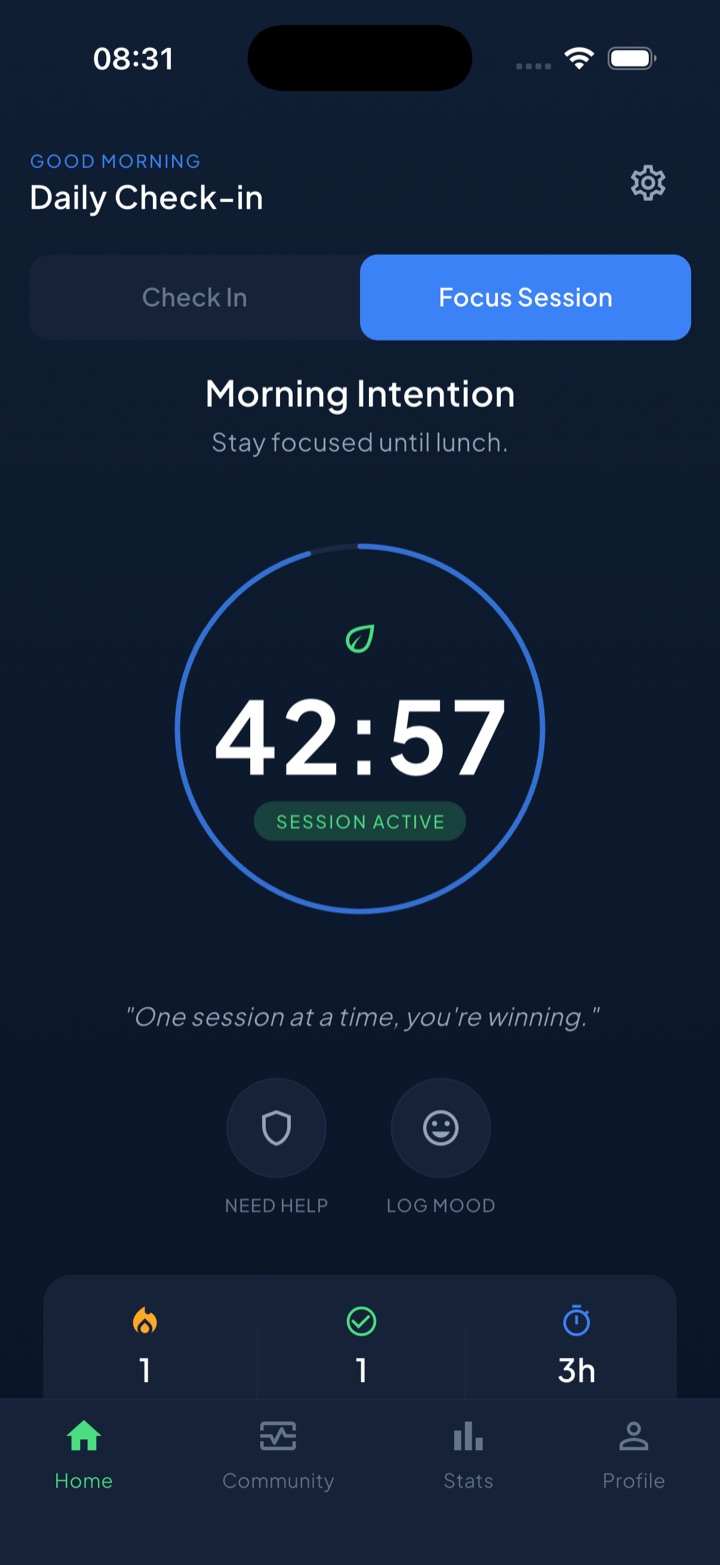
Because the session runs a Live Activity countdown on your Lock Screen, the finish line stays visible without you touching the phone, so a quick “check” never becomes the interruption that trains distractibility. Over weeks, the daily streak turns phone-free deep reps into a habit rather than a one-off effort. You don’t need an app for the principle, of course: a phone in another room and a kitchen timer give you the same uninterrupted block for free. The point is simply that the attention you rehearse every day is the attention you’ll have on exam day, so rehearse the focused kind.
Frequently asked questions
Why do I keep making careless mistakes even when I know the material?
Because careless mistakes are usually attention failures, not knowledge failures. Under time pressure your brain skims, and a skimming brain misreads a sign, drops a step, or answers the question it expected instead of the one printed. Fatigue, rushing, and a mind fragmented by constant phone-checking all make these lapses more frequent. The fix is training and protecting attention, not relearning content you already know.
How can I reduce silly mistakes on a test?
Slow down at the two highest-risk moments: reading the question and recording the answer. Underline exactly what is asked, do the work, then verify the answer matches the question before moving on. Build this checking habit during practice, not just on exam day. Away from exams, practise sustained attention with phone-free deep-work reps and puzzles, and protect your sleep, which quietly governs attention.
Does using my phone a lot make me more careless?
It plausibly contributes. Heavy task-switching trains your attention to jump, and research suggests that even having a phone nearby can occupy mental bandwidth you would otherwise use to concentrate. Neither proves phones cause exam errors, but the mechanism is consistent: a mind used to constant interruption sustains focus less well, and careless mistakes are what happens when focus lapses at the wrong second.